

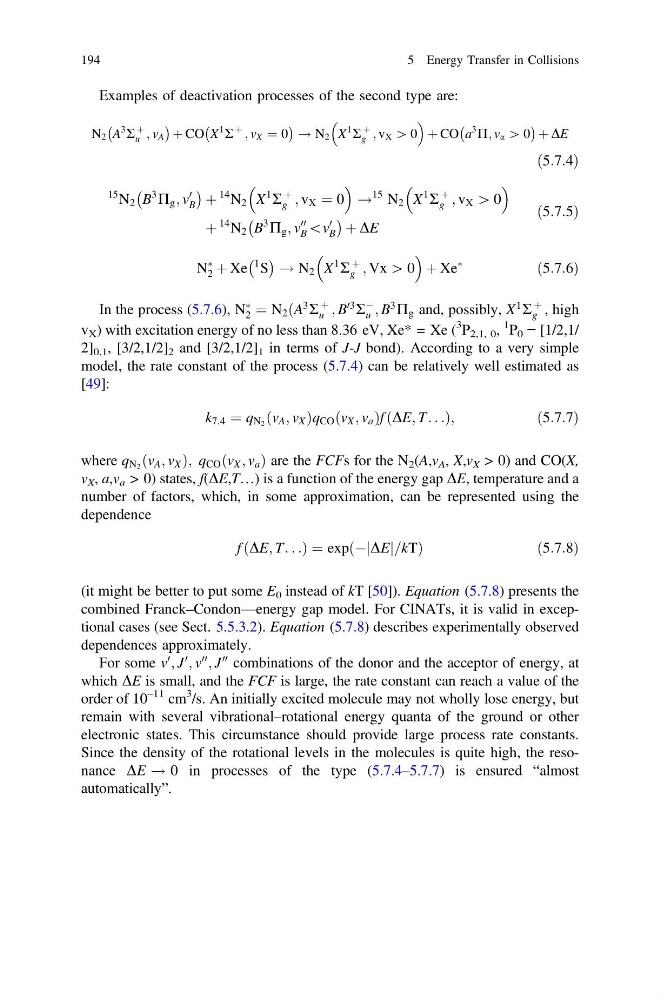
Examples of deactivation processes of the second type are:
N 2 A
3 R
þ
u ; v A
À
Á þ CO X
1 R
þ ; v X ¼ 0
À
Á ! N 2 X
1 R
þ
g ; v X [ 0
þ CO a
3 P; v a [ 0
À
Á þ DE
ð5:7:4Þ
15 N 2 B
3 P g ; v
0
B
À
Á þ
14 N 2 X
1 R
þ
g ; v X ¼ 0
!
15 N 2 X
1 R
þ
g ; v X [ 0
þ
14 N 2 B
3 P g ; v
00
B \v
0
B
À
Á þ DE
ð5:7:5Þ
N
Ã
2 þ Xe
1 S
À Á ! N 2 X
1 R
þ
g ; Vx [ 0
þ Xe
Ã
ð5:7:6Þ
In the process (5.7.6), N
Ã
2 ¼ N 2 ðA
3 R
þ
u ; B
03 R
À
u ; B
3 P g and, possibly, X
1 R
þ
g , high
v X ) with excitation energy of no less than 8.36 eV, Xe* = Xe (
3 P 2,1, 0 ,
1 P 0 − [1/2,1/
2] 0,1 , [3/2,1/2] 2 and [3/2,1/2] 1 in terms of J-J bond). According to a very simple
model, the rate constant of the process (5.7.4) can be relatively well estimated as
[49]:
k 7:4 ¼ q N 2 v A ; v X
ð
Þq CO v X ; v a
ð
Þf ðDE; T. . .Þ;
ð5:7:7Þ
where q N 2 v A ; v X
ð
Þ; q CO v X ; v a
ð
Þare the FCFs for the N 2 (A,v A , X,v X > 0) and CO(X,
v X , a,v a > 0) states, f(DE,T…) is a function of the energy gap DE, temperature and a
number of factors, which, in some approximation, can be represented using the
dependence
f ðDE; T. . .Þ ¼ expðÀjDEj=kTÞ
ð 5:7:8Þ
(it might be better to put some E 0 instead of kT [50]). Equation (5.7.8) presents the
combined Franck–Condon—energy gap model. For CINATs, it is valid in exceptional cases (see Sect. 5.5.3.2). Equation (5.7.8) describes experimentally observed
dependences approximately.
For some v
0
; J
0
; v
00
; J
00 combinations of the donor and the acceptor of energy, at
which DE is small, and the FCF is large, the rate constant can reach a value of the
order of 10
–11 cm
3 /s. An initially excited molecule may not wholly lose energy, but
remain with several vibrational–rotational energy quanta of the ground or other
electronic states. This circumstance should provide large process rate constants.
Since the density of the rotational levels in the molecules is quite high, the resonance DE ! 0 in processes of the type (5.7.4–5.7.7) is ensured “almost
automatically”.
194
5 Energy Transfer in Collisions
N 2 A
3 R
þ
u ; v A
À
Á þ CO X
1 R
þ ; v X ¼ 0
À
Á ! N 2 X
1 R
þ
g ; v X [ 0
þ CO a
3 P; v a [ 0
À
Á þ DE
ð5:7:4Þ
15 N 2 B
3 P g ; v
0
B
À
Á þ
14 N 2 X
1 R
þ
g ; v X ¼ 0
!
15 N 2 X
1 R
þ
g ; v X [ 0
þ
14 N 2 B
3 P g ; v
00
B \v
0
B
À
Á þ DE
ð5:7:5Þ
N
Ã
2 þ Xe
1 S
À Á ! N 2 X
1 R
þ
g ; Vx [ 0
þ Xe
Ã
ð5:7:6Þ
In the process (5.7.6), N
Ã
2 ¼ N 2 ðA
3 R
þ
u ; B
03 R
À
u ; B
3 P g and, possibly, X
1 R
þ
g , high
v X ) with excitation energy of no less than 8.36 eV, Xe* = Xe (
3 P 2,1, 0 ,
1 P 0 − [1/2,1/
2] 0,1 , [3/2,1/2] 2 and [3/2,1/2] 1 in terms of J-J bond). According to a very simple
model, the rate constant of the process (5.7.4) can be relatively well estimated as
[49]:
k 7:4 ¼ q N 2 v A ; v X
ð
Þq CO v X ; v a
ð
Þf ðDE; T. . .Þ;
ð5:7:7Þ
where q N 2 v A ; v X
ð
Þ; q CO v X ; v a
ð
Þare the FCFs for the N 2 (A,v A , X,v X > 0) and CO(X,
v X , a,v a > 0) states, f(DE,T…) is a function of the energy gap DE, temperature and a
number of factors, which, in some approximation, can be represented using the
dependence
f ðDE; T. . .Þ ¼ expðÀjDEj=kTÞ
ð 5:7:8Þ
(it might be better to put some E 0 instead of kT [50]). Equation (5.7.8) presents the
combined Franck–Condon—energy gap model. For CINATs, it is valid in exceptional cases (see Sect. 5.5.3.2). Equation (5.7.8) describes experimentally observed
dependences approximately.
For some v
0
; J
0
; v
00
; J
00 combinations of the donor and the acceptor of energy, at
which DE is small, and the FCF is large, the rate constant can reach a value of the
order of 10
–11 cm
3 /s. An initially excited molecule may not wholly lose energy, but
remain with several vibrational–rotational energy quanta of the ground or other
electronic states. This circumstance should provide large process rate constants.
Since the density of the rotational levels in the molecules is quite high, the resonance DE ! 0 in processes of the type (5.7.4–5.7.7) is ensured “almost
automatically”.
194
5 Energy Transfer in Collisions