

We already know that strictly speaking, describing the collision of NO(X
2 P 1/2,3/
2 ,v > 0) molecule with helium atom, we must describe this process in the framework of the NO-He complex PES. It is clear that this, or rather, these PESs are
repulsive, but this does not change the matter. What is very important, we have the
right to a collision complex with each vibronic level of NO(X
2 P 1/2,3/2 ,v) to ‘give’
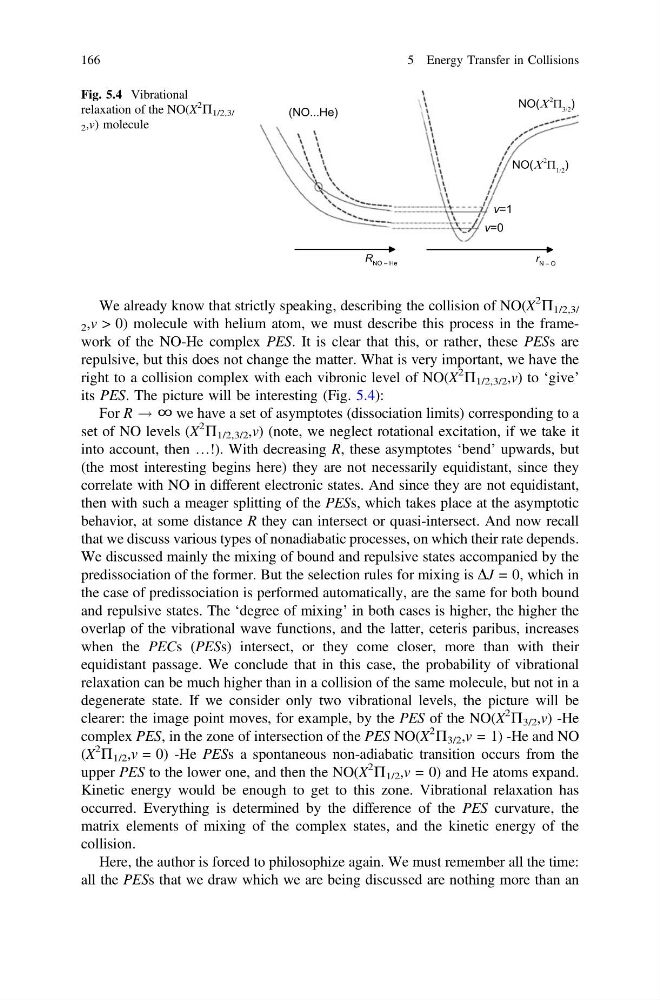
its PES. The picture will be interesting (Fig. 5.4):
For R ! ∞ we have a set of asymptotes (dissociation limits) corresponding to a
set of NO levels (X
2 P 1/2,3/2 ,v) (note, we neglect rotational excitation, if we take it
into account, then …!). With decreasing R, these asymptotes ‘bend’ upwards, but
(the most interesting begins here) they are not necessarily equidistant, since they
correlate with NO in different electronic states. And since they are not equidistant,
then with such a meager splitting of the PESs, which takes place at the asymptotic
behavior, at some distance R they can intersect or quasi-intersect. And now recall
that we discuss various types of nonadiabatic processes, on which their rate depends.
We discussed mainly the mixing of bound and repulsive states accompanied by the
predissociation of the former. But the selection rules for mixing is DJ = 0, which in
the case of predissociation is performed automatically, are the same for both bound
and repulsive states. The ‘degree of mixing’ in both cases is higher, the higher the
overlap of the vibrational wave functions, and the latter, ceteris paribus, increases
when the PECs (PESs) intersect, or they come closer, more than with their
equidistant passage. We conclude that in this case, the probability of vibrational
relaxation can be much higher than in a collision of the same molecule, but not in a
degenerate state. If we consider only two vibrational levels, the picture will be
clearer: the image point moves, for example, by the PES of the NO(X
2 P 3/2 ,v) -He
complex PES, in the zone of intersection of the PES NO(X
2 P 3/2 ,v = 1) -He and NO
(X
2 P 1/2 ,v = 0) -He PESs a spontaneous non-adiabatic transition occurs from the
upper PES to the lower one, and then the NO(X
2 P 1/2 ,v = 0) and He atoms expand.
Kinetic energy would be enough to get to this zone. Vibrational relaxation has
occurred. Everything is determined by the difference of the PES curvature, the
matrix elements of mixing of the complex states, and the kinetic energy of the
collision.
Here, the author is forced to philosophize again. We must remember all the time:
all the PESs that we draw which we are being discussed are nothing more than an
Fig. 5.4 Vibrational
relaxation of the NO(X
2
P 1/2,3/
2 ,v) molecule
166
5 Energy Transfer in Collisions
2 P 1/2,3/
2 ,v > 0) molecule with helium atom, we must describe this process in the framework of the NO-He complex PES. It is clear that this, or rather, these PESs are
repulsive, but this does not change the matter. What is very important, we have the
right to a collision complex with each vibronic level of NO(X
2 P 1/2,3/2 ,v) to ‘give’
its PES. The picture will be interesting (Fig. 5.4):
For R ! ∞ we have a set of asymptotes (dissociation limits) corresponding to a
set of NO levels (X
2 P 1/2,3/2 ,v) (note, we neglect rotational excitation, if we take it
into account, then …!). With decreasing R, these asymptotes ‘bend’ upwards, but
(the most interesting begins here) they are not necessarily equidistant, since they
correlate with NO in different electronic states. And since they are not equidistant,
then with such a meager splitting of the PESs, which takes place at the asymptotic
behavior, at some distance R they can intersect or quasi-intersect. And now recall
that we discuss various types of nonadiabatic processes, on which their rate depends.
We discussed mainly the mixing of bound and repulsive states accompanied by the
predissociation of the former. But the selection rules for mixing is DJ = 0, which in
the case of predissociation is performed automatically, are the same for both bound
and repulsive states. The ‘degree of mixing’ in both cases is higher, the higher the
overlap of the vibrational wave functions, and the latter, ceteris paribus, increases
when the PECs (PESs) intersect, or they come closer, more than with their
equidistant passage. We conclude that in this case, the probability of vibrational
relaxation can be much higher than in a collision of the same molecule, but not in a
degenerate state. If we consider only two vibrational levels, the picture will be
clearer: the image point moves, for example, by the PES of the NO(X
2 P 3/2 ,v) -He
complex PES, in the zone of intersection of the PES NO(X
2 P 3/2 ,v = 1) -He and NO
(X
2 P 1/2 ,v = 0) -He PESs a spontaneous non-adiabatic transition occurs from the
upper PES to the lower one, and then the NO(X
2 P 1/2 ,v = 0) and He atoms expand.
Kinetic energy would be enough to get to this zone. Vibrational relaxation has
occurred. Everything is determined by the difference of the PES curvature, the
matrix elements of mixing of the complex states, and the kinetic energy of the
collision.
Here, the author is forced to philosophize again. We must remember all the time:
all the PESs that we draw which we are being discussed are nothing more than an
Fig. 5.4 Vibrational
relaxation of the NO(X
2
P 1/2,3/
2 ,v) molecule
166
5 Energy Transfer in Collisions