

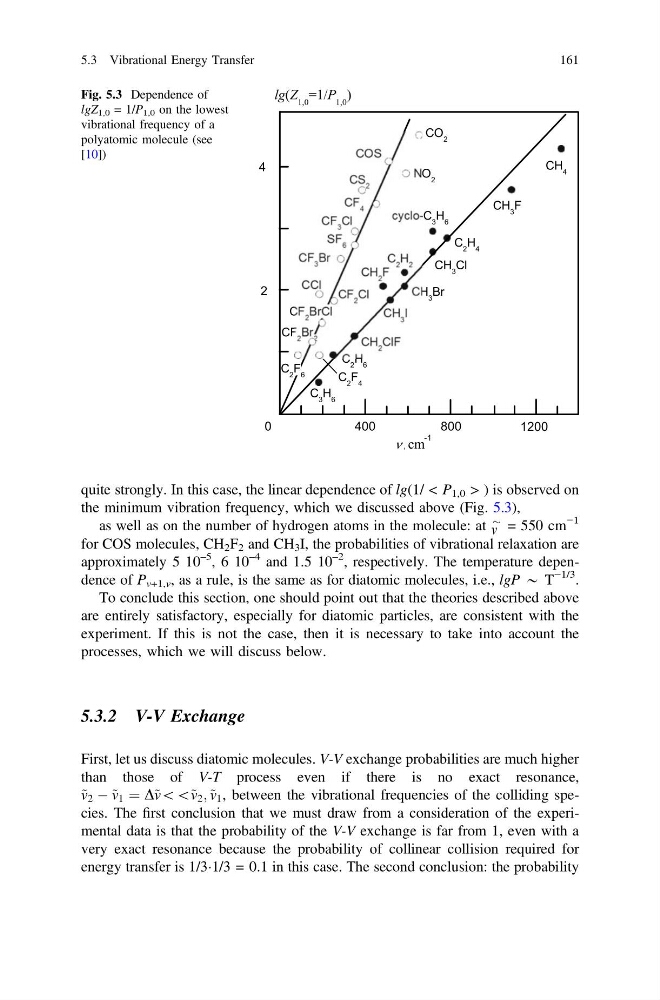
quite strongly. In this case, the linear dependence of lg(1/ < P 1,0 > ) is observed on
the minimum vibration frequency, which we discussed above (Fig. 5.3),
as well as on the number of hydrogen atoms in the molecule: at
$
m = 550 cm
−1
for COS molecules, CH 2 F 2 and CH 3 I, the probabilities of vibrational relaxation are
approximately 5 10
–5 , 6 10
–4 and 1.5 10
–2 , respectively. The temperature dependence of P v+1,v , as a rule, is the same as for diatomic molecules, i.e., lgP * T
−1/3 .
To conclude this section, one should point out that the theories described above
are entirely satisfactory, especially for diatomic particles, are consistent with the
experiment. If this is not the case, then it is necessary to take into account the
processes, which we will discuss below.
5.3.2 V-V Exchange
First, let us discuss diatomic molecules. V-V exchange probabilities are much higher
than those of V-T process even if there is no exact resonance,
~ v 2 À ~ v 1 ¼ D~ v\\~ v 2 ; ~ v 1 , between the vibrational frequencies of the colliding species. The first conclusion that we must draw from a consideration of the experimental data is that the probability of the V-V exchange is far from 1, even with a
very exact resonance because the probability of collinear collision required for
energy transfer is 1/3Á1/3 = 0.1 in this case. The second conclusion: the probability
Fig. 5.3 Dependence of
lgZ 1,0 = 1/P 1,0 on the lowest
vibrational frequency of a
polyatomic molecule (see
[10])
5.3 Vibrational Energy Transfer
161
the minimum vibration frequency, which we discussed above (Fig. 5.3),
as well as on the number of hydrogen atoms in the molecule: at
$
m = 550 cm
−1
for COS molecules, CH 2 F 2 and CH 3 I, the probabilities of vibrational relaxation are
approximately 5 10
–5 , 6 10
–4 and 1.5 10
–2 , respectively. The temperature dependence of P v+1,v , as a rule, is the same as for diatomic molecules, i.e., lgP * T
−1/3 .
To conclude this section, one should point out that the theories described above
are entirely satisfactory, especially for diatomic particles, are consistent with the
experiment. If this is not the case, then it is necessary to take into account the
processes, which we will discuss below.
5.3.2 V-V Exchange
First, let us discuss diatomic molecules. V-V exchange probabilities are much higher
than those of V-T process even if there is no exact resonance,
~ v 2 À ~ v 1 ¼ D~ v\\~ v 2 ; ~ v 1 , between the vibrational frequencies of the colliding species. The first conclusion that we must draw from a consideration of the experimental data is that the probability of the V-V exchange is far from 1, even with a
very exact resonance because the probability of collinear collision required for
energy transfer is 1/3Á1/3 = 0.1 in this case. The second conclusion: the probability
Fig. 5.3 Dependence of
lgZ 1,0 = 1/P 1,0 on the lowest
vibrational frequency of a
polyatomic molecule (see
[10])
5.3 Vibrational Energy Transfer
161