

energy of translational motion (non-quantized) to quantized degrees of freedom;
however, following the detailed balance principle, this approach is fully suitable for
considering the processes of energy relaxation of quantized degrees of freedom.
You see that the semiclassical approximation and the adiabatic principle are, in a
sense, antipodes. In the future, we will recall the adiabatic principle from time to
time.
It should be said that the approaches to solving the problem of the probability of
the V$T processes for low and high vibrational levels close to the dissociation limit
are very different since the values of vibrational quanta and vibration amplitudes
differ. At the lower vibrational levels, the vibration amplitude is small compared to
the characteristic sizes of the intermolecular interaction, comparable with 1/a (a is
the parameter of the Morse potential, see Sect. 3.5):
UðrÞ ¼ e 1 À expfÀa r À r e
ð
Þ
f
g
2 Àe;
ð5:3:2Þ
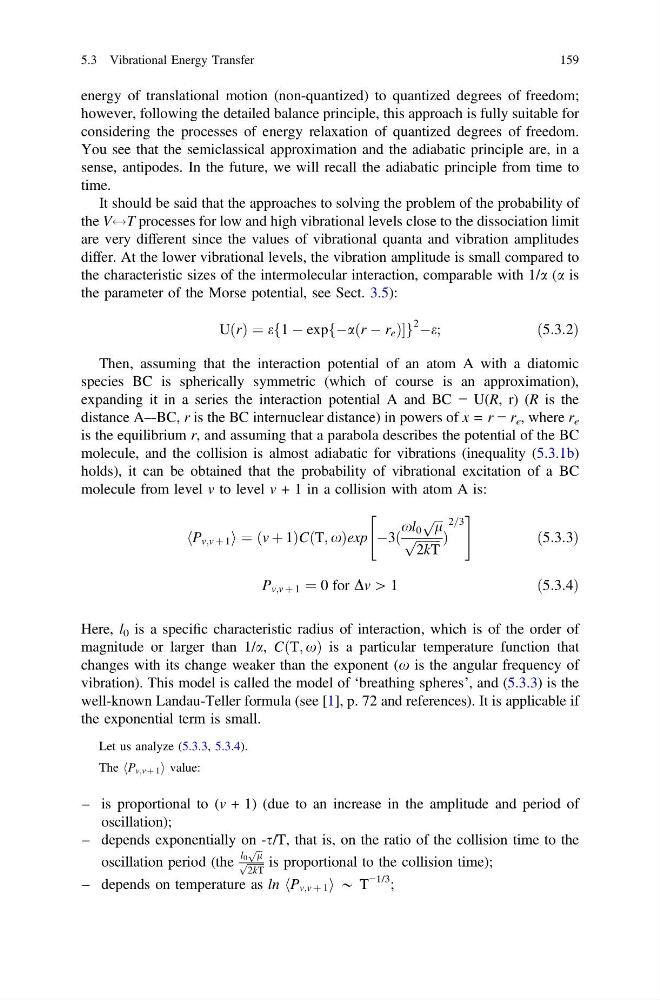
Then, assuming that the interaction potential of an atom A with a diatomic
species BC is spherically symmetric (which of course is an approximation),
expanding it in a series the interaction potential A and BC − U(R, r) (R is the
distance A–-BC, r is the BC internuclear distance) in powers of x = r − r e , where r e
is the equilibrium r, and assuming that a parabola describes the potential of the BC
molecule, and the collision is almost adiabatic for vibrations (inequality (5.3.1b)
holds), it can be obtained that the probability of vibrational excitation of a BC
molecule from level v to level v + 1 in a collision with atom A is:
hP v;v þ 1 i ¼ v þ 1
ð
ÞCðT; xÞexp À3ð
xl 0
ffiffiffi
l
p
ffiffiffiffiffiffiffiffi
2kT
p
Þ
2=3
"
#
ð5:3:3Þ
P v;v þ 1 ¼ 0 for Dv [ 1
ð5:3:4Þ
Here, l 0 is a specific characteristic radius of interaction, which is of the order of
magnitude or larger than 1/a, CðT; xÞ is a particular temperature function that
changes with its change weaker than the exponent (x is the angular frequency of
vibration). This model is called the model of ‘breathing spheres’, and (5.3.3) is the
well-known Landau-Teller formula (see [1], p. 72 and references). It is applicable if
the exponential term is small.
Let us analyze (5.3.3, 5.3.4).
The hP v;v þ 1 i value:
– is proportional to (v + 1) (due to an increase in the amplitude and period of
oscillation);
– depends exponentially on -s/T, that is, on the ratio of the collision time to the
oscillation period (the
l 0
ffiffi l
p
ffiffiffiffiffi ffi
2kT
p
is proportional to the collision time);
– depends on temperature as ln hP v;v þ 1 i * T
−1/3
;
5.3 Vibrational Energy Transfer
159
however, following the detailed balance principle, this approach is fully suitable for
considering the processes of energy relaxation of quantized degrees of freedom.
You see that the semiclassical approximation and the adiabatic principle are, in a
sense, antipodes. In the future, we will recall the adiabatic principle from time to
time.
It should be said that the approaches to solving the problem of the probability of
the V$T processes for low and high vibrational levels close to the dissociation limit
are very different since the values of vibrational quanta and vibration amplitudes
differ. At the lower vibrational levels, the vibration amplitude is small compared to
the characteristic sizes of the intermolecular interaction, comparable with 1/a (a is
the parameter of the Morse potential, see Sect. 3.5):
UðrÞ ¼ e 1 À expfÀa r À r e
ð
Þ
f
g
2 Àe;
ð5:3:2Þ
Then, assuming that the interaction potential of an atom A with a diatomic
species BC is spherically symmetric (which of course is an approximation),
expanding it in a series the interaction potential A and BC − U(R, r) (R is the
distance A–-BC, r is the BC internuclear distance) in powers of x = r − r e , where r e
is the equilibrium r, and assuming that a parabola describes the potential of the BC
molecule, and the collision is almost adiabatic for vibrations (inequality (5.3.1b)
holds), it can be obtained that the probability of vibrational excitation of a BC
molecule from level v to level v + 1 in a collision with atom A is:
hP v;v þ 1 i ¼ v þ 1
ð
ÞCðT; xÞexp À3ð
xl 0
ffiffiffi
l
p
ffiffiffiffiffiffiffiffi
2kT
p
Þ
2=3
"
#
ð5:3:3Þ
P v;v þ 1 ¼ 0 for Dv [ 1
ð5:3:4Þ
Here, l 0 is a specific characteristic radius of interaction, which is of the order of
magnitude or larger than 1/a, CðT; xÞ is a particular temperature function that
changes with its change weaker than the exponent (x is the angular frequency of
vibration). This model is called the model of ‘breathing spheres’, and (5.3.3) is the
well-known Landau-Teller formula (see [1], p. 72 and references). It is applicable if
the exponential term is small.
Let us analyze (5.3.3, 5.3.4).
The hP v;v þ 1 i value:
– is proportional to (v + 1) (due to an increase in the amplitude and period of
oscillation);
– depends exponentially on -s/T, that is, on the ratio of the collision time to the
oscillation period (the
l 0
ffiffi l
p
ffiffiffiffiffi ffi
2kT
p
is proportional to the collision time);
– depends on temperature as ln hP v;v þ 1 i * T
−1/3
;
5.3 Vibrational Energy Transfer
159