

HCl, H 2 O, and OH is Z rot = 7, 3, and 10, respectively, at T = 300 K. Here, the rule
DJ = ± 1 is usually fulfilled [3], p. 71.
The remaining molecules. For them, as well as for hydrides, the number of
collisions required for relaxation is less than ten, Z rot = 4.8 and 3.6 for N 2 (X) and
O 2 (X), respectively.
All these data are related to the molecule ground state, low rotational quantum
numbers, and collisions with the same molecules. The Z rot values increase if the
collision of molecules with high and low J values occurs due to the difference of
rotational quanta [1], p. 71, [4]. These molecules are characterized by small values
of rotational quanta B
O 2 ðXÞ
e
¼ 1:5 cm
À1
À B
I 2 ðXÞ
e
¼ 0:04 cm
À1
, therefore, in the
process of rotational relaxation, the ‘little DJ’ propensity rule is violated: during
rotational relaxation of I 2 B0
þ
u ; v A ; J A
À
Á ; DJ 40 were recorded [5].
The relaxation efficiency decreases with increasing temperature; different works
give a dependence on 1/T to (1/T)
1/2 ; some works indicate the absence of this
dependence.
5.3 Vibrational Energy Transfer
5.3.1 V $ T, V $ R, T Processes
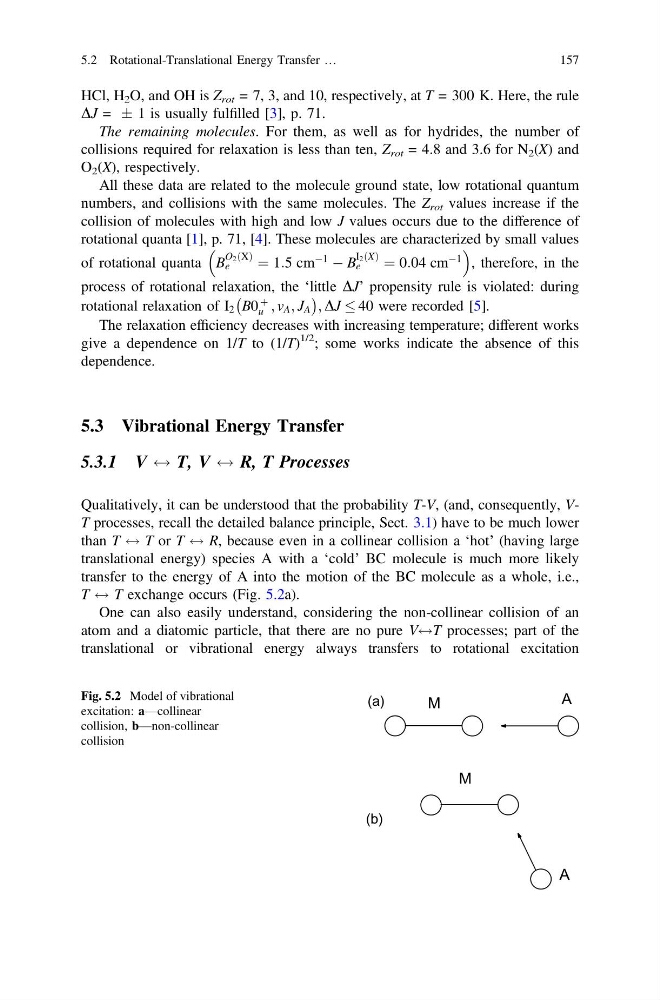
Qualitatively, it can be understood that the probability T-V, (and, consequently, VT processes, recall the detailed balance principle, Sect. 3.1) have to be much lower
than T $ T or T $ R, because even in a collinear collision a ‘hot’ (having large
translational energy) species A with a ‘cold’ BC molecule is much more likely
transfer to the energy of A into the motion of the BC molecule as a whole, i.e.,
T $ T exchange occurs (Fig. 5.2a).
One can also easily understand, considering the non-collinear collision of an
atom and a diatomic particle, that there are no pure V$T processes; part of the
translational or vibrational energy always transfers to rotational excitation
(b)
(a)
M
M
A
A
Fig. 5.2 Model of vibrational
excitation: a—collinear
collision, b—non-collinear
collision
5.2 Rotational-Translational Energy Transfer …
157
DJ = ± 1 is usually fulfilled [3], p. 71.
The remaining molecules. For them, as well as for hydrides, the number of
collisions required for relaxation is less than ten, Z rot = 4.8 and 3.6 for N 2 (X) and
O 2 (X), respectively.
All these data are related to the molecule ground state, low rotational quantum
numbers, and collisions with the same molecules. The Z rot values increase if the
collision of molecules with high and low J values occurs due to the difference of
rotational quanta [1], p. 71, [4]. These molecules are characterized by small values
of rotational quanta B
O 2 ðXÞ
e
¼ 1:5 cm
À1
À B
I 2 ðXÞ
e
¼ 0:04 cm
À1
, therefore, in the
process of rotational relaxation, the ‘little DJ’ propensity rule is violated: during
rotational relaxation of I 2 B0
þ
u ; v A ; J A
À
Á ; DJ 40 were recorded [5].
The relaxation efficiency decreases with increasing temperature; different works
give a dependence on 1/T to (1/T)
1/2 ; some works indicate the absence of this
dependence.
5.3 Vibrational Energy Transfer
5.3.1 V $ T, V $ R, T Processes
Qualitatively, it can be understood that the probability T-V, (and, consequently, VT processes, recall the detailed balance principle, Sect. 3.1) have to be much lower
than T $ T or T $ R, because even in a collinear collision a ‘hot’ (having large
translational energy) species A with a ‘cold’ BC molecule is much more likely
transfer to the energy of A into the motion of the BC molecule as a whole, i.e.,
T $ T exchange occurs (Fig. 5.2a).
One can also easily understand, considering the non-collinear collision of an
atom and a diatomic particle, that there are no pure V$T processes; part of the
translational or vibrational energy always transfers to rotational excitation
(b)
(a)
M
M
A
A
Fig. 5.2 Model of vibrational
excitation: a—collinear
collision, b—non-collinear
collision
5.2 Rotational-Translational Energy Transfer …
157