

CO
Ã
2 ! CO X
1 R
þ
g
þ O
3 P
À Á
ð4:8:2Þ
Luminescence of these states is not observed since the radiative transition rate is
much lower than that of predissociation or (at higher pressures) collisional deactivation of states. In this case, the radiation lifetime can significantly exceed the
value calculated from the absorption spectra due to state mixing (see Sect. 4.6.2.2).
At p CO 2 > 5 Torr, the principal channel of the CO
Ã
2 decay is collisional deactivation
CO
Ã
2 þ CO 2 e
X
1 R
þ
g
! . . . ! 2CO 2 e
X
1 R
þ
g
;
ð4:8:3Þ
and u CO 2 < 1 (see Table 4.5). Optical transitions to the
1 A 2 ð
1 R
À
u Þ and
1 A 2 ,
1 B 2 (
1 D u )
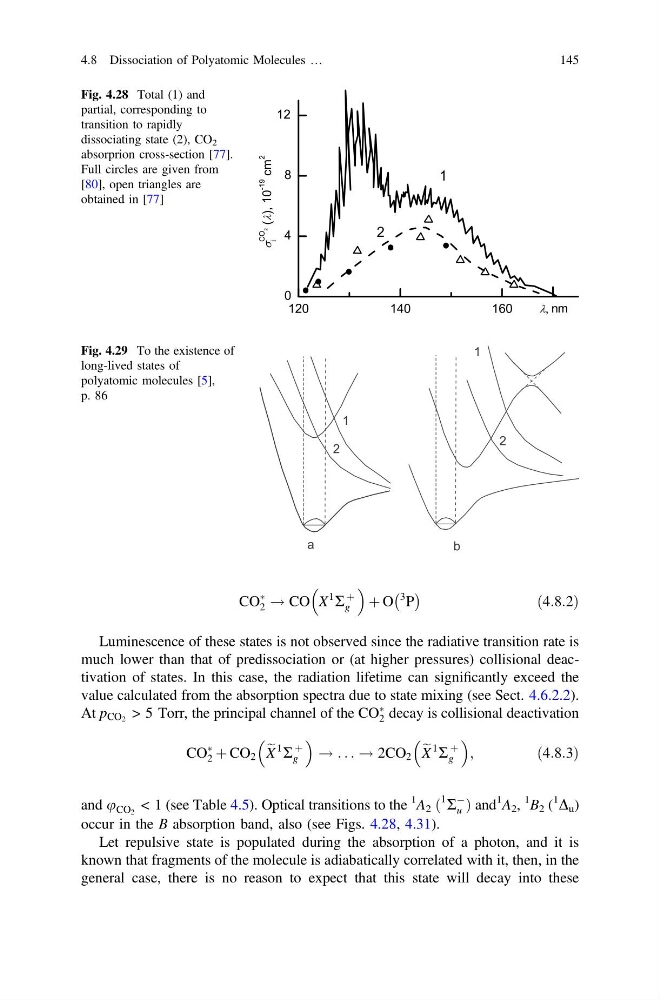
occur in the B absorption band, also (see Figs. 4.28, 4.31).
Let repulsive state is populated during the absorption of a photon, and it is
known that fragments of the molecule is adiabatically correlated with it, then, in the
general case, there is no reason to expect that this state will decay into these
Fig. 4.28 Total (1) and
partial, corresponding to
transition to rapidly
dissociating state (2), CO 2
absorprion cross-section [77].
Full circles are given from
[80], open triangles are
obtained in [77]
Fig. 4.29 To the existence of
long-lived states of
polyatomic molecules [5],
p. 86
4.8 Dissociation of Polyatomic Molecules …
145
Ã
2 ! CO X
1 R
þ
g
þ O
3 P
À Á
ð4:8:2Þ
Luminescence of these states is not observed since the radiative transition rate is
much lower than that of predissociation or (at higher pressures) collisional deactivation of states. In this case, the radiation lifetime can significantly exceed the
value calculated from the absorption spectra due to state mixing (see Sect. 4.6.2.2).
At p CO 2 > 5 Torr, the principal channel of the CO
Ã
2 decay is collisional deactivation
CO
Ã
2 þ CO 2 e
X
1 R
þ
g
! . . . ! 2CO 2 e
X
1 R
þ
g
;
ð4:8:3Þ
and u CO 2 < 1 (see Table 4.5). Optical transitions to the
1 A 2 ð
1 R
À
u Þ and
1 A 2 ,
1 B 2 (
1 D u )
occur in the B absorption band, also (see Figs. 4.28, 4.31).
Let repulsive state is populated during the absorption of a photon, and it is
known that fragments of the molecule is adiabatically correlated with it, then, in the
general case, there is no reason to expect that this state will decay into these
Fig. 4.28 Total (1) and
partial, corresponding to
transition to rapidly
dissociating state (2), CO 2
absorprion cross-section [77].
Full circles are given from
[80], open triangles are
obtained in [77]
Fig. 4.29 To the existence of
long-lived states of
polyatomic molecules [5],
p. 86
4.8 Dissociation of Polyatomic Molecules …
145