

1
j i ¼ cos XvJn
j
iþ sin X
0
v
0
J
0
n
0
j
i
2
j i ¼ Àsin XvJn
j
iþcos X
0
v
0
J
0
n
0
j
i ;
ð4:6:34Þ
where the mixing angle h can be obtained using (4.6.33)
tan 2h ¼
2H
DE
;
ð4:6:35Þ
H ¼
ffiffiffiffiffiffiffiffiffi ffi
FCF
p
XvJn b
H
X
0
v
0
J
0
n
0
D
E
;
ð4:6:36Þ
b
H is the operator of the interaction between the W and W
0 states, DE is an energy
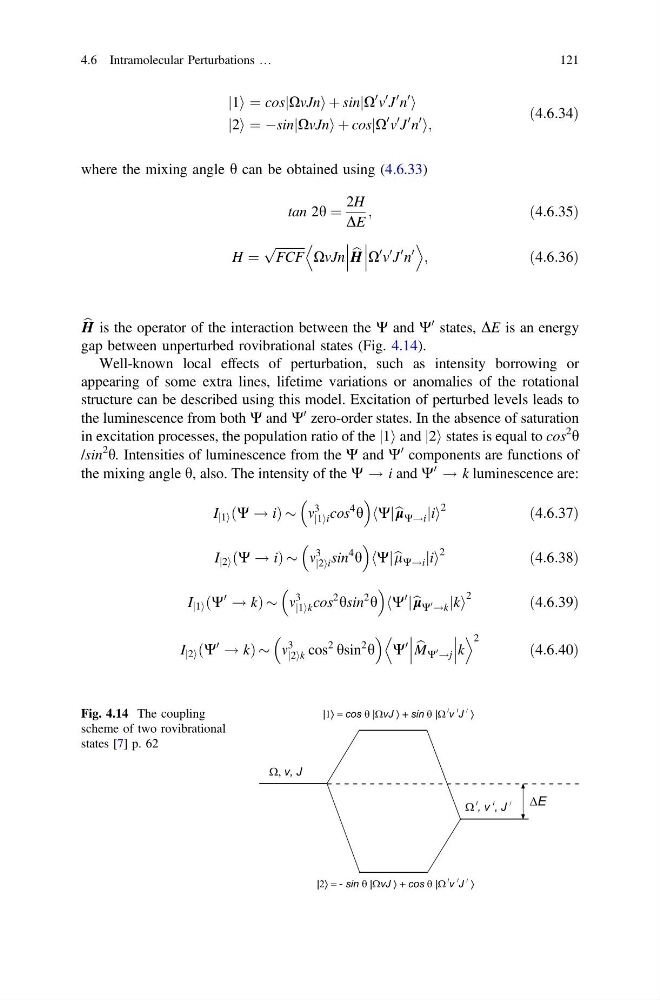
gap between unperturbed rovibrational states (Fig. 4.14).
Well-known local effects of perturbation, such as intensity borrowing or
appearing of some extra lines, lifetime variations or anomalies of the rotational
structure can be described using this model. Excitation of perturbed levels leads to
the luminescence from both W and W
0 zero-order states. In the absence of saturation
in excitation processes, the population ratio of the 1
j i and 2
j i states is equal to cos
2 h
/sin
2 h. Intensities of luminescence from the W and W
0 components are functions of
the mixing angle h, also. The intensity of the W ! i and W
0
! k luminescence are:
I 1
j i W ! i
ð
Þ$ m
3
1
j ii cos
4 h
W b l W!i
j
ji
h
i
2
ð4:6:37Þ
I 2
j i W ! i
ð
Þ$ m
3
2
j ii sin
4 h
W b l W!i
j
ji
h
i
2
ð4:6:38Þ
I 1
j i W
0
! k
ð
Þ$ m
3
1
j ik cos
2 hsin
2 h
W
0
b l W
0 !k
j
jk
h
i
2
ð4:6:39Þ
I 2
j i W
0
! k
ð
Þ$ m
3
2
j ik cos
2 hsin
2 h
W
0 b
M W
0 !j
k
D
E 2
ð4:6:40Þ
Fig. 4.14 The coupling
scheme of two rovibrational
states [7] p. 62
4.6 Intramolecular Perturbations …
121
j i ¼ cos XvJn
j
iþ sin X
0
v
0
J
0
n
0
j
i
2
j i ¼ Àsin XvJn
j
iþcos X
0
v
0
J
0
n
0
j
i ;
ð4:6:34Þ
where the mixing angle h can be obtained using (4.6.33)
tan 2h ¼
2H
DE
;
ð4:6:35Þ
H ¼
ffiffiffiffiffiffiffiffiffi ffi
FCF
p
XvJn b
H
X
0
v
0
J
0
n
0
D
E
;
ð4:6:36Þ
b
H is the operator of the interaction between the W and W
0 states, DE is an energy
gap between unperturbed rovibrational states (Fig. 4.14).
Well-known local effects of perturbation, such as intensity borrowing or
appearing of some extra lines, lifetime variations or anomalies of the rotational
structure can be described using this model. Excitation of perturbed levels leads to
the luminescence from both W and W
0 zero-order states. In the absence of saturation
in excitation processes, the population ratio of the 1
j i and 2
j i states is equal to cos
2 h
/sin
2 h. Intensities of luminescence from the W and W
0 components are functions of
the mixing angle h, also. The intensity of the W ! i and W
0
! k luminescence are:
I 1
j i W ! i
ð
Þ$ m
3
1
j ii cos
4 h
W b l W!i
j
ji
h
i
2
ð4:6:37Þ
I 2
j i W ! i
ð
Þ$ m
3
2
j ii sin
4 h
W b l W!i
j
ji
h
i
2
ð4:6:38Þ
I 1
j i W
0
! k
ð
Þ$ m
3
1
j ik cos
2 hsin
2 h
W
0
b l W
0 !k
j
jk
h
i
2
ð4:6:39Þ
I 2
j i W
0
! k
ð
Þ$ m
3
2
j ik cos
2 hsin
2 h
W
0 b
M W
0 !j
k
D
E 2
ð4:6:40Þ
Fig. 4.14 The coupling
scheme of two rovibrational
states [7] p. 62
4.6 Intramolecular Perturbations …
121