

T
00
nucl ¼ E AB
à v 0
ð Þ À hm ¼ E AB r
ð Þ þ T
0
r
0
e
À Á ;
ð4:5:1Þ
r = r 1 , r 2 . If, in a vicinity of the r
0
e point, the transition occurs on a flat part of the
AB PEC (in this case, the points r 3 , r
0
e coincide)
E AB r
ð Þ ¼ 0; T
00
nucl ¼ T
00
r
ð Þ ¼ T
0
r
0
e
À Á ;
ð4:5:2Þ
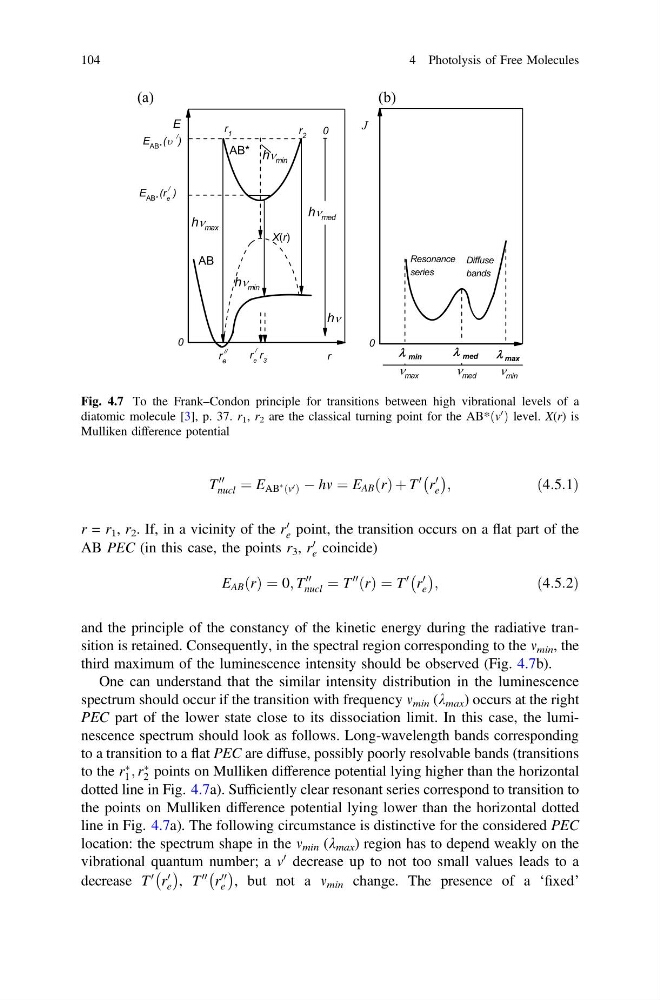
and the principle of the constancy of the kinetic energy during the radiative transition is retained. Consequently, in the spectral region corresponding to the m min , the
third maximum of the luminescence intensity should be observed (Fig. 4.7b).
One can understand that the similar intensity distribution in the luminescence
spectrum should occur if the transition with frequency m min (k max ) occurs at the right
PEC part of the lower state close to its dissociation limit. In this case, the luminescence spectrum should look as follows. Long-wavelength bands corresponding
to a transition to a flat PEC are diffuse, possibly poorly resolvable bands (transitions
to the r
Ã
1 ; r
Ã
2 points on Mulliken difference potential lying higher than the horizontal
dotted line in Fig. 4.7a). Sufficiently clear resonant series correspond to transition to
the points on Mulliken difference potential lying lower than the horizontal dotted
line in Fig. 4.7a). The following circumstance is distinctive for the considered PEC
location: the spectrum shape in the m min (k max ) region has to depend weakly on the
vibrational quantum number; a v
0 decrease up to not too small values leads to a
decrease T
0
r
0
e
À Á
, T
00
r
00
e
À Á
, but not a m min change. The presence of a ‘fixed’
(a)
(b)
Fig. 4.7 To the Frank–Condon principle for transitions between high vibrational levels of a
diatomic molecule [3], p. 37. r 1 , r 2 are the classical turning point for the AB*ðv
0 Þ level. X(r) is
Mulliken difference potential
104
4 Photolysis of Free Molecules
00
nucl ¼ E AB
à v 0
ð Þ À hm ¼ E AB r
ð Þ þ T
0
r
0
e
À Á ;
ð4:5:1Þ
r = r 1 , r 2 . If, in a vicinity of the r
0
e point, the transition occurs on a flat part of the
AB PEC (in this case, the points r 3 , r
0
e coincide)
E AB r
ð Þ ¼ 0; T
00
nucl ¼ T
00
r
ð Þ ¼ T
0
r
0
e
À Á ;
ð4:5:2Þ
and the principle of the constancy of the kinetic energy during the radiative transition is retained. Consequently, in the spectral region corresponding to the m min , the
third maximum of the luminescence intensity should be observed (Fig. 4.7b).
One can understand that the similar intensity distribution in the luminescence
spectrum should occur if the transition with frequency m min (k max ) occurs at the right
PEC part of the lower state close to its dissociation limit. In this case, the luminescence spectrum should look as follows. Long-wavelength bands corresponding
to a transition to a flat PEC are diffuse, possibly poorly resolvable bands (transitions
to the r
Ã
1 ; r
Ã
2 points on Mulliken difference potential lying higher than the horizontal
dotted line in Fig. 4.7a). Sufficiently clear resonant series correspond to transition to
the points on Mulliken difference potential lying lower than the horizontal dotted
line in Fig. 4.7a). The following circumstance is distinctive for the considered PEC
location: the spectrum shape in the m min (k max ) region has to depend weakly on the
vibrational quantum number; a v
0 decrease up to not too small values leads to a
decrease T
0
r
0
e
À Á
, T
00
r
00
e
À Á
, but not a m min change. The presence of a ‘fixed’
(a)
(b)
Fig. 4.7 To the Frank–Condon principle for transitions between high vibrational levels of a
diatomic molecule [3], p. 37. r 1 , r 2 are the classical turning point for the AB*ðv
0 Þ level. X(r) is
Mulliken difference potential
104
4 Photolysis of Free Molecules