

where n es depends on spin and space coordinates. However, n es species has to be
the same as that of U Á r since W es has to belong to a species of the point group
concerned. Therefore, states with total spin quantum numbers different by 1
DS ¼ Æ1
ð4:2:14Þ
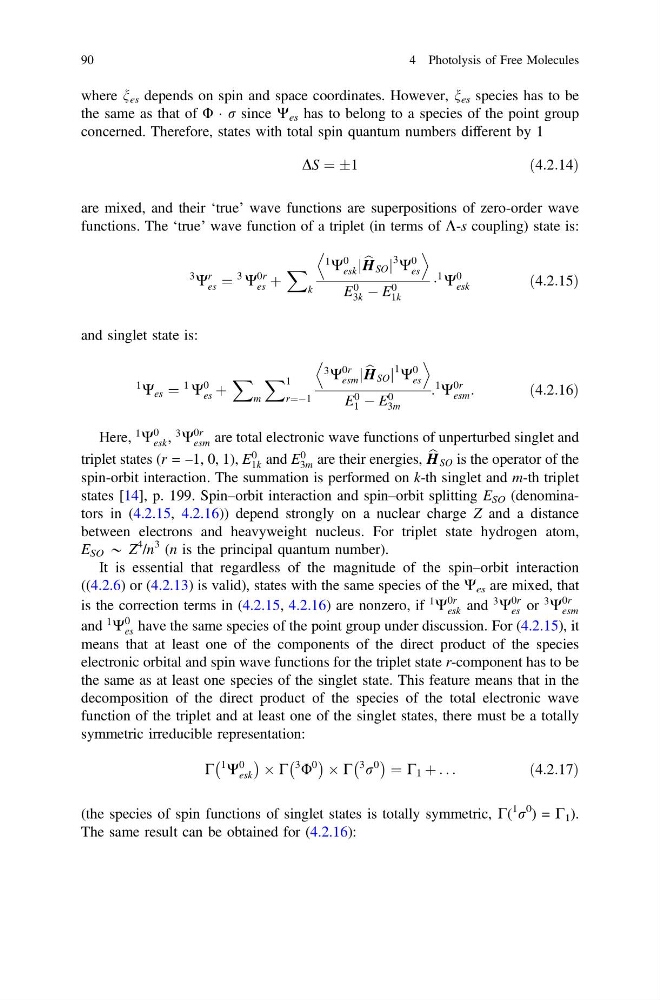
are mixed, and their ‘true’ wave functions are superpositions of zero-order wave
functions. The ‘true’ wave function of a triplet (in terms of K-s coupling) state is:
3 W
r
es ¼
3 W
0r
es þ
X
k
1 W
0
esk j b
H SO j
3 W
0
es
D
E
E
0
3k À E
0
1k
Á
1 W
0
esk
ð4:2:15Þ
and singlet state is:
1 W es ¼
1 W
0
es þ
X
m
X 1
r¼À1
3 W
0r
esm j b
H SO j
1 W
0
es
D
E
E
0
1 À E
0
3m
:
1 W
0r
esm :
ð4:2:16Þ
Here,
1 W
0
esk ,
3 W
0r
esm are total electronic wave functions of unperturbed singlet and
triplet states (r = –1, 0, 1), E
0
1k and E
0
3m are their energies, b
H SO is the operator of the
spin-orbit interaction. The summation is performed on k-th singlet and m-th triplet
states [14], p. 199. Spin–orbit interaction and spin–orbit splitting E SO (denominators in (4.2.15, 4.2.16)) depend strongly on a nuclear charge Z and a distance
between electrons and heavyweight nucleus. For triplet state hydrogen atom,
E SO * Z
4 /n
3 (n is the principal quantum number).
It is essential that regardless of the magnitude of the spin–orbit interaction
((4.2.6) or (4.2.13) is valid), states with the same species of the W es are mixed, that
is the correction terms in (4.2.15, 4.2.16) are nonzero, if
1 W
0r
esk and
3 W
0r
es or
3 W
0r
esm
and
1 W
0
es have the same species of the point group under discussion. For (4.2.15), it
means that at least one of the components of the direct product of the species
electronic orbital and spin wave functions for the triplet state r-component has to be
the same as at least one species of the singlet state. This feature means that in the
decomposition of the direct product of the species of the total electronic wave
function of the triplet and at least one of the singlet states, there must be a totally
symmetric irreducible representation:
C
1 W
0
esk
À
Á Â C
3 U
0
À
Á Â C
3
r
0
À Á ¼ C 1 þ . . .
ð4:2:17Þ
(the species of spin functions of singlet states is totally symmetric, C(
1
r
0
) = C 1 ).
The same result can be obtained for (4.2.16):
90
4 Photolysis of Free Molecules
the same as that of U Á r since W es has to belong to a species of the point group
concerned. Therefore, states with total spin quantum numbers different by 1
DS ¼ Æ1
ð4:2:14Þ
are mixed, and their ‘true’ wave functions are superpositions of zero-order wave
functions. The ‘true’ wave function of a triplet (in terms of K-s coupling) state is:
3 W
r
es ¼
3 W
0r
es þ
X
k
1 W
0
esk j b
H SO j
3 W
0
es
D
E
E
0
3k À E
0
1k
Á
1 W
0
esk
ð4:2:15Þ
and singlet state is:
1 W es ¼
1 W
0
es þ
X
m
X 1
r¼À1
3 W
0r
esm j b
H SO j
1 W
0
es
D
E
E
0
1 À E
0
3m
:
1 W
0r
esm :
ð4:2:16Þ
Here,
1 W
0
esk ,
3 W
0r
esm are total electronic wave functions of unperturbed singlet and
triplet states (r = –1, 0, 1), E
0
1k and E
0
3m are their energies, b
H SO is the operator of the
spin-orbit interaction. The summation is performed on k-th singlet and m-th triplet
states [14], p. 199. Spin–orbit interaction and spin–orbit splitting E SO (denominators in (4.2.15, 4.2.16)) depend strongly on a nuclear charge Z and a distance
between electrons and heavyweight nucleus. For triplet state hydrogen atom,
E SO * Z
4 /n
3 (n is the principal quantum number).
It is essential that regardless of the magnitude of the spin–orbit interaction
((4.2.6) or (4.2.13) is valid), states with the same species of the W es are mixed, that
is the correction terms in (4.2.15, 4.2.16) are nonzero, if
1 W
0r
esk and
3 W
0r
es or
3 W
0r
esm
and
1 W
0
es have the same species of the point group under discussion. For (4.2.15), it
means that at least one of the components of the direct product of the species
electronic orbital and spin wave functions for the triplet state r-component has to be
the same as at least one species of the singlet state. This feature means that in the
decomposition of the direct product of the species of the total electronic wave
function of the triplet and at least one of the singlet states, there must be a totally
symmetric irreducible representation:
C
1 W
0
esk
À
Á Â C
3 U
0
À
Á Â C
3
r
0
À Á ¼ C 1 þ . . .
ð4:2:17Þ
(the species of spin functions of singlet states is totally symmetric, C(
1
r
0
) = C 1 ).
The same result can be obtained for (4.2.16):
90
4 Photolysis of Free Molecules