

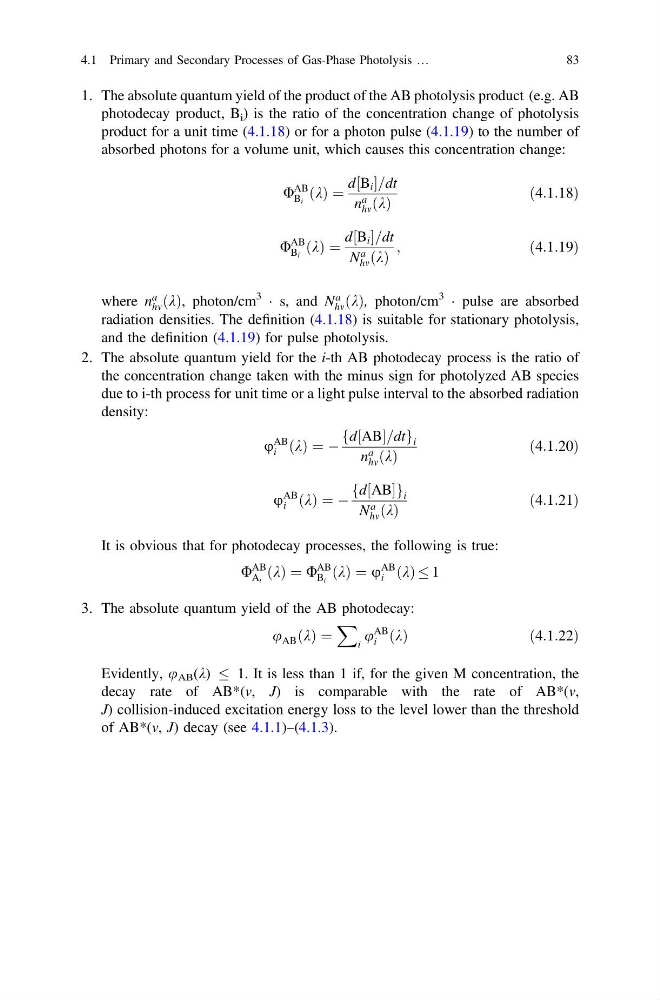
1. The absolute quantum yield of the product of the AB photolysis product (e.g. AB
photodecay product, B i ) is the ratio of the concentration change of photolysis
product for a unit time (4.1.18) or for a photon pulse (4.1.19) to the number of
absorbed photons for a volume unit, which causes this concentration change:
U
AB
B i
ðkÞ ¼
d B i
½ =dt
n
a
hm ðkÞ
ð4:1:18Þ
U
AB
B i
ðkÞ ¼
d B i
½ =dt
N a
hm ðkÞ
;
ð4:1:19Þ
where n
a
hm ðkÞ, photon/cm
3
Á s, and N
a
hm ðkÞ, photon/cm
3
Á pulse are absorbed
radiation densities. The definition (4.1.18) is suitable for stationary photolysis,
and the definition (4.1.19) for pulse photolysis.
2. The absolute quantum yield for the i-th AB photodecay process is the ratio of
the concentration change taken with the minus sign for photolyzed AB species
due to i-th process for unit time or a light pulse interval to the absorbed radiation
density:
u
AB
i ðkÞ ¼ À
d AB
½ =dt
f
g i
n
a
hm ðkÞ
ð4:1:20Þ
u
AB
i ðkÞ ¼ À
d AB
½
f
g i
N
a
hm ðkÞ
ð4:1:21Þ
It is obvious that for photodecay processes, the following is true:
U
AB
A i
ðkÞ ¼ U
AB
B i
ðkÞ ¼ u
AB
i ðkÞ 1
3. The absolute quantum yield of the AB photodecay:
u AB ðkÞ ¼
X
i
u
AB
i ðkÞ
ð 4:1:22Þ
Evidently, u AB (k)
1. It is less than 1 if, for the given M concentration, the
decay rate of AB*(v, J) is comparable with the rate of AB*(v,
J) collision-induced excitation energy loss to the level lower than the threshold
of AB*(v, J) decay (see 4.1.1)–(4.1.3).
4.1 Primary and Secondary Processes of Gas-Phase Photolysis …
83
photodecay product, B i ) is the ratio of the concentration change of photolysis
product for a unit time (4.1.18) or for a photon pulse (4.1.19) to the number of
absorbed photons for a volume unit, which causes this concentration change:
U
AB
B i
ðkÞ ¼
d B i
½ =dt
n
a
hm ðkÞ
ð4:1:18Þ
U
AB
B i
ðkÞ ¼
d B i
½ =dt
N a
hm ðkÞ
;
ð4:1:19Þ
where n
a
hm ðkÞ, photon/cm
3
Á s, and N
a
hm ðkÞ, photon/cm
3
Á pulse are absorbed
radiation densities. The definition (4.1.18) is suitable for stationary photolysis,
and the definition (4.1.19) for pulse photolysis.
2. The absolute quantum yield for the i-th AB photodecay process is the ratio of
the concentration change taken with the minus sign for photolyzed AB species
due to i-th process for unit time or a light pulse interval to the absorbed radiation
density:
u
AB
i ðkÞ ¼ À
d AB
½ =dt
f
g i
n
a
hm ðkÞ
ð4:1:20Þ
u
AB
i ðkÞ ¼ À
d AB
½
f
g i
N
a
hm ðkÞ
ð4:1:21Þ
It is obvious that for photodecay processes, the following is true:
U
AB
A i
ðkÞ ¼ U
AB
B i
ðkÞ ¼ u
AB
i ðkÞ 1
3. The absolute quantum yield of the AB photodecay:
u AB ðkÞ ¼
X
i
u
AB
i ðkÞ
ð 4:1:22Þ
Evidently, u AB (k)
1. It is less than 1 if, for the given M concentration, the
decay rate of AB*(v, J) is comparable with the rate of AB*(v,
J) collision-induced excitation energy loss to the level lower than the threshold
of AB*(v, J) decay (see 4.1.1)–(4.1.3).
4.1 Primary and Secondary Processes of Gas-Phase Photolysis …
83