

or
k F ¼
2
ffiffiffi
p
p
p
a
¼ 1:228
p
a
But the distance of a corner (diagonal) of the first B-Z from the center is
d ¼
ffiffi ffi
2
p p
a
¼ 1:414
p
a
The above calculations give us that the value of k F lies between
p
a
\k F \1:414
p
a
This indicates that the radius k F goes beyond the first B-Z near edges (boundaries) but remains within near corners (Fig. 2.30).
Example 3 Determine the radius of the Fermi sphere for a body-centered cubic
crystal of side a. Show that (i) the Fermi sphere is entirely contained within the first
B-Z (ii) it covers 88 % of the shortest distance from the center of the zone, and
(iii) it is separated by a distance of 0:174
p
a
À Á
from the zone boundaries.
Solution: Given: A bcc crystal, number of atoms per unit cell, n = 2, k F = ?
Radius of the Fermi sphere can be obtained by
k F ¼
3p
2 n
a 3
1=3
¼
3p
2 2
a 3
1=3
¼
6
p
1=3 p
a
¼ 1:24
p
a
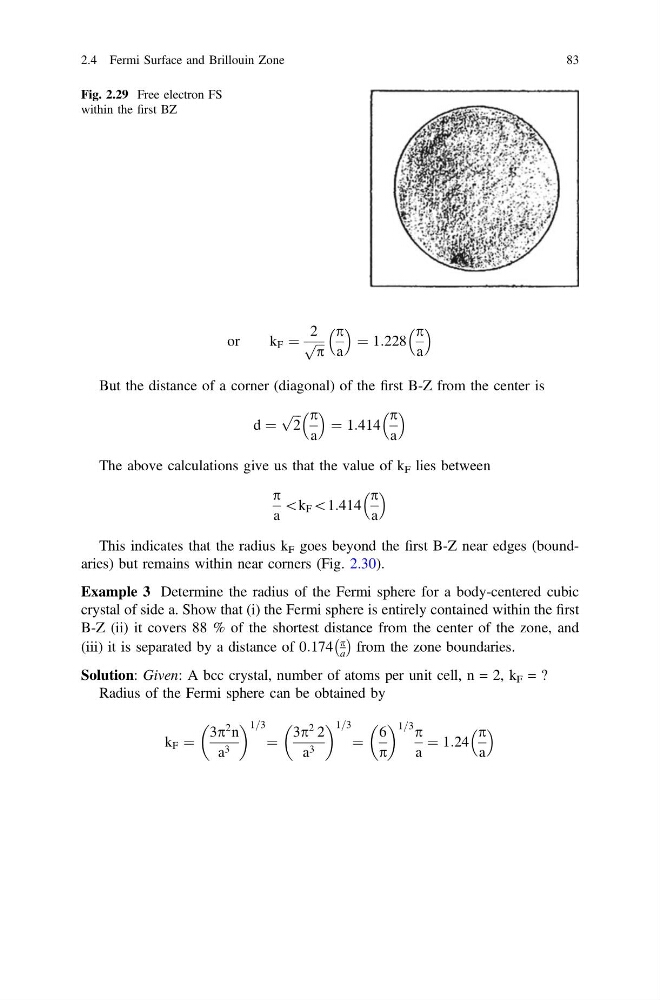
Fig. 2.29 Free electron FS
within the first BZ
2.4 Fermi Surface and Brillouin Zone
83
k F ¼
2
ffiffiffi
p
p
p
a
¼ 1:228
p
a
But the distance of a corner (diagonal) of the first B-Z from the center is
d ¼
ffiffi ffi
2
p p
a
¼ 1:414
p
a
The above calculations give us that the value of k F lies between
p
a
\k F \1:414
p
a
This indicates that the radius k F goes beyond the first B-Z near edges (boundaries) but remains within near corners (Fig. 2.30).
Example 3 Determine the radius of the Fermi sphere for a body-centered cubic
crystal of side a. Show that (i) the Fermi sphere is entirely contained within the first
B-Z (ii) it covers 88 % of the shortest distance from the center of the zone, and
(iii) it is separated by a distance of 0:174
p
a
À Á
from the zone boundaries.
Solution: Given: A bcc crystal, number of atoms per unit cell, n = 2, k F = ?
Radius of the Fermi sphere can be obtained by
k F ¼
3p
2 n
a 3
1=3
¼
3p
2 2
a 3
1=3
¼
6
p
1=3 p
a
¼ 1:24
p
a
Fig. 2.29 Free electron FS
within the first BZ
2.4 Fermi Surface and Brillouin Zone
83