

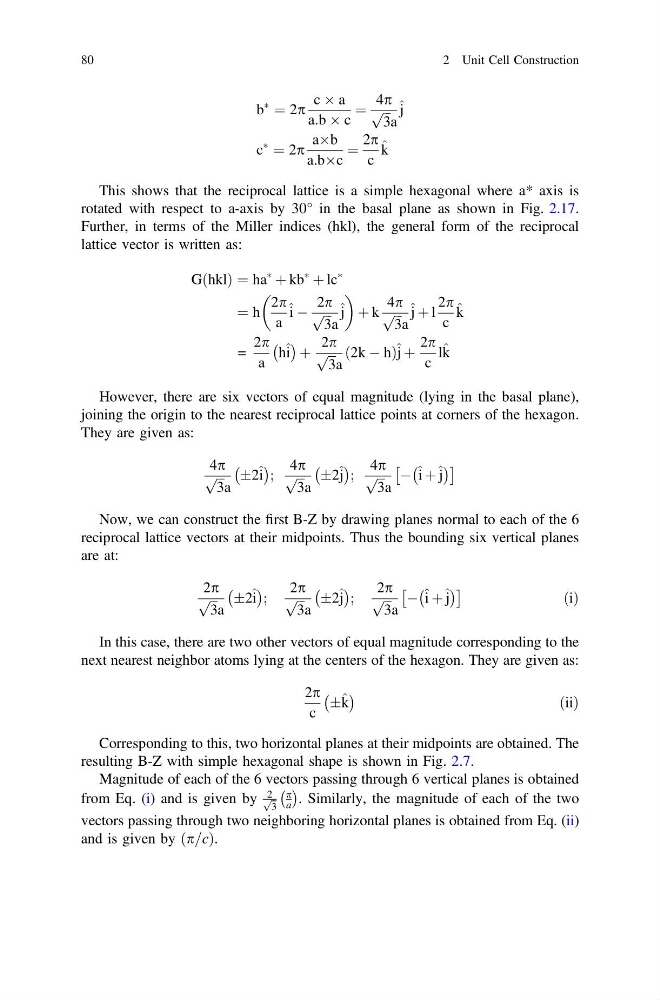
b
Ã
¼ 2p
c  a
a:b  c
¼
4p
ffiffi ffi
3
p
a
^ j
c
Ã
¼ 2p
aÂb
a.bÂc
¼
2p
c
^ k
This shows that the reciprocal lattice is a simple hexagonal where a* axis is
rotated with respect to a-axis by 30° in the basal plane as shown in Fig. 2.17.
Further, in terms of the Miller indices (hkl), the general form of the reciprocal
lattice vector is written as:
GðhklÞ ¼ ha
Ã
þ kb
Ã
þ lc
Ã
¼ h
2p
a
^ i À
2p
ffiffi ffi
3
p
a
^ j
þ k
4p
ffiffi ffi
3
p
a
^ j þ l
2p
c
^ k
=
2p
a
h ^ i
À Á þ
2p
ffiffi ffi
3
p
a
2k À h
ð
Þ ^ j þ
2p
c
l ^ k
However, there are six vectors of equal magnitude (lying in the basal plane),
joining the origin to the nearest reciprocal lattice points at corners of the hexagon.
They are given as:
4p
ffiffi ffi
3
p
a
Æ2 ^ i
À
Á ;
4p
ffiffi ffi
3
p
a
Æ2 ^ j
À
Á ;
4p
ffiffi ffi
3
p
a
À ^ i þ ^ j
À
Á
Â
Ã
Now, we can construct the first B-Z by drawing planes normal to each of the 6
reciprocal lattice vectors at their midpoints. Thus the bounding six vertical planes
are at:
2p
ffiffi ffi
3
p
a
Æ2 ^ i
À
Á ;
2p
ffiffi ffi
3
p
a
Æ2 ^ j
À
Á ;
2p
ffiffi ffi
3
p
a
À ^ i þ ^ j
À
Á
Â
Ã
ðiÞ
In this case, there are two other vectors of equal magnitude corresponding to the
next nearest neighbor atoms lying at the centers of the hexagon. They are given as:
2p
c
Æ ^ k
À Á
ðiiÞ
Corresponding to this, two horizontal planes at their midpoints are obtained. The
resulting B-Z with simple hexagonal shape is shown in Fig. 2.7.
Magnitude of each of the 6 vectors passing through 6 vertical planes is obtained
from Eq. (i) and is given by
2 ffiffi
3
p p
a
À Á
. Similarly, the magnitude of each of the two
vectors passing through two neighboring horizontal planes is obtained from Eq. (ii)
and is given by p=c
ð Þ.
80
2 Unit Cell Construction
Ã
¼ 2p
c  a
a:b  c
¼
4p
ffiffi ffi
3
p
a
^ j
c
Ã
¼ 2p
aÂb
a.bÂc
¼
2p
c
^ k
This shows that the reciprocal lattice is a simple hexagonal where a* axis is
rotated with respect to a-axis by 30° in the basal plane as shown in Fig. 2.17.
Further, in terms of the Miller indices (hkl), the general form of the reciprocal
lattice vector is written as:
GðhklÞ ¼ ha
Ã
þ kb
Ã
þ lc
Ã
¼ h
2p
a
^ i À
2p
ffiffi ffi
3
p
a
^ j
þ k
4p
ffiffi ffi
3
p
a
^ j þ l
2p
c
^ k
=
2p
a
h ^ i
À Á þ
2p
ffiffi ffi
3
p
a
2k À h
ð
Þ ^ j þ
2p
c
l ^ k
However, there are six vectors of equal magnitude (lying in the basal plane),
joining the origin to the nearest reciprocal lattice points at corners of the hexagon.
They are given as:
4p
ffiffi ffi
3
p
a
Æ2 ^ i
À
Á ;
4p
ffiffi ffi
3
p
a
Æ2 ^ j
À
Á ;
4p
ffiffi ffi
3
p
a
À ^ i þ ^ j
À
Á
Â
Ã
Now, we can construct the first B-Z by drawing planes normal to each of the 6
reciprocal lattice vectors at their midpoints. Thus the bounding six vertical planes
are at:
2p
ffiffi ffi
3
p
a
Æ2 ^ i
À
Á ;
2p
ffiffi ffi
3
p
a
Æ2 ^ j
À
Á ;
2p
ffiffi ffi
3
p
a
À ^ i þ ^ j
À
Á
Â
Ã
ðiÞ
In this case, there are two other vectors of equal magnitude corresponding to the
next nearest neighbor atoms lying at the centers of the hexagon. They are given as:
2p
c
Æ ^ k
À Á
ðiiÞ
Corresponding to this, two horizontal planes at their midpoints are obtained. The
resulting B-Z with simple hexagonal shape is shown in Fig. 2.7.
Magnitude of each of the 6 vectors passing through 6 vertical planes is obtained
from Eq. (i) and is given by
2 ffiffi
3
p p
a
À Á
. Similarly, the magnitude of each of the two
vectors passing through two neighboring horizontal planes is obtained from Eq. (ii)
and is given by p=c
ð Þ.
80
2 Unit Cell Construction