

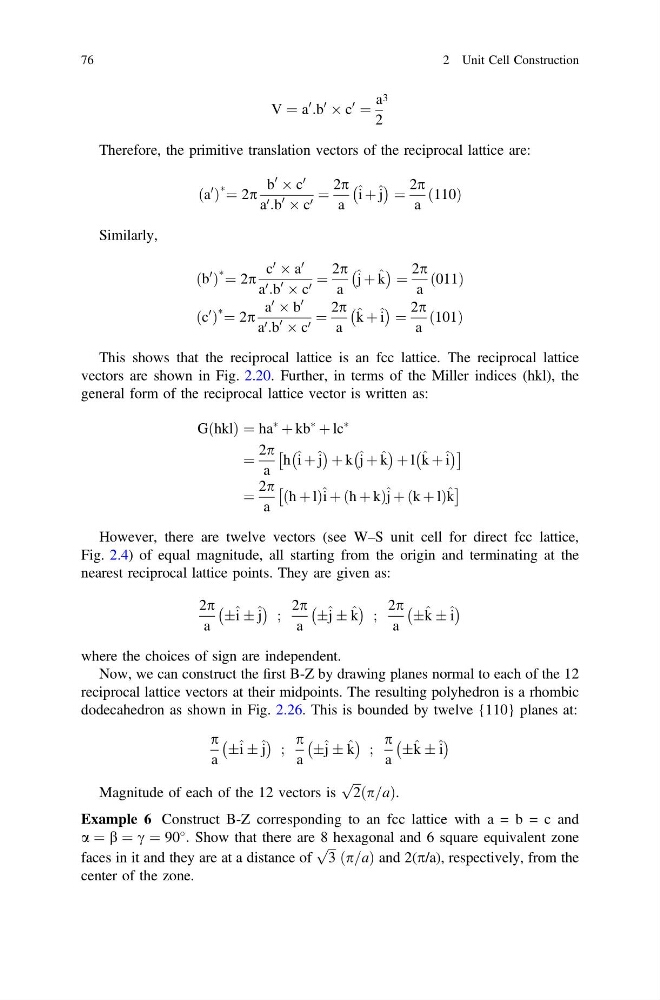
V ¼ a
0
:b
0
 c
0
¼
a
2
3
Therefore, the primitive translation vectors of the reciprocal lattice are:
a
0
ð Þ
à ¼ 2p
b
0
 c
0
a 0 :b
0
 c 0 ¼
2p
a
^ i þ ^ j
À
Á ¼
2p
a
110
ð
Þ
Similarly,
b
0
ð Þ
à ¼ 2p
c
0
 a
0
a 0 :b
0
 c 0 ¼
2p
a
^ j þ ^ k
À
Á ¼
2p
a
011
ð
Þ
c
0
ð Þ
à ¼ 2p
a
0
 b
0
a 0 :b
0
 c 0 ¼
2p
a
^ k þ ^ i
À
Á ¼
2p
a
101
ð
Þ
This shows that the reciprocal lattice is an fcc lattice. The reciprocal lattice
vectors are shown in Fig. 2.20. Further, in terms of the Miller indices (hkl), the
general form of the reciprocal lattice vector is written as:
GðhklÞ ¼ ha
Ã
þ kb
Ã
þ lc
Ã
¼
2p
a
h ^ i þ ^ j
À
Á þ k ^ j þ ^ k
À
Á þ l ^ k þ ^ i
À
Á
Â
Ã
¼
2p
a
h þ l
ð
Þ ^ i þ h þ k
ð
Þ ^ j þ k þ l
ð
Þ ^ k
Â
Ã
However, there are twelve vectors (see W–S unit cell for direct fcc lattice,
Fig. 2.4) of equal magnitude, all starting from the origin and terminating at the
nearest reciprocal lattice points. They are given as:
2p
a
Æ ^ i Æ ^ j
À
Á ;
2p
a
Æ ^ j Æ ^ k
À
Á ;
2p
a
Æ ^ k Æ ^ i
À
Á
where the choices of sign are independent.
Now, we can construct the first B-Z by drawing planes normal to each of the 12
reciprocal lattice vectors at their midpoints. The resulting polyhedron is a rhombic
dodecahedron as shown in Fig. 2.26. This is bounded by twelve {110} planes at:
p
a
Æ ^ i Æ ^ j
À
Á ;
p
a
Æ ^ j Æ ^ k
À
Á ;
p
a
Æ ^ k Æ ^ i
À
Á
Magnitude of each of the 12 vectors is
ffiffi ffi
2
p p=a
ð
Þ.
Example 6 Construct B-Z corresponding to an fcc lattice with a = b = c and
a ¼ b ¼ c ¼ 90
: Show that there are 8 hexagonal and 6 square equivalent zone
faces in it and they are at a distance of
ffiffi ffi
3
p p=a
ð
Þ and 2(p/a), respectively, from the
center of the zone.
76
2 Unit Cell Construction
0
:b
0
 c
0
¼
a
2
3
Therefore, the primitive translation vectors of the reciprocal lattice are:
a
0
ð Þ
à ¼ 2p
b
0
 c
0
a 0 :b
0
 c 0 ¼
2p
a
^ i þ ^ j
À
Á ¼
2p
a
110
ð
Þ
Similarly,
b
0
ð Þ
à ¼ 2p
c
0
 a
0
a 0 :b
0
 c 0 ¼
2p
a
^ j þ ^ k
À
Á ¼
2p
a
011
ð
Þ
c
0
ð Þ
à ¼ 2p
a
0
 b
0
a 0 :b
0
 c 0 ¼
2p
a
^ k þ ^ i
À
Á ¼
2p
a
101
ð
Þ
This shows that the reciprocal lattice is an fcc lattice. The reciprocal lattice
vectors are shown in Fig. 2.20. Further, in terms of the Miller indices (hkl), the
general form of the reciprocal lattice vector is written as:
GðhklÞ ¼ ha
Ã
þ kb
Ã
þ lc
Ã
¼
2p
a
h ^ i þ ^ j
À
Á þ k ^ j þ ^ k
À
Á þ l ^ k þ ^ i
À
Á
Â
Ã
¼
2p
a
h þ l
ð
Þ ^ i þ h þ k
ð
Þ ^ j þ k þ l
ð
Þ ^ k
Â
Ã
However, there are twelve vectors (see W–S unit cell for direct fcc lattice,
Fig. 2.4) of equal magnitude, all starting from the origin and terminating at the
nearest reciprocal lattice points. They are given as:
2p
a
Æ ^ i Æ ^ j
À
Á ;
2p
a
Æ ^ j Æ ^ k
À
Á ;
2p
a
Æ ^ k Æ ^ i
À
Á
where the choices of sign are independent.
Now, we can construct the first B-Z by drawing planes normal to each of the 12
reciprocal lattice vectors at their midpoints. The resulting polyhedron is a rhombic
dodecahedron as shown in Fig. 2.26. This is bounded by twelve {110} planes at:
p
a
Æ ^ i Æ ^ j
À
Á ;
p
a
Æ ^ j Æ ^ k
À
Á ;
p
a
Æ ^ k Æ ^ i
À
Á
Magnitude of each of the 12 vectors is
ffiffi ffi
2
p p=a
ð
Þ.
Example 6 Construct B-Z corresponding to an fcc lattice with a = b = c and
a ¼ b ¼ c ¼ 90
: Show that there are 8 hexagonal and 6 square equivalent zone
faces in it and they are at a distance of
ffiffi ffi
3
p p=a
ð
Þ and 2(p/a), respectively, from the
center of the zone.
76
2 Unit Cell Construction