

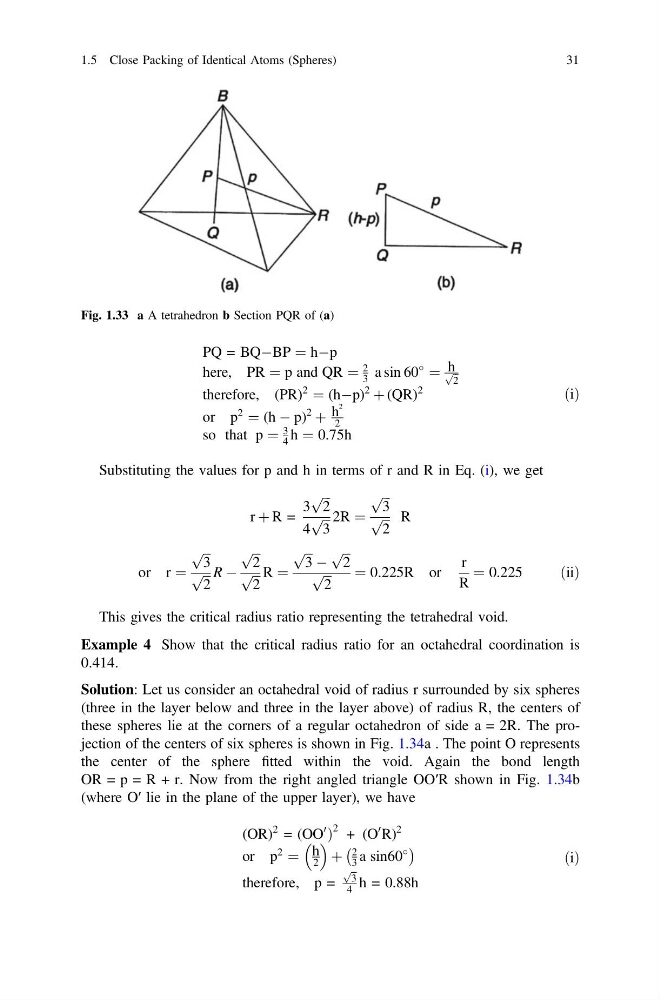
Fig. 1.33 a A tetrahedron b Section PQR of (a)
PQ = BQÀBP ¼ hÀp
here, PR ¼ p and QR ¼
2
3 a sin 60
¼ h ffiffi
2
p
therefore, (PR)
2
¼ (hÀp)
2
þ (QR)
2
or p
2
¼ (h À p)
2
þ h
2
2
so that p ¼
3
4 h ¼ 0.75h
ðiÞ
Substituting the values for p and h in terms of r and R in Eq. (i), we get
r þ R =
3
ffiffi ffi
2
p
4
ffiffi ffi
3
p 2R ¼
ffiffi ffi
3
p
ffiffi ffi
2
p R
or r ¼
ffiffi ffi
3
p
ffiffi ffi
2
p R À
ffiffi ffi
2
p
ffiffi ffi
2
p R ¼
ffiffi ffi
3
p À
ffiffi ffi
2
p
ffiffi ffi
2
p
¼ 0.225R or
r
R
¼ 0.225
ðiiÞ
This gives the critical radius ratio representing the tetrahedral void.
Example 4 Show that the critical radius ratio for an octahedral coordination is
0.414.
Solution: Let us consider an octahedral void of radius r surrounded by six spheres
(three in the layer below and three in the layer above) of radius R, the centers of
these spheres lie at the corners of a regular octahedron of side a = 2R. The projection of the centers of six spheres is shown in Fig. 1.34a . The point O represents
the center of the sphere fitted within the void. Again the bond length
OR = p = R + r. Now from the right angled triangle OO′R shown in Fig. 1.34b
(where O′ lie in the plane of the upper layer), we have
(OR)
2 = (OO
0
Þ
2 + (O
0 R)
2
or p
2
¼ h
2
þ
2
3 a sin60
À
Á
therefore, p =
ffiffi
3
p
4 h = 0.88h
ðiÞ
1.5 Close Packing of Identical Atoms (Spheres)
31
PQ = BQÀBP ¼ hÀp
here, PR ¼ p and QR ¼
2
3 a sin 60
¼ h ffiffi
2
p
therefore, (PR)
2
¼ (hÀp)
2
þ (QR)
2
or p
2
¼ (h À p)
2
þ h
2
2
so that p ¼
3
4 h ¼ 0.75h
ðiÞ
Substituting the values for p and h in terms of r and R in Eq. (i), we get
r þ R =
3
ffiffi ffi
2
p
4
ffiffi ffi
3
p 2R ¼
ffiffi ffi
3
p
ffiffi ffi
2
p R
or r ¼
ffiffi ffi
3
p
ffiffi ffi
2
p R À
ffiffi ffi
2
p
ffiffi ffi
2
p R ¼
ffiffi ffi
3
p À
ffiffi ffi
2
p
ffiffi ffi
2
p
¼ 0.225R or
r
R
¼ 0.225
ðiiÞ
This gives the critical radius ratio representing the tetrahedral void.
Example 4 Show that the critical radius ratio for an octahedral coordination is
0.414.
Solution: Let us consider an octahedral void of radius r surrounded by six spheres
(three in the layer below and three in the layer above) of radius R, the centers of
these spheres lie at the corners of a regular octahedron of side a = 2R. The projection of the centers of six spheres is shown in Fig. 1.34a . The point O represents
the center of the sphere fitted within the void. Again the bond length
OR = p = R + r. Now from the right angled triangle OO′R shown in Fig. 1.34b
(where O′ lie in the plane of the upper layer), we have
(OR)
2 = (OO
0
Þ
2 + (O
0 R)
2
or p
2
¼ h
2
þ
2
3 a sin60
À
Á
therefore, p =
ffiffi
3
p
4 h = 0.88h
ðiÞ
1.5 Close Packing of Identical Atoms (Spheres)
31