

The number of tetrahedral and octahedral voids associated per sphere in a close
packing of identical atoms can be obtained by using the following procedure:
(i) Consider a reference sphere, around which there are six triangular voids
(three alternate voids are of the same kind).
(ii) When the next layer is placed, only three voids of one kind are occupied.
They become tetrahedral voids and other three become octahedral voids.
This gives us three tetrahedral and three octahedral voids.
(iii) Similar is the situation when a layer below the reference layer is considered.
This also gives us three tetrahedral and three octahedral voids.
(iv) The reference layer also covers a triangular void in the layer above it and
another in the layer below it. This gives us two tetrahedral voids.
Therefore, each sphere is surrounded by
3 þ 3 ¼ 6 octahedral voids and 3 þ 3 þ 2 ¼ 8 tetrahedral voids
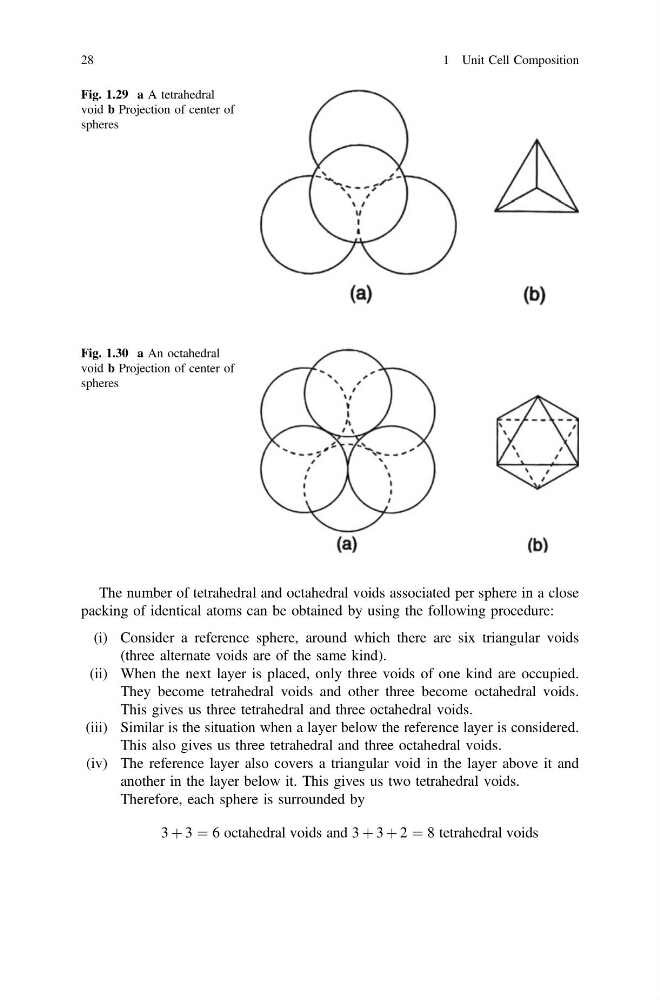
Fig. 1.29 a A tetrahedral
void b Projection of center of
spheres
Fig. 1.30 a An octahedral
void b Projection of center of
spheres
28
1 Unit Cell Composition
packing of identical atoms can be obtained by using the following procedure:
(i) Consider a reference sphere, around which there are six triangular voids
(three alternate voids are of the same kind).
(ii) When the next layer is placed, only three voids of one kind are occupied.
They become tetrahedral voids and other three become octahedral voids.
This gives us three tetrahedral and three octahedral voids.
(iii) Similar is the situation when a layer below the reference layer is considered.
This also gives us three tetrahedral and three octahedral voids.
(iv) The reference layer also covers a triangular void in the layer above it and
another in the layer below it. This gives us two tetrahedral voids.
Therefore, each sphere is surrounded by
3 þ 3 ¼ 6 octahedral voids and 3 þ 3 þ 2 ¼ 8 tetrahedral voids
Fig. 1.29 a A tetrahedral
void b Projection of center of
spheres
Fig. 1.30 a An octahedral
void b Projection of center of
spheres
28
1 Unit Cell Composition