

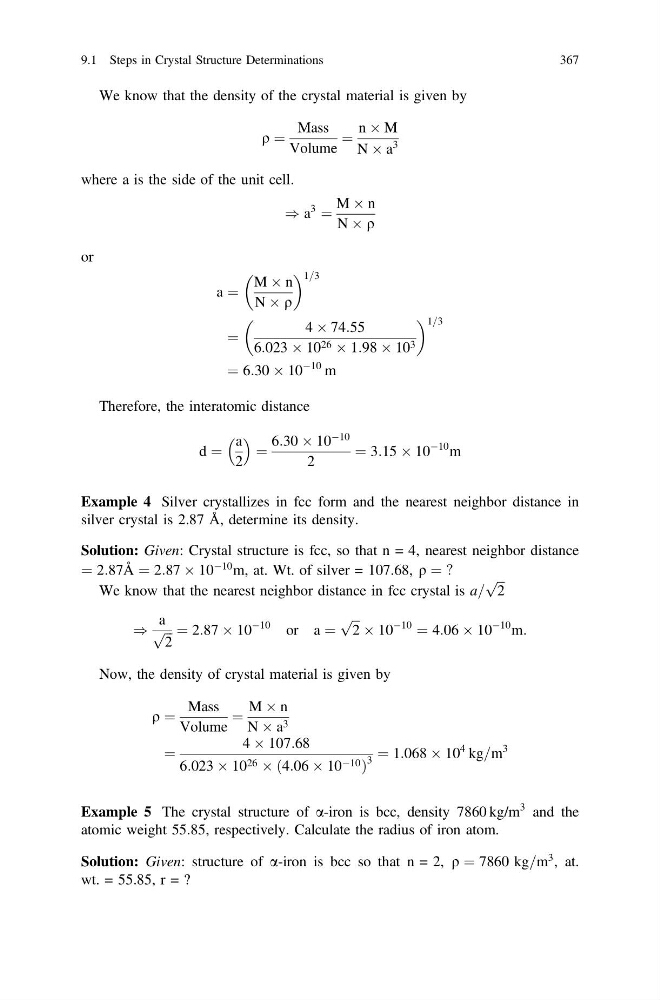
We know that the density of the crystal material is given by
q ¼
Mass
Volume
¼
n  M
N Â a
3
where a is the side of the unit cell.
) a
3
¼
M Â n
N Â q
or
a ¼
M Â n
N Â q
1=3
¼
4 Â 74:55
6:023 Â 10 26 Â 1:98 Â 10 3
1=3
¼ 6:30 Â 10
À10 m
Therefore, the interatomic distance
d ¼
a
2
¼
6:30 Â 10
À10
2
¼ 3:15 Â 10
À10 m
Example 4 Silver crystallizes in fcc form and the nearest neighbor distance in
silver crystal is 2.87 Å, determine its density.
Solution: Given: Crystal structure is fcc, so that n = 4, nearest neighbor distance
¼ 2:87 ˚
A ¼ 2:87 Â 10
À10 m, at. Wt. of silver = 107.68, q ¼ ?
We know that the nearest neighbor distance in fcc crystal is a=
ffiffi ffi
2
p
)
a
ffiffi ffi
2
p ¼ 2:87 Â 10
À10
or a ¼
ffiffi ffi
2
p  10
À10
¼ 4:06 Â 10
À10 m:
Now, the density of crystal material is given by
q ¼
Mass
Volume
¼
M Â n
N Â a 3
¼
4 Â 107:68
6:023 Â 10 26 Â 4:06 Â 10 À10
ð
Þ
3
¼ 1:068 Â 10
4 kg=m
3
Example 5 The crystal structure of a-iron is bcc, density 7860 kg/m
3 and the
atomic weight 55.85, respectively. Calculate the radius of iron atom.
Solution: Given: structure of a-iron is bcc so that n = 2, q ¼ 7860 kg=m
3 , at.
wt. = 55.85, r = ?
9.1 Steps in Crystal Structure Determinations
367
q ¼
Mass
Volume
¼
n  M
N Â a
3
where a is the side of the unit cell.
) a
3
¼
M Â n
N Â q
or
a ¼
M Â n
N Â q
1=3
¼
4 Â 74:55
6:023 Â 10 26 Â 1:98 Â 10 3
1=3
¼ 6:30 Â 10
À10 m
Therefore, the interatomic distance
d ¼
a
2
¼
6:30 Â 10
À10
2
¼ 3:15 Â 10
À10 m
Example 4 Silver crystallizes in fcc form and the nearest neighbor distance in
silver crystal is 2.87 Å, determine its density.
Solution: Given: Crystal structure is fcc, so that n = 4, nearest neighbor distance
¼ 2:87 ˚
A ¼ 2:87 Â 10
À10 m, at. Wt. of silver = 107.68, q ¼ ?
We know that the nearest neighbor distance in fcc crystal is a=
ffiffi ffi
2
p
)
a
ffiffi ffi
2
p ¼ 2:87 Â 10
À10
or a ¼
ffiffi ffi
2
p  10
À10
¼ 4:06 Â 10
À10 m:
Now, the density of crystal material is given by
q ¼
Mass
Volume
¼
M Â n
N Â a 3
¼
4 Â 107:68
6:023 Â 10 26 Â 4:06 Â 10 À10
ð
Þ
3
¼ 1:068 Â 10
4 kg=m
3
Example 5 The crystal structure of a-iron is bcc, density 7860 kg/m
3 and the
atomic weight 55.85, respectively. Calculate the radius of iron atom.
Solution: Given: structure of a-iron is bcc so that n = 2, q ¼ 7860 kg=m
3 , at.
wt. = 55.85, r = ?
9.1 Steps in Crystal Structure Determinations
367