

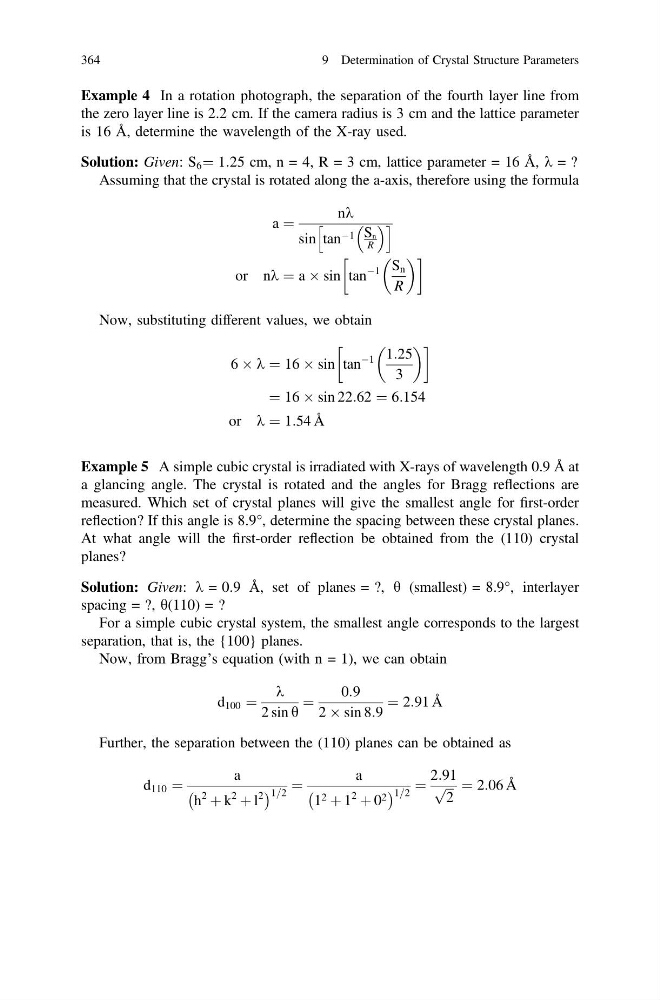
Example 4 In a rotation photograph, the separation of the fourth layer line from
the zero layer line is 2.2 cm. If the camera radius is 3 cm and the lattice parameter
is 16 Å, determine the wavelength of the X-ray used.
Solution: Given: S 6 ¼ 1:25 cm, n = 4, R = 3 cm, lattice parameter = 16 Å, k = ?
Assuming that the crystal is rotated along the a-axis, therefore using the formula
a ¼
nk
sin tan À1 S n
R
h
i
or nk ¼ a  sin tan
À1 S n
R
!
Now, substituting different values, we obtain
6 Â k ¼ 16 Â sin tan
À1 1:25
3
!
¼ 16 Â sin 22:62 ¼ 6:154
or k ¼ 1:54 ˚
A
Example 5 A simple cubic crystal is irradiated with X-rays of wavelength 0.9 Å at
a glancing angle. The crystal is rotated and the angles for Bragg reflections are
measured. Which set of crystal planes will give the smallest angle for first-order
reflection? If this angle is 8.9°, determine the spacing between these crystal planes.
At what angle will the first-order reflection be obtained from the (110) crystal
planes?
Solution: Given: k = 0.9 Å, set of planes = ?, h (smallest) = 8.9°, interlayer
spacing = ?, h(110) = ?
For a simple cubic crystal system, the smallest angle corresponds to the largest
separation, that is, the {100} planes.
Now, from Bragg’s equation (with n = 1), we can obtain
d 100 ¼
k
2 sin h
¼
0:9
2 Â sin 8:9
¼ 2:91 ˚
A
Further, the separation between the (110) planes can be obtained as
d 110 ¼
a
h
2
þ k
2
þ l
2
À
Á 1=2 ¼
a
1 2 þ 1
2
þ 0 2
À
Á 1=2 ¼
2:91
ffiffi ffi
2
p ¼ 2:06 ˚
A
364
9 Determination of Crystal Structure Parameters
the zero layer line is 2.2 cm. If the camera radius is 3 cm and the lattice parameter
is 16 Å, determine the wavelength of the X-ray used.
Solution: Given: S 6 ¼ 1:25 cm, n = 4, R = 3 cm, lattice parameter = 16 Å, k = ?
Assuming that the crystal is rotated along the a-axis, therefore using the formula
a ¼
nk
sin tan À1 S n
R
h
i
or nk ¼ a  sin tan
À1 S n
R
!
Now, substituting different values, we obtain
6 Â k ¼ 16 Â sin tan
À1 1:25
3
!
¼ 16 Â sin 22:62 ¼ 6:154
or k ¼ 1:54 ˚
A
Example 5 A simple cubic crystal is irradiated with X-rays of wavelength 0.9 Å at
a glancing angle. The crystal is rotated and the angles for Bragg reflections are
measured. Which set of crystal planes will give the smallest angle for first-order
reflection? If this angle is 8.9°, determine the spacing between these crystal planes.
At what angle will the first-order reflection be obtained from the (110) crystal
planes?
Solution: Given: k = 0.9 Å, set of planes = ?, h (smallest) = 8.9°, interlayer
spacing = ?, h(110) = ?
For a simple cubic crystal system, the smallest angle corresponds to the largest
separation, that is, the {100} planes.
Now, from Bragg’s equation (with n = 1), we can obtain
d 100 ¼
k
2 sin h
¼
0:9
2 Â sin 8:9
¼ 2:91 ˚
A
Further, the separation between the (110) planes can be obtained as
d 110 ¼
a
h
2
þ k
2
þ l
2
À
Á 1=2 ¼
a
1 2 þ 1
2
þ 0 2
À
Á 1=2 ¼
2:91
ffiffi ffi
2
p ¼ 2:06 ˚
A
364
9 Determination of Crystal Structure Parameters