

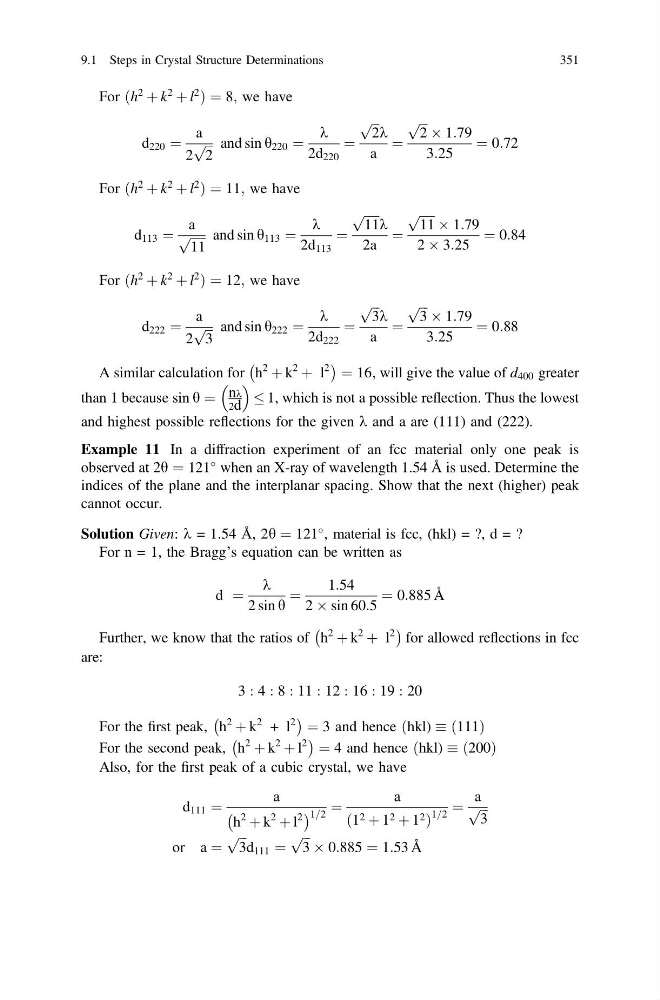
For h
2
þ k
2
þ l
2
ð
Þ¼8; we have
d 220 ¼
a
2
ffiffi ffi
2
p and sin h 220 ¼
k
2d 220
¼
ffiffi ffi
2
p k
a
¼
ffiffi ffi
2
p  1:79
3:25
¼ 0:72
For h
2
þ k
2
þ l
2
ð
Þ¼11; we have
d 113 ¼
a
ffiffiffiffiffi
11
p
and sin h 113 ¼
k
2d 113
¼
ffiffiffiffiffi
11
p k
2a
¼
ffiffiffiffiffi
11
p  1:79
2 Â 3:25
¼ 0:84
For h
2
þ k
2
þ l
2
ð
Þ¼12; we have
d 222 ¼
a
2
ffiffi ffi
3
p and sin h 222 ¼
k
2d 222
¼
ffiffi ffi
3
p k
a
¼
ffiffi ffi
3
p  1:79
3:25
¼ 0:88
A similar calculation for h
2
þ k
2
þ l
2
À
Á ¼ 16; will give the value of d 400 greater
than 1 because sin h ¼ nk
2d
1, which is not a possible reflection. Thus the lowest
and highest possible reflections for the given k and a are (111) and (222).
Example 11 In a diffraction experiment of an fcc material only one peak is
observed at 2h ¼ 121
when an X-ray of wavelength 1.54 Å is used. Determine the
indices of the plane and the interplanar spacing. Show that the next (higher) peak
cannot occur.
Solution Given: k = 1.54 Å, 2h ¼ 121
, material is fcc, (hkl) = ?, d = ?
For n = 1, the Bragg’s equation can be written as
d ¼
k
2 sin h
¼
1:54
2 Â sin 60:5
¼ 0:885 ˚
A
Further, we know that the ratios of h
2
þ k
2
þ l
2
À
Á
for allowed reflections in fcc
are:
3 : 4 : 8 : 11 : 12 : 16 : 19 : 20
For the first peak, h
2
þ k
2 + l
2
À
Á ¼ 3 and hence ðhkl) ð111Þ
For the second peak, h
2
þ k
2
þ l
2
À
Á ¼ 4 and hence ðhkl) ð200Þ
Also, for the first peak of a cubic crystal, we have
d 111 ¼
a
h
2
þ k
2
þ l
2
À
Á 1=2 ¼
a
1 2 þ 1 2 þ 1 2
ð
Þ
1=2
¼
a
ffiffi ffi
3
p
or a ¼
ffiffi ffi
3
p
d 111 ¼
ffiffi ffi
3
p  0:885 ¼ 1:53 ˚
A
9.1 Steps in Crystal Structure Determinations
351
2
þ k
2
þ l
2
ð
Þ¼8; we have
d 220 ¼
a
2
ffiffi ffi
2
p and sin h 220 ¼
k
2d 220
¼
ffiffi ffi
2
p k
a
¼
ffiffi ffi
2
p  1:79
3:25
¼ 0:72
For h
2
þ k
2
þ l
2
ð
Þ¼11; we have
d 113 ¼
a
ffiffiffiffiffi
11
p
and sin h 113 ¼
k
2d 113
¼
ffiffiffiffiffi
11
p k
2a
¼
ffiffiffiffiffi
11
p  1:79
2 Â 3:25
¼ 0:84
For h
2
þ k
2
þ l
2
ð
Þ¼12; we have
d 222 ¼
a
2
ffiffi ffi
3
p and sin h 222 ¼
k
2d 222
¼
ffiffi ffi
3
p k
a
¼
ffiffi ffi
3
p  1:79
3:25
¼ 0:88
A similar calculation for h
2
þ k
2
þ l
2
À
Á ¼ 16; will give the value of d 400 greater
than 1 because sin h ¼ nk
2d
1, which is not a possible reflection. Thus the lowest
and highest possible reflections for the given k and a are (111) and (222).
Example 11 In a diffraction experiment of an fcc material only one peak is
observed at 2h ¼ 121
when an X-ray of wavelength 1.54 Å is used. Determine the
indices of the plane and the interplanar spacing. Show that the next (higher) peak
cannot occur.
Solution Given: k = 1.54 Å, 2h ¼ 121
, material is fcc, (hkl) = ?, d = ?
For n = 1, the Bragg’s equation can be written as
d ¼
k
2 sin h
¼
1:54
2 Â sin 60:5
¼ 0:885 ˚
A
Further, we know that the ratios of h
2
þ k
2
þ l
2
À
Á
for allowed reflections in fcc
are:
3 : 4 : 8 : 11 : 12 : 16 : 19 : 20
For the first peak, h
2
þ k
2 + l
2
À
Á ¼ 3 and hence ðhkl) ð111Þ
For the second peak, h
2
þ k
2
þ l
2
À
Á ¼ 4 and hence ðhkl) ð200Þ
Also, for the first peak of a cubic crystal, we have
d 111 ¼
a
h
2
þ k
2
þ l
2
À
Á 1=2 ¼
a
1 2 þ 1 2 þ 1 2
ð
Þ
1=2
¼
a
ffiffi ffi
3
p
or a ¼
ffiffi ffi
3
p
d 111 ¼
ffiffi ffi
3
p  0:885 ¼ 1:53 ˚
A
9.1 Steps in Crystal Structure Determinations
351