

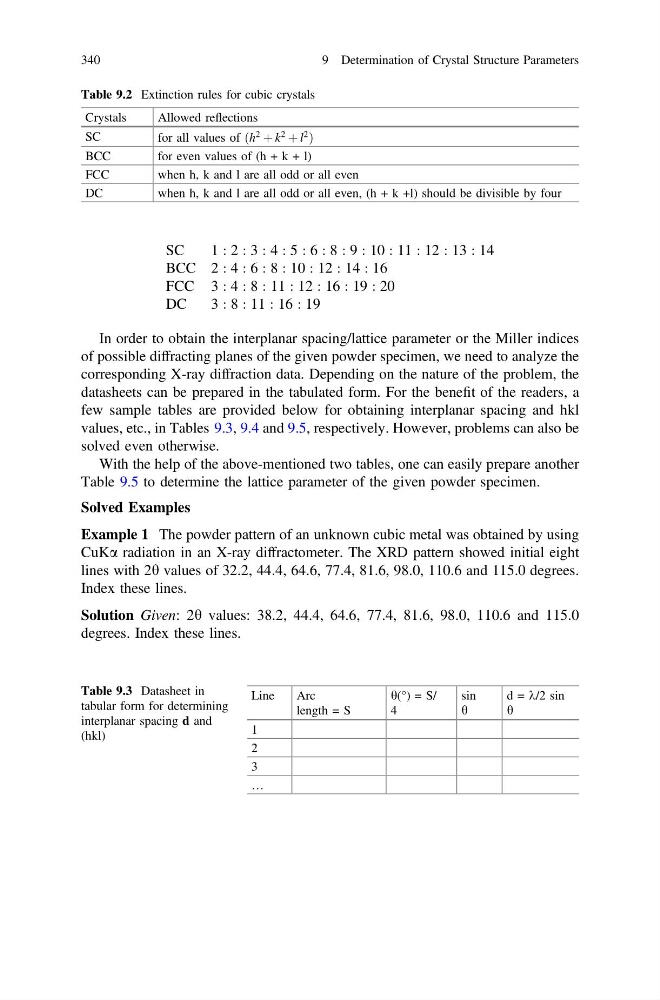
SC
1 : 2 : 3 : 4 : 5 : 6 : 8 : 9 : 10 : 11 : 12 : 13 : 14
BCC 2 : 4 : 6 : 8 : 10 : 12 : 14 : 16
FCC 3 : 4 : 8 : 11 : 12 : 16 : 19 : 20
DC
3 : 8 : 11 : 16 : 19
In order to obtain the interplanar spacing/lattice parameter or the Miller indices
of possible diffracting planes of the given powder specimen, we need to analyze the
corresponding X-ray diffraction data. Depending on the nature of the problem, the
datasheets can be prepared in the tabulated form. For the benefit of the readers, a
few sample tables are provided below for obtaining interplanar spacing and hkl
values, etc., in Tables 9.3, 9.4 and 9.5, respectively. However, problems can also be
solved even otherwise.
With the help of the above-mentioned two tables, one can easily prepare another
Table 9.5 to determine the lattice parameter of the given powder specimen.
Solved Examples
Example 1 The powder pattern of an unknown cubic metal was obtained by using
CuKa radiation in an X-ray diffractometer. The XRD pattern showed initial eight
lines with 2h values of 32.2, 44.4, 64.6, 77.4, 81.6, 98.0, 110.6 and 115.0 degrees.
Index these lines.
Solution Given: 2h values: 38.2, 44.4, 64.6, 77.4, 81.6, 98.0, 110.6 and 115.0
degrees. Index these lines.
Table 9.2 Extinction rules for cubic crystals
Crystals
Allowed reflections
SC
for all values of h
2 þ k
2 þ l
2
ð
Þ
BCC
for even values of (h + k + l)
FCC
when h, k and l are all odd or all even
DC
when h, k and l are all odd or all even, (h + k +l) should be divisible by four
Table 9.3 Datasheet in
tabular form for determining
interplanar spacing d and
(hkl)
Line
Arc
length = S
h(°) = S/
4
sin
h
d = k/2 sin
h
1
2
3
…
340
9 Determination of Crystal Structure Parameters
1 : 2 : 3 : 4 : 5 : 6 : 8 : 9 : 10 : 11 : 12 : 13 : 14
BCC 2 : 4 : 6 : 8 : 10 : 12 : 14 : 16
FCC 3 : 4 : 8 : 11 : 12 : 16 : 19 : 20
DC
3 : 8 : 11 : 16 : 19
In order to obtain the interplanar spacing/lattice parameter or the Miller indices
of possible diffracting planes of the given powder specimen, we need to analyze the
corresponding X-ray diffraction data. Depending on the nature of the problem, the
datasheets can be prepared in the tabulated form. For the benefit of the readers, a
few sample tables are provided below for obtaining interplanar spacing and hkl
values, etc., in Tables 9.3, 9.4 and 9.5, respectively. However, problems can also be
solved even otherwise.
With the help of the above-mentioned two tables, one can easily prepare another
Table 9.5 to determine the lattice parameter of the given powder specimen.
Solved Examples
Example 1 The powder pattern of an unknown cubic metal was obtained by using
CuKa radiation in an X-ray diffractometer. The XRD pattern showed initial eight
lines with 2h values of 32.2, 44.4, 64.6, 77.4, 81.6, 98.0, 110.6 and 115.0 degrees.
Index these lines.
Solution Given: 2h values: 38.2, 44.4, 64.6, 77.4, 81.6, 98.0, 110.6 and 115.0
degrees. Index these lines.
Table 9.2 Extinction rules for cubic crystals
Crystals
Allowed reflections
SC
for all values of h
2 þ k
2 þ l
2
ð
Þ
BCC
for even values of (h + k + l)
FCC
when h, k and l are all odd or all even
DC
when h, k and l are all odd or all even, (h + k +l) should be divisible by four
Table 9.3 Datasheet in
tabular form for determining
interplanar spacing d and
(hkl)
Line
Arc
length = S
h(°) = S/
4
sin
h
d = k/2 sin
h
1
2
3
…
340
9 Determination of Crystal Structure Parameters