

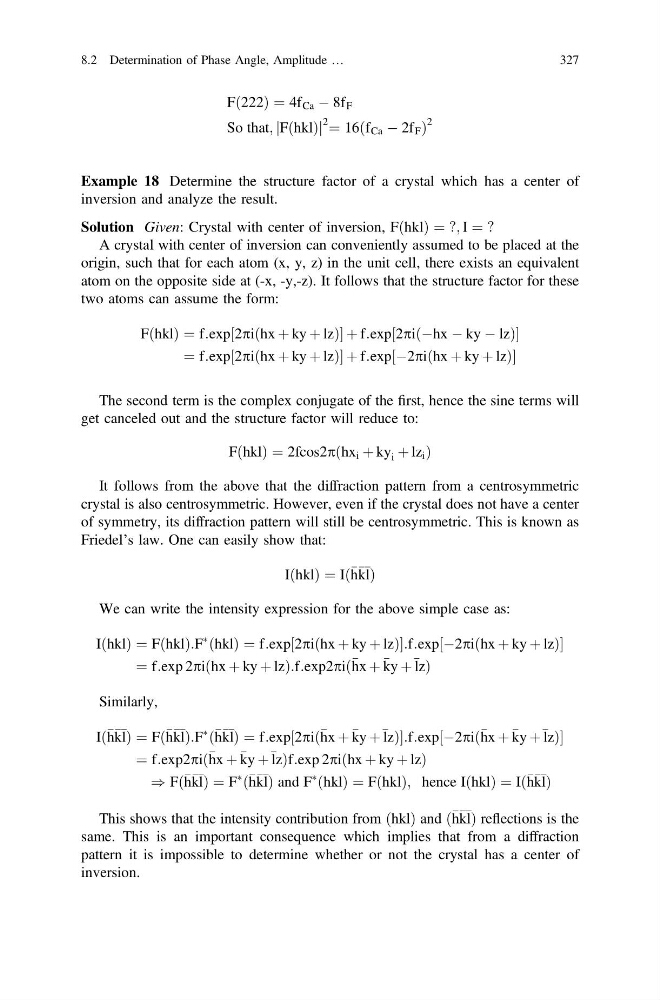
F 222
ð
Þ ¼ 4f Ca À 8f F
So that; F hkl
ð Þ
j
j
2 ¼ 16 f Ca À 2f F
ð
Þ
2
Example 18 Determine the structure factor of a crystal which has a center of
inversion and analyze the result.
Solution Given: Crystal with center of inversion, F hkl
ð Þ ¼ ?; I ¼ ?
A crystal with center of inversion can conveniently assumed to be placed at the
origin, such that for each atom (x, y, z) in the unit cell, there exists an equivalent
atom on the opposite side at (-x, -y,-z). It follows that the structure factor for these
two atoms can assume the form:
F hkl
ð Þ ¼ f:exp 2pi hx þ ky þ lz
ð
Þ
½
þ f:exp 2pi Àhx À ky À lz
ð
Þ
½
¼ f:exp 2pi hx þ ky þ lz
ð
Þ
½
þ f:exp À2pi hx þ ky þ lz
ð
Þ
½
The second term is the complex conjugate of the first, hence the sine terms will
get canceled out and the structure factor will reduce to:
F hkl
ð Þ ¼ 2fcos2p hx i þ ky i þ lz i
ð
Þ
It follows from the above that the diffraction pattern from a centrosymmetric
crystal is also centrosymmetric. However, even if the crystal does not have a center
of symmetry, its diffraction pattern will still be centrosymmetric. This is known as
Friedel’s law. One can easily show that:
I hkl
ð Þ ¼ Ið h k lÞ
We can write the intensity expression for the above simple case as:
I hkl
ð Þ ¼ F hkl
ð Þ:F
à hkl
ð Þ ¼ f:exp 2pi hx þ ky þ lz
ð
Þ
½
:f:exp À2pi hx þ ky þ lz
ð
Þ
½
¼ f:exp 2pi hx þ ky þ lz
ð
Þ :f:exp2pi hx þ ky þ lz
ð
Þ
Similarly,
Ið h k lÞ ¼ Fð h k lÞ:F
Ã
ð h k lÞ ¼ f:exp 2pi hx þ ky þ lz
ð
Þ
½
:f:exp À2pi hx þ ky þ lz
ð
Þ
½
¼ f:exp2pi hx þ ky þ lz
ð
Þ f:exp 2pi hx þ ky þ lz
ð
Þ
) F h k l
ð Þ ¼ F
à h k l
ð Þ and F
à hkl
ð Þ ¼ F hkl
ð Þ; hence I hkl
ð Þ ¼ Ið h k lÞ
This shows that the intensity contribution from hkl
ð Þ and ð h k lÞ reflections is the
same. This is an important consequence which implies that from a diffraction
pattern it is impossible to determine whether or not the crystal has a center of
inversion.
8.2 Determination of Phase Angle, Amplitude …
327
ð
Þ ¼ 4f Ca À 8f F
So that; F hkl
ð Þ
j
j
2 ¼ 16 f Ca À 2f F
ð
Þ
2
Example 18 Determine the structure factor of a crystal which has a center of
inversion and analyze the result.
Solution Given: Crystal with center of inversion, F hkl
ð Þ ¼ ?; I ¼ ?
A crystal with center of inversion can conveniently assumed to be placed at the
origin, such that for each atom (x, y, z) in the unit cell, there exists an equivalent
atom on the opposite side at (-x, -y,-z). It follows that the structure factor for these
two atoms can assume the form:
F hkl
ð Þ ¼ f:exp 2pi hx þ ky þ lz
ð
Þ
½
þ f:exp 2pi Àhx À ky À lz
ð
Þ
½
¼ f:exp 2pi hx þ ky þ lz
ð
Þ
½
þ f:exp À2pi hx þ ky þ lz
ð
Þ
½
The second term is the complex conjugate of the first, hence the sine terms will
get canceled out and the structure factor will reduce to:
F hkl
ð Þ ¼ 2fcos2p hx i þ ky i þ lz i
ð
Þ
It follows from the above that the diffraction pattern from a centrosymmetric
crystal is also centrosymmetric. However, even if the crystal does not have a center
of symmetry, its diffraction pattern will still be centrosymmetric. This is known as
Friedel’s law. One can easily show that:
I hkl
ð Þ ¼ Ið h k lÞ
We can write the intensity expression for the above simple case as:
I hkl
ð Þ ¼ F hkl
ð Þ:F
à hkl
ð Þ ¼ f:exp 2pi hx þ ky þ lz
ð
Þ
½
:f:exp À2pi hx þ ky þ lz
ð
Þ
½
¼ f:exp 2pi hx þ ky þ lz
ð
Þ :f:exp2pi hx þ ky þ lz
ð
Þ
Similarly,
Ið h k lÞ ¼ Fð h k lÞ:F
Ã
ð h k lÞ ¼ f:exp 2pi hx þ ky þ lz
ð
Þ
½
:f:exp À2pi hx þ ky þ lz
ð
Þ
½
¼ f:exp2pi hx þ ky þ lz
ð
Þ f:exp 2pi hx þ ky þ lz
ð
Þ
) F h k l
ð Þ ¼ F
à h k l
ð Þ and F
à hkl
ð Þ ¼ F hkl
ð Þ; hence I hkl
ð Þ ¼ Ið h k lÞ
This shows that the intensity contribution from hkl
ð Þ and ð h k lÞ reflections is the
same. This is an important consequence which implies that from a diffraction
pattern it is impossible to determine whether or not the crystal has a center of
inversion.
8.2 Determination of Phase Angle, Amplitude …
327