

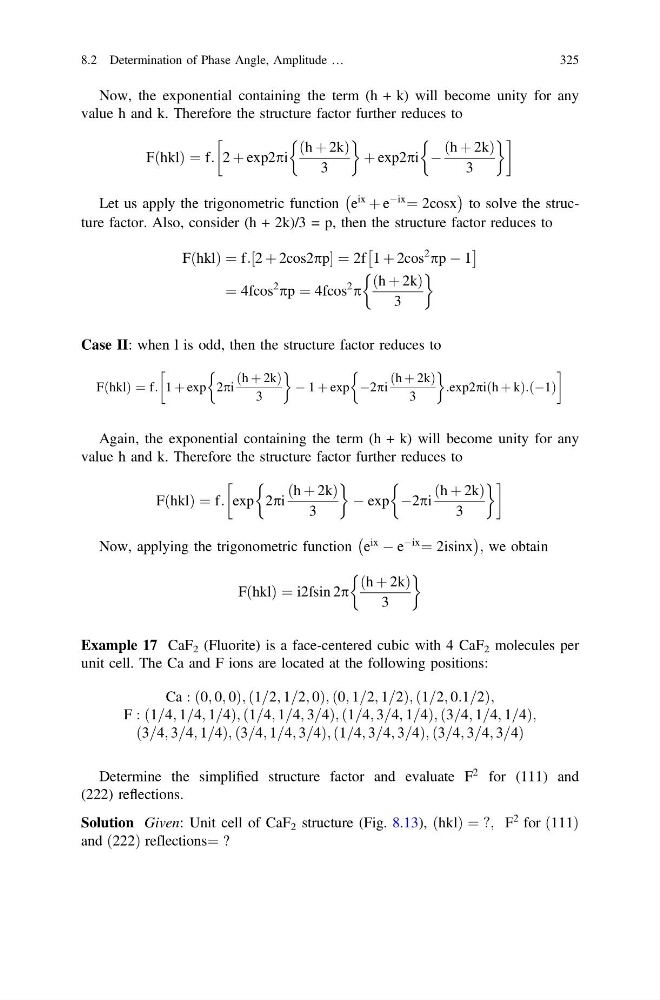
Now, the exponential containing the term (h + k) will become unity for any
value h and k. Therefore the structure factor further reduces to
F hkl
ð Þ ¼ f: 2 þ exp2pi
h þ 2k
ð
Þ
3
&
'
þ exp2pi À
h þ 2k
ð
Þ
3
&
' !
Let us apply the trigonometric function e
ix
þ e
Àix
¼ 2cosx
À
Á
to solve the structure factor. Also, consider (h + 2k)/3 = p, then the structure factor reduces to
F hkl
ð Þ ¼ f: 2 þ 2cos2pp
½
¼2f 1 þ 2cos
2
pp À 1
Â
Ã
¼ 4fcos
2
pp ¼ 4fcos
2
p
h þ 2k
ð
Þ
3
&
'
Case II: when l is odd, then the structure factor reduces to
F hkl
ð Þ ¼ f: 1 þ exp 2pi
h þ 2k
ð
Þ
3
&
'
À 1 þ exp À2pi
h þ 2k
ð
Þ
3
&
'
:exp2pi h þ k
ð
Þ:ðÀ1Þ
!
Again, the exponential containing the term (h + k) will become unity for any
value h and k. Therefore the structure factor further reduces to
F hkl
ð Þ ¼ f: exp 2pi
h þ 2k
ð
Þ
3
&
'
À exp À2pi
h þ 2k
ð
Þ
3
&
' !
Now, applying the trigonometric function e
ix
À e
Àix
¼ 2isinx
À
Á ; we obtain
F hkl
ð Þ ¼ i2fsin 2p
h þ 2k
ð
Þ
3
&
'
Example 17 CaF 2 (Fluorite) is a face-centered cubic with 4 CaF 2 molecules per
unit cell. The Ca and F ions are located at the following positions:
Ca : 0; 0; 0
ð
Þ; 1=2; 1=2; 0
ð
Þ ; 0; 1=2; 1=2
ð
Þ ; 1=2; 0:1=2
ð
Þ ;
F : 1=4; 1=4; 1=4
ð
Þ ; 1=4; 1=4; 3=4
ð
Þ ; 1=4; 3=4; 1=4
ð
Þ ; 3=4; 1=4; 1=4
ð
Þ ;
3=4; 3=4; 1=4
ð
Þ ; 3=4; 1=4; 3=4
ð
Þ ; 1=4; 3=4; 3=4
ð
Þ ; 3=4; 3=4; 3=4
ð
Þ
Determine the simplified structure factor and evaluate F
2 for (111) and
(222) reflections.
Solution Given: Unit cell of CaF 2 structure (Fig. 8.13), hkl
ð Þ ¼ ?; F
2 for ð111Þ
and ð222Þ reflections¼ ?
8.2 Determination of Phase Angle, Amplitude …
325
value h and k. Therefore the structure factor further reduces to
F hkl
ð Þ ¼ f: 2 þ exp2pi
h þ 2k
ð
Þ
3
&
'
þ exp2pi À
h þ 2k
ð
Þ
3
&
' !
Let us apply the trigonometric function e
ix
þ e
Àix
¼ 2cosx
À
Á
to solve the structure factor. Also, consider (h + 2k)/3 = p, then the structure factor reduces to
F hkl
ð Þ ¼ f: 2 þ 2cos2pp
½
¼2f 1 þ 2cos
2
pp À 1
Â
Ã
¼ 4fcos
2
pp ¼ 4fcos
2
p
h þ 2k
ð
Þ
3
&
'
Case II: when l is odd, then the structure factor reduces to
F hkl
ð Þ ¼ f: 1 þ exp 2pi
h þ 2k
ð
Þ
3
&
'
À 1 þ exp À2pi
h þ 2k
ð
Þ
3
&
'
:exp2pi h þ k
ð
Þ:ðÀ1Þ
!
Again, the exponential containing the term (h + k) will become unity for any
value h and k. Therefore the structure factor further reduces to
F hkl
ð Þ ¼ f: exp 2pi
h þ 2k
ð
Þ
3
&
'
À exp À2pi
h þ 2k
ð
Þ
3
&
' !
Now, applying the trigonometric function e
ix
À e
Àix
¼ 2isinx
À
Á ; we obtain
F hkl
ð Þ ¼ i2fsin 2p
h þ 2k
ð
Þ
3
&
'
Example 17 CaF 2 (Fluorite) is a face-centered cubic with 4 CaF 2 molecules per
unit cell. The Ca and F ions are located at the following positions:
Ca : 0; 0; 0
ð
Þ; 1=2; 1=2; 0
ð
Þ ; 0; 1=2; 1=2
ð
Þ ; 1=2; 0:1=2
ð
Þ ;
F : 1=4; 1=4; 1=4
ð
Þ ; 1=4; 1=4; 3=4
ð
Þ ; 1=4; 3=4; 1=4
ð
Þ ; 3=4; 1=4; 1=4
ð
Þ ;
3=4; 3=4; 1=4
ð
Þ ; 3=4; 1=4; 3=4
ð
Þ ; 1=4; 3=4; 3=4
ð
Þ ; 3=4; 3=4; 3=4
ð
Þ
Determine the simplified structure factor and evaluate F
2 for (111) and
(222) reflections.
Solution Given: Unit cell of CaF 2 structure (Fig. 8.13), hkl
ð Þ ¼ ?; F
2 for ð111Þ
and ð222Þ reflections¼ ?
8.2 Determination of Phase Angle, Amplitude …
325