

F hkl
ð Þ ¼ f C :
exp2pi h:0 þ k:0 þ l:0
ð
Þ þ exp2pi h:
1
2 þ k:
1
2 þ l:0
À
Á þ
exp2pi h:0 þ k:
1
2 þ l:
1
2
À
Á þ exp2pi h:
1
2 þ k:0 þ l:
1
2
À
Á þ
exp2pi h:
1
4 þ k:
1
4 þ l:
1
4
À
Á þ exp2pi h:
3
4 þ k:
3
4 þ l:
1
4
À
Á þ
exp2pi h:
1
4 þ k:
3
4 þ l:
3
4
À
Á þ exp2pi h:
3
4 þ k:
1
4 þ l:
3
4
À
Á
2
6
6
6
4
3
7
7
7
5
¼ f C : 1 þ exppi h þ k
ð
Þþexppi k þ l
ð
Þþexppi l þ h
ð
Þ
½
þ exp
pi h þ k þ l
ð
Þ
2
f: 1 þ exppi h þ k
ð
Þþexppi k þ l
ð
Þþexppi l þ h
ð
Þ
½
¼ f C : 1 þ exp
pi h þ k þ l
ð
Þ
2
: 1 þ exppi h þ k
ð
Þþexppi k þ l
ð
Þþexppi l þ h
ð
Þ
½
The terms within the bracket [ ] are identical as in fcc, hence the same criteria
will apply. That is when h, k, l are unmixed indices then the sum (h + k), (k + l)
and (l + h) are all even integers and the structure factor of fcc will be
F hkl
ð Þ ¼ f C 1 þ 1 þ 1 þ 1
½
¼4f C and I / F(hkl)
j
j
2 ¼ 16f
2
C
Further, if indices hkl are mixed, it can be seen that
F hkl
ð Þ ¼ 0; and I / F(hkl)
j
j
2 ¼ 0
Now considering the complete equation for unmixed hkl indices, we can write
F hkl
ð Þ ¼ 4f C þ 1 þ exp
pi h þ k þ l
ð
Þ
2
Since the exponent contains the term (h + k + l)/2 as a factor of π, which can be
a fraction. In order to overcome this difficulty, let us make use of the basic quantum
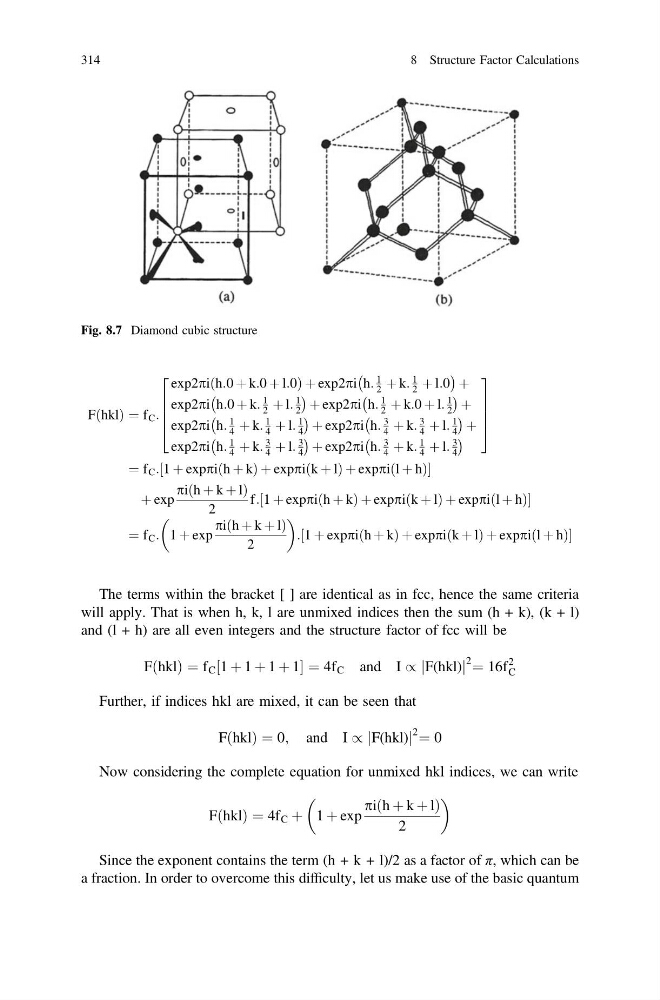
Fig. 8.7 Diamond cubic structure
314
8 Structure Factor Calculations
ð Þ ¼ f C :
exp2pi h:0 þ k:0 þ l:0
ð
Þ þ exp2pi h:
1
2 þ k:
1
2 þ l:0
À
Á þ
exp2pi h:0 þ k:
1
2 þ l:
1
2
À
Á þ exp2pi h:
1
2 þ k:0 þ l:
1
2
À
Á þ
exp2pi h:
1
4 þ k:
1
4 þ l:
1
4
À
Á þ exp2pi h:
3
4 þ k:
3
4 þ l:
1
4
À
Á þ
exp2pi h:
1
4 þ k:
3
4 þ l:
3
4
À
Á þ exp2pi h:
3
4 þ k:
1
4 þ l:
3
4
À
Á
2
6
6
6
4
3
7
7
7
5
¼ f C : 1 þ exppi h þ k
ð
Þþexppi k þ l
ð
Þþexppi l þ h
ð
Þ
½
þ exp
pi h þ k þ l
ð
Þ
2
f: 1 þ exppi h þ k
ð
Þþexppi k þ l
ð
Þþexppi l þ h
ð
Þ
½
¼ f C : 1 þ exp
pi h þ k þ l
ð
Þ
2
: 1 þ exppi h þ k
ð
Þþexppi k þ l
ð
Þþexppi l þ h
ð
Þ
½
The terms within the bracket [ ] are identical as in fcc, hence the same criteria
will apply. That is when h, k, l are unmixed indices then the sum (h + k), (k + l)
and (l + h) are all even integers and the structure factor of fcc will be
F hkl
ð Þ ¼ f C 1 þ 1 þ 1 þ 1
½
¼4f C and I / F(hkl)
j
j
2 ¼ 16f
2
C
Further, if indices hkl are mixed, it can be seen that
F hkl
ð Þ ¼ 0; and I / F(hkl)
j
j
2 ¼ 0
Now considering the complete equation for unmixed hkl indices, we can write
F hkl
ð Þ ¼ 4f C þ 1 þ exp
pi h þ k þ l
ð
Þ
2
Since the exponent contains the term (h + k + l)/2 as a factor of π, which can be
a fraction. In order to overcome this difficulty, let us make use of the basic quantum
Fig. 8.7 Diamond cubic structure
314
8 Structure Factor Calculations