

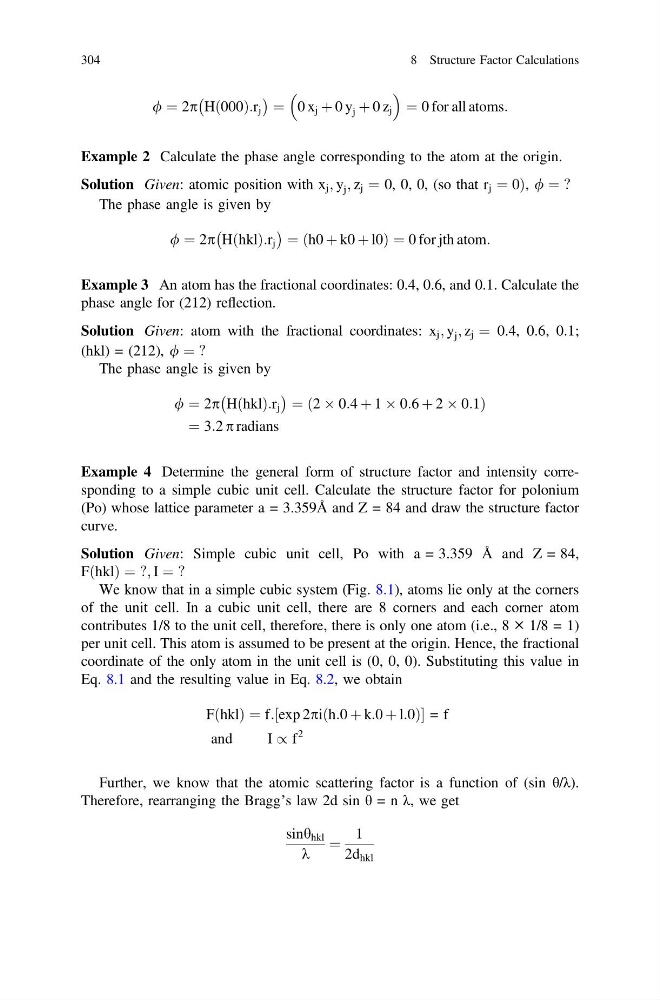
/ ¼ 2p H 000
ð
Þ:r j
À
Á ¼ 0 x j þ 0 y j þ 0 z j
¼ 0 for all atoms:
Example 2 Calculate the phase angle corresponding to the atom at the origin.
Solution Given: atomic position with x j ; y j ; z j ¼ 0, 0, 0, (so that r j ¼ 0Þ, / ¼ ?
The phase angle is given by
/ ¼ 2p H hkl
ð Þ:r j
À
Á ¼ h0 þ k0 þ l0
ð
Þ¼0 for jth atom:
Example 3 An atom has the fractional coordinates: 0.4, 0.6, and 0.1. Calculate the
phase angle for (212) reflection.
Solution Given: atom with the fractional coordinates: x j ; y j ; z j ¼ 0.4, 0.6, 0.1;
(hkl) = (212), / ¼ ?
The phase angle is given by
/ ¼ 2p H hkl
ð Þ:r j
À
Á ¼ 2 Â 0:4 þ 1 Â 0:6 þ 2 Â 0:1
ð
Þ
¼ 3:2 p radians
Example 4 Determine the general form of structure factor and intensity corresponding to a simple cubic unit cell. Calculate the structure factor for polonium
(Po) whose lattice parameter a = 3.359Å and Z = 84 and draw the structure factor
curve.
Solution Given: Simple cubic unit cell, Po with a = 3.359 Å and Z = 84,
F hkl
ð Þ ¼ ?; I ¼ ?
We know that in a simple cubic system (Fig. 8.1), atoms lie only at the corners
of the unit cell. In a cubic unit cell, there are 8 corners and each corner atom
contributes 1/8 to the unit cell, therefore, there is only one atom (i.e., 8 × 1/8 = 1)
per unit cell. This atom is assumed to be present at the origin. Hence, the fractional
coordinate of the only atom in the unit cell is (0, 0, 0). Substituting this value in
Eq. 8.1 and the resulting value in Eq. 8.2, we obtain
F hkl
ð Þ ¼ f: exp 2pi h:0 þ k:0 þ l:0
ð
Þ
½
= f
and
I / f
2
Further, we know that the atomic scattering factor is a function of (sin θ/λ).
Therefore, rearranging the Bragg’s law 2d sin θ = n λ, we get
sinh hkl
k
¼
1
2d hkl
304
8 Structure Factor Calculations
ð
Þ:r j
À
Á ¼ 0 x j þ 0 y j þ 0 z j
¼ 0 for all atoms:
Example 2 Calculate the phase angle corresponding to the atom at the origin.
Solution Given: atomic position with x j ; y j ; z j ¼ 0, 0, 0, (so that r j ¼ 0Þ, / ¼ ?
The phase angle is given by
/ ¼ 2p H hkl
ð Þ:r j
À
Á ¼ h0 þ k0 þ l0
ð
Þ¼0 for jth atom:
Example 3 An atom has the fractional coordinates: 0.4, 0.6, and 0.1. Calculate the
phase angle for (212) reflection.
Solution Given: atom with the fractional coordinates: x j ; y j ; z j ¼ 0.4, 0.6, 0.1;
(hkl) = (212), / ¼ ?
The phase angle is given by
/ ¼ 2p H hkl
ð Þ:r j
À
Á ¼ 2 Â 0:4 þ 1 Â 0:6 þ 2 Â 0:1
ð
Þ
¼ 3:2 p radians
Example 4 Determine the general form of structure factor and intensity corresponding to a simple cubic unit cell. Calculate the structure factor for polonium
(Po) whose lattice parameter a = 3.359Å and Z = 84 and draw the structure factor
curve.
Solution Given: Simple cubic unit cell, Po with a = 3.359 Å and Z = 84,
F hkl
ð Þ ¼ ?; I ¼ ?
We know that in a simple cubic system (Fig. 8.1), atoms lie only at the corners
of the unit cell. In a cubic unit cell, there are 8 corners and each corner atom
contributes 1/8 to the unit cell, therefore, there is only one atom (i.e., 8 × 1/8 = 1)
per unit cell. This atom is assumed to be present at the origin. Hence, the fractional
coordinate of the only atom in the unit cell is (0, 0, 0). Substituting this value in
Eq. 8.1 and the resulting value in Eq. 8.2, we obtain
F hkl
ð Þ ¼ f: exp 2pi h:0 þ k:0 þ l:0
ð
Þ
½
= f
and
I / f
2
Further, we know that the atomic scattering factor is a function of (sin θ/λ).
Therefore, rearranging the Bragg’s law 2d sin θ = n λ, we get
sinh hkl
k
¼
1
2d hkl
304
8 Structure Factor Calculations