

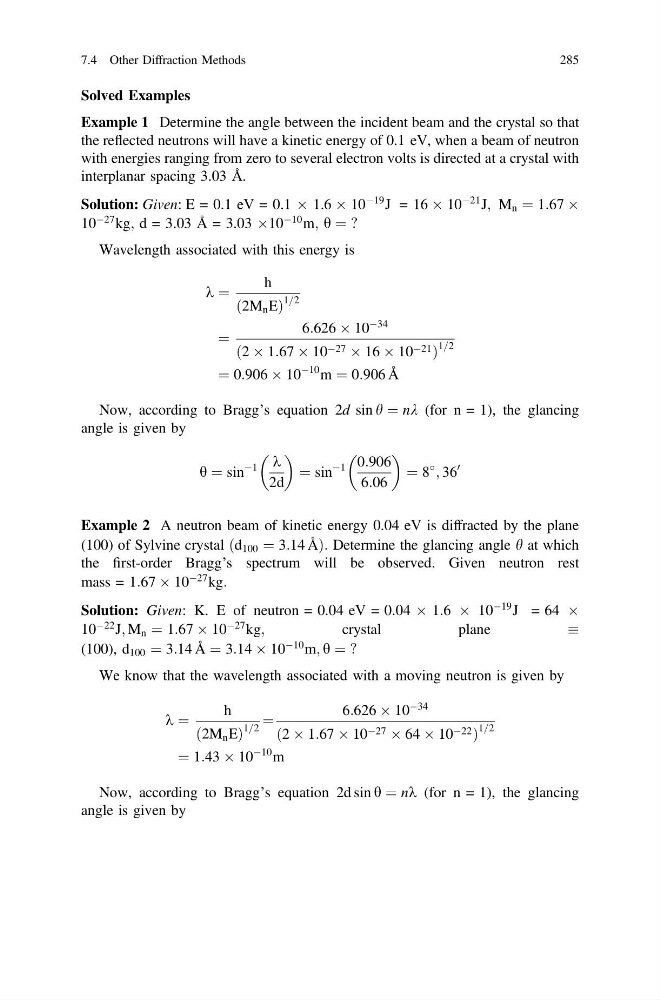
Solved Examples
Example 1 Determine the angle between the incident beam and the crystal so that
the reflected neutrons will have a kinetic energy of 0.1 eV, when a beam of neutron
with energies ranging from zero to several electron volts is directed at a crystal with
interplanar spacing 3.03 Å.
Solution: Given: E = 0.1 eV = 0.1 Â 1.6 Â 10
À19 J = 16 Â 10
À21 J; M n ¼ 1:67 Â
10
À27 kg; d = 3.03 Å = 3.03 Â10
À10 m; h ¼ ?
Wavelength associated with this energy is
k ¼
h
2M n E
ð
Þ
1=2
¼
6:626 Â 10
À34
2 Â 1:67 Â 10 À27 Â 16 Â 10 À21
ð
Þ
1=2
¼ 0:906 Â 10
À10 m ¼ 0:906 ˚
A
Now, according to Bragg’s equation 2d sin h ¼ nk (for n = 1), the glancing
angle is given by
h ¼ sin
À1 k
2d
¼ sin
À1 0:906
6:06
¼ 8
; 36
0
Example 2 A neutron beam of kinetic energy 0.04 eV is diffracted by the plane
(100) of Sylvine crystal ðd 100 ¼ 3:14 ˚
AÞ: Determine the glancing angle h at which
the first-order Bragg’s spectrum will be observed. Given neutron rest
mass = 1:67 Â 10
À27 kg:
Solution: Given: K. E of neutron = 0.04 eV = 0.04 Â 1.6 Â 10
À19 J = 64 Â
10
À22 J; M n ¼ 1:67 Â 10
À27 kg;
crystal
plane
(100), d 100 ¼ 3:14 ˚
A ¼ 3:14 Â 10
À10 m; h ¼ ?
We know that the wavelength associated with a moving neutron is given by
k ¼
h
2M n E
ð
Þ
1=2
¼
6:626 Â 10
À34
2 Â 1:67 Â 10 À27 Â 64 Â 10 À22
ð
Þ
1=2
¼ 1:43 Â 10
À10 m
Now, according to Bragg’s equation 2d sin h ¼ nk (for n = 1), the glancing
angle is given by
7.4 Other Diffraction Methods
285
Example 1 Determine the angle between the incident beam and the crystal so that
the reflected neutrons will have a kinetic energy of 0.1 eV, when a beam of neutron
with energies ranging from zero to several electron volts is directed at a crystal with
interplanar spacing 3.03 Å.
Solution: Given: E = 0.1 eV = 0.1 Â 1.6 Â 10
À19 J = 16 Â 10
À21 J; M n ¼ 1:67 Â
10
À27 kg; d = 3.03 Å = 3.03 Â10
À10 m; h ¼ ?
Wavelength associated with this energy is
k ¼
h
2M n E
ð
Þ
1=2
¼
6:626 Â 10
À34
2 Â 1:67 Â 10 À27 Â 16 Â 10 À21
ð
Þ
1=2
¼ 0:906 Â 10
À10 m ¼ 0:906 ˚
A
Now, according to Bragg’s equation 2d sin h ¼ nk (for n = 1), the glancing
angle is given by
h ¼ sin
À1 k
2d
¼ sin
À1 0:906
6:06
¼ 8
; 36
0
Example 2 A neutron beam of kinetic energy 0.04 eV is diffracted by the plane
(100) of Sylvine crystal ðd 100 ¼ 3:14 ˚
AÞ: Determine the glancing angle h at which
the first-order Bragg’s spectrum will be observed. Given neutron rest
mass = 1:67 Â 10
À27 kg:
Solution: Given: K. E of neutron = 0.04 eV = 0.04 Â 1.6 Â 10
À19 J = 64 Â
10
À22 J; M n ¼ 1:67 Â 10
À27 kg;
crystal
plane
(100), d 100 ¼ 3:14 ˚
A ¼ 3:14 Â 10
À10 m; h ¼ ?
We know that the wavelength associated with a moving neutron is given by
k ¼
h
2M n E
ð
Þ
1=2
¼
6:626 Â 10
À34
2 Â 1:67 Â 10 À27 Â 64 Â 10 À22
ð
Þ
1=2
¼ 1:43 Â 10
À10 m
Now, according to Bragg’s equation 2d sin h ¼ nk (for n = 1), the glancing
angle is given by
7.4 Other Diffraction Methods
285