

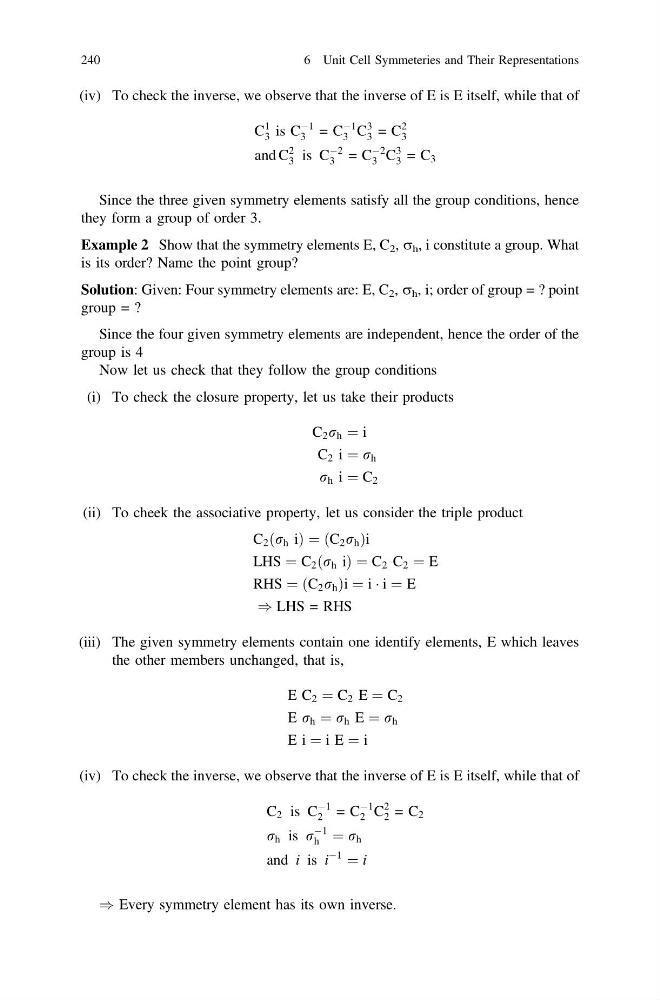
(iv) To check the inverse, we observe that the inverse of E is E itself, while that of
C
1
3 is C
À1
3 = C
À1
3 C
3
3 = C
2
3
and C
2
3 is C
À2
3 = C
À2
3 C
3
3 = C 3
Since the three given symmetry elements satisfy all the group conditions, hence
they form a group of order 3.
Example 2 Show that the symmetry elements E, C 2 , r h , i constitute a group. What
is its order? Name the point group?
Solution: Given: Four symmetry elements are: E, C 2 , r h , i; order of group = ? point
group = ?
Since the four given symmetry elements are independent, hence the order of the
group is 4
Now let us check that they follow the group conditions
(i) To check the closure property, let us take their products
C 2 r h ¼ i
C 2 i ¼ r h
r h i ¼ C 2
(ii) To cheek the associative property, let us consider the triple product
C 2 r h i
ð
Þ ¼ C 2 r h
ð
Þi
LHS ¼ C 2 r h i
ð
Þ ¼ C 2 C 2 ¼ E
RHS ¼ C 2 r h
ð
Þi ¼ i Á i ¼ E
) LHS = RHS
(iii) The given symmetry elements contain one identify elements, E which leaves
the other members unchanged, that is,
E C 2 ¼ C 2 E ¼ C 2
E r h ¼ r h E ¼ r h
E i ¼ i E ¼ i
(iv) To check the inverse, we observe that the inverse of E is E itself, while that of
C 2 is C
À1
2 = C
À1
2 C
2
2 = C 2
r h is r
À1
h ¼ r h
and i is i
À1
¼ i
) Every symmetry element has its own inverse.
240
6 Unit Cell Symmeteries and Their Representations
C
1
3 is C
À1
3 = C
À1
3 C
3
3 = C
2
3
and C
2
3 is C
À2
3 = C
À2
3 C
3
3 = C 3
Since the three given symmetry elements satisfy all the group conditions, hence
they form a group of order 3.
Example 2 Show that the symmetry elements E, C 2 , r h , i constitute a group. What
is its order? Name the point group?
Solution: Given: Four symmetry elements are: E, C 2 , r h , i; order of group = ? point
group = ?
Since the four given symmetry elements are independent, hence the order of the
group is 4
Now let us check that they follow the group conditions
(i) To check the closure property, let us take their products
C 2 r h ¼ i
C 2 i ¼ r h
r h i ¼ C 2
(ii) To cheek the associative property, let us consider the triple product
C 2 r h i
ð
Þ ¼ C 2 r h
ð
Þi
LHS ¼ C 2 r h i
ð
Þ ¼ C 2 C 2 ¼ E
RHS ¼ C 2 r h
ð
Þi ¼ i Á i ¼ E
) LHS = RHS
(iii) The given symmetry elements contain one identify elements, E which leaves
the other members unchanged, that is,
E C 2 ¼ C 2 E ¼ C 2
E r h ¼ r h E ¼ r h
E i ¼ i E ¼ i
(iv) To check the inverse, we observe that the inverse of E is E itself, while that of
C 2 is C
À1
2 = C
À1
2 C
2
2 = C 2
r h is r
À1
h ¼ r h
and i is i
À1
¼ i
) Every symmetry element has its own inverse.
240
6 Unit Cell Symmeteries and Their Representations