

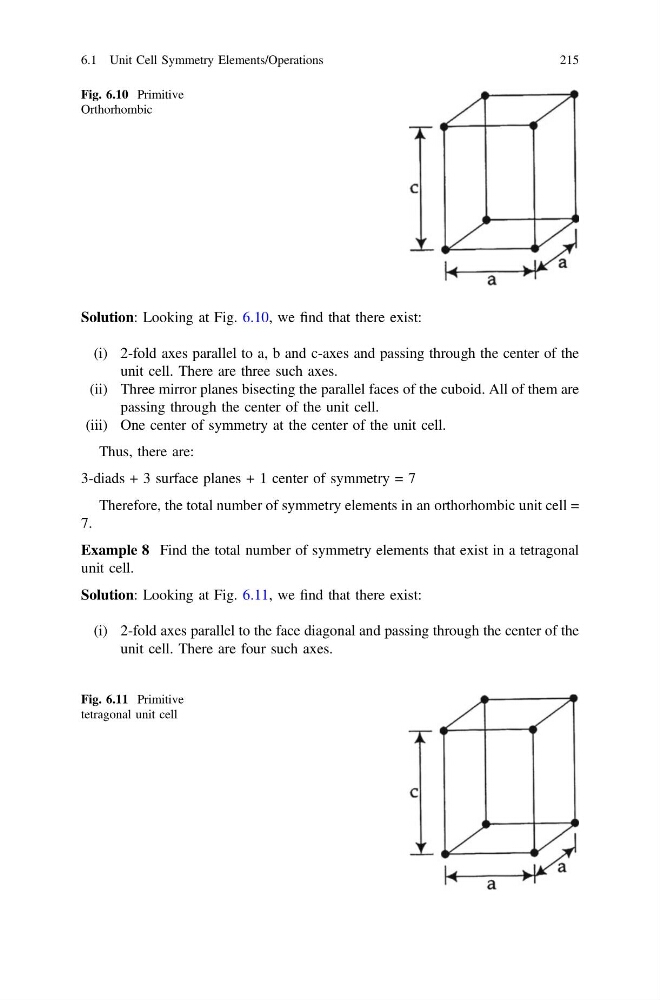
Solution: Looking at Fig. 6.10, we find that there exist:
(i) 2-fold axes parallel to a, b and c-axes and passing through the center of the
unit cell. There are three such axes.
(ii) Three mirror planes bisecting the parallel faces of the cuboid. All of them are
passing through the center of the unit cell.
(iii) One center of symmetry at the center of the unit cell.
Thus, there are:
3-diads + 3 surface planes + 1 center of symmetry = 7
Therefore, the total number of symmetry elements in an orthorhombic unit cell =
7.
Example 8 Find the total number of symmetry elements that exist in a tetragonal
unit cell.
Solution: Looking at Fig. 6.11, we find that there exist:
(i) 2-fold axes parallel to the face diagonal and passing through the center of the
unit cell. There are four such axes.
Fig. 6.10 Primitive
Orthorhombic
Fig. 6.11 Primitive
tetragonal unit cell
6.1 Unit Cell Symmetry Elements/Operations
215
(i) 2-fold axes parallel to a, b and c-axes and passing through the center of the
unit cell. There are three such axes.
(ii) Three mirror planes bisecting the parallel faces of the cuboid. All of them are
passing through the center of the unit cell.
(iii) One center of symmetry at the center of the unit cell.
Thus, there are:
3-diads + 3 surface planes + 1 center of symmetry = 7
Therefore, the total number of symmetry elements in an orthorhombic unit cell =
7.
Example 8 Find the total number of symmetry elements that exist in a tetragonal
unit cell.
Solution: Looking at Fig. 6.11, we find that there exist:
(i) 2-fold axes parallel to the face diagonal and passing through the center of the
unit cell. There are four such axes.
Fig. 6.10 Primitive
Orthorhombic
Fig. 6.11 Primitive
tetragonal unit cell
6.1 Unit Cell Symmetry Elements/Operations
215