

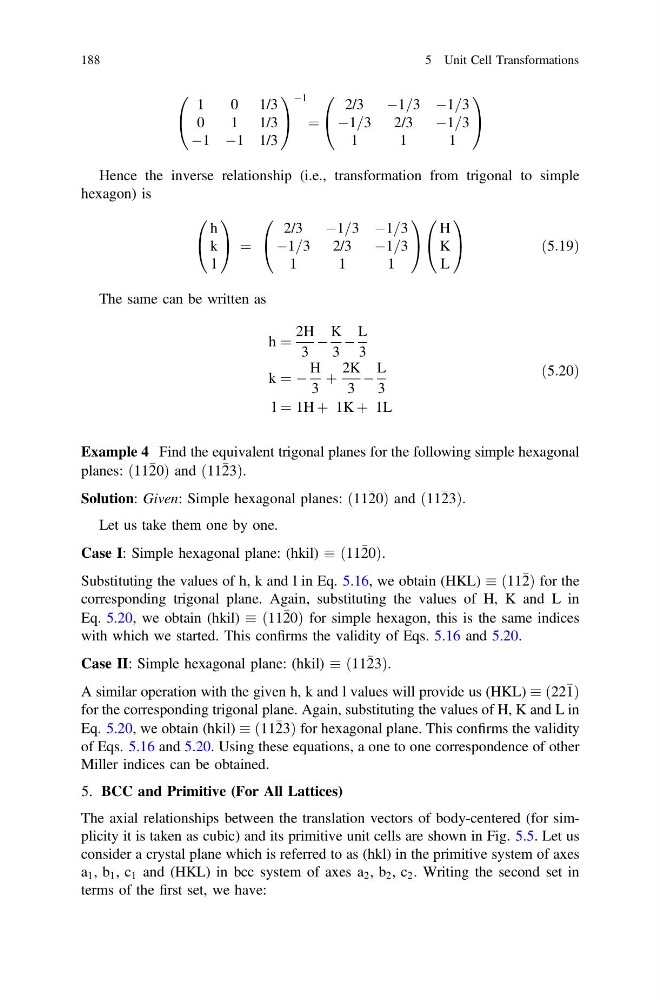
1
0 1/3
0
1 1/3
À1 À1 1/3
0
@
1
A
À1
¼
2/3
À1=3 À1=3
À1=3
2/3
À1=3
1
1
1
0
@
1
A
Hence the inverse relationship (i.e., transformation from trigonal to simple
hexagon) is
h
k
l
0
@
1
A ¼
2/3
À1=3 À1=3
À1=3
2/3
À1=3
1
1
1
0
@
1
A
H
K
L
0
@
1
A
ð5:19Þ
The same can be written as
h ¼
2H
3
À
K
3
À
L
3
k ¼ À
H
3
þ
2K
3
À
L
3
l ¼ 1H þ 1K þ 1L
ð5:20Þ
Example 4 Find the equivalent trigonal planes for the following simple hexagonal
planes: ð11 20Þ and ð11 23Þ.
Solution: Given: Simple hexagonal planes: ð11 20Þ and ð11 23Þ.
Let us take them one by one.
Case I: Simple hexagonal plane: (hkil) ð11 20Þ.
Substituting the values of h, k and l in Eq. 5.16, we obtain (HKL) ð11 2Þ for the
corresponding trigonal plane. Again, substituting the values of H, K and L in
Eq. 5.20, we obtain (hkil) ð11 20Þ for simple hexagon, this is the same indices
with which we started. This confirms the validity of Eqs. 5.16 and 5.20.
Case II: Simple hexagonal plane: (hkil) ð11 23Þ.
A similar operation with the given h, k and l values will provide us (HKL) ð22 1Þ
for the corresponding trigonal plane. Again, substituting the values of H, K and L in
Eq. 5.20, we obtain (hkil) ð11
23Þ for hexagonal plane. This confirms the validity
of Eqs. 5.16 and 5.20. Using these equations, a one to one correspondence of other
Miller indices can be obtained.
5. BCC and Primitive (For All Lattices)
The axial relationships between the translation vectors of body-centered (for simplicity it is taken as cubic) and its primitive unit cells are shown in Fig. 5.5. Let us
consider a crystal plane which is referred to as (hkl) in the primitive system of axes
a 1 , b 1 , c 1 and (HKL) in bcc system of axes a 2 , b 2 , c 2 . Writing the second set in
terms of the first set, we have:
188
5 Unit Cell Transformations
0 1/3
0
1 1/3
À1 À1 1/3
0
@
1
A
À1
¼
2/3
À1=3 À1=3
À1=3
2/3
À1=3
1
1
1
0
@
1
A
Hence the inverse relationship (i.e., transformation from trigonal to simple
hexagon) is
h
k
l
0
@
1
A ¼
2/3
À1=3 À1=3
À1=3
2/3
À1=3
1
1
1
0
@
1
A
H
K
L
0
@
1
A
ð5:19Þ
The same can be written as
h ¼
2H
3
À
K
3
À
L
3
k ¼ À
H
3
þ
2K
3
À
L
3
l ¼ 1H þ 1K þ 1L
ð5:20Þ
Example 4 Find the equivalent trigonal planes for the following simple hexagonal
planes: ð11 20Þ and ð11 23Þ.
Solution: Given: Simple hexagonal planes: ð11 20Þ and ð11 23Þ.
Let us take them one by one.
Case I: Simple hexagonal plane: (hkil) ð11 20Þ.
Substituting the values of h, k and l in Eq. 5.16, we obtain (HKL) ð11 2Þ for the
corresponding trigonal plane. Again, substituting the values of H, K and L in
Eq. 5.20, we obtain (hkil) ð11 20Þ for simple hexagon, this is the same indices
with which we started. This confirms the validity of Eqs. 5.16 and 5.20.
Case II: Simple hexagonal plane: (hkil) ð11 23Þ.
A similar operation with the given h, k and l values will provide us (HKL) ð22 1Þ
for the corresponding trigonal plane. Again, substituting the values of H, K and L in
Eq. 5.20, we obtain (hkil) ð11
23Þ for hexagonal plane. This confirms the validity
of Eqs. 5.16 and 5.20. Using these equations, a one to one correspondence of other
Miller indices can be obtained.
5. BCC and Primitive (For All Lattices)
The axial relationships between the translation vectors of body-centered (for simplicity it is taken as cubic) and its primitive unit cells are shown in Fig. 5.5. Let us
consider a crystal plane which is referred to as (hkl) in the primitive system of axes
a 1 , b 1 , c 1 and (HKL) in bcc system of axes a 2 , b 2 , c 2 . Writing the second set in
terms of the first set, we have:
188
5 Unit Cell Transformations