

d 111
ð
Þ ¼
2:12
3 sin
2 60 þ 6 cos 2 60 À cos 60
ð
Þ
Â
à 1=2
¼
2:12
2:25 þ 6 0:25 À 0:5
ð
Þ
½
1
2
¼
2:12
2:25 À 1:5
½
1=2
¼
2:12
0:75
½
1=2
¼ 2:45 ˚
A
4.5 Zone and Zone Axis
(a) Zone
A zone in crystal may be defined as a set of crystal planes (or faces) which when
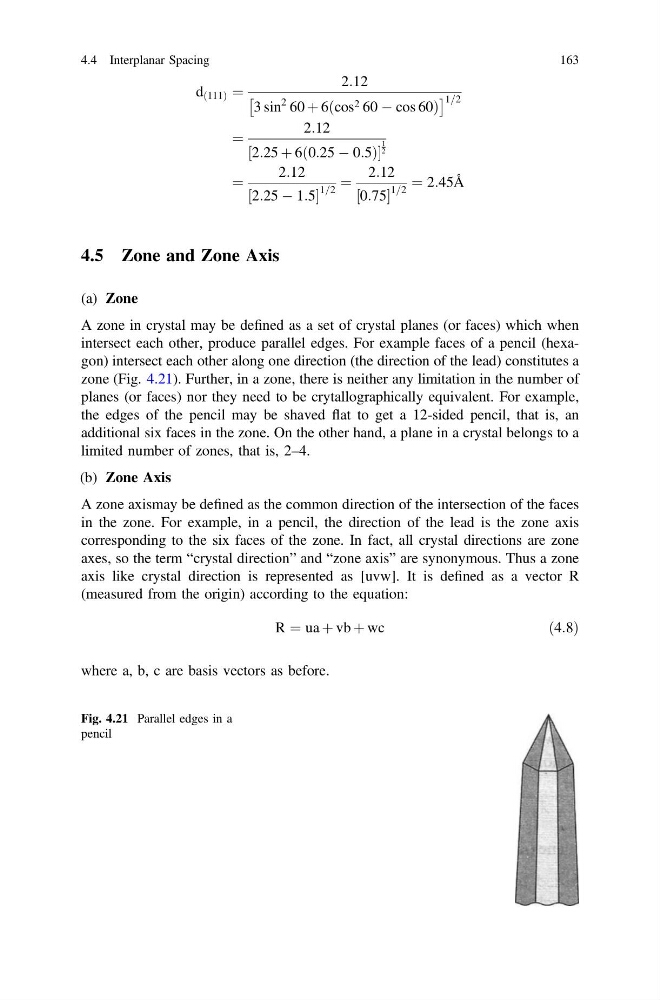
intersect each other, produce parallel edges. For example faces of a pencil (hexagon) intersect each other along one direction (the direction of the lead) constitutes a
zone (Fig. 4.21). Further, in a zone, there is neither any limitation in the number of
planes (or faces) nor they need to be crytallographically equivalent. For example,
the edges of the pencil may be shaved flat to get a 12-sided pencil, that is, an
additional six faces in the zone. On the other hand, a plane in a crystal belongs to a
limited number of zones, that is, 2–4.
(b) Zone Axis
A zone axismay be defined as the common direction of the intersection of the faces
in the zone. For example, in a pencil, the direction of the lead is the zone axis
corresponding to the six faces of the zone. In fact, all crystal directions are zone
axes, so the term “crystal direction” and “zone axis” are synonymous. Thus a zone
axis like crystal direction is represented as [uvw]. It is defined as a vector R
(measured from the origin) according to the equation:
R ¼ ua þ vb þ wc
ð4:8Þ
where a, b, c are basis vectors as before.
Fig. 4.21 Parallel edges in a
pencil
4.4 Interplanar Spacing
163
ð
Þ ¼
2:12
3 sin
2 60 þ 6 cos 2 60 À cos 60
ð
Þ
Â
à 1=2
¼
2:12
2:25 þ 6 0:25 À 0:5
ð
Þ
½
1
2
¼
2:12
2:25 À 1:5
½
1=2
¼
2:12
0:75
½
1=2
¼ 2:45 ˚
A
4.5 Zone and Zone Axis
(a) Zone
A zone in crystal may be defined as a set of crystal planes (or faces) which when
intersect each other, produce parallel edges. For example faces of a pencil (hexagon) intersect each other along one direction (the direction of the lead) constitutes a
zone (Fig. 4.21). Further, in a zone, there is neither any limitation in the number of
planes (or faces) nor they need to be crytallographically equivalent. For example,
the edges of the pencil may be shaved flat to get a 12-sided pencil, that is, an
additional six faces in the zone. On the other hand, a plane in a crystal belongs to a
limited number of zones, that is, 2–4.
(b) Zone Axis
A zone axismay be defined as the common direction of the intersection of the faces
in the zone. For example, in a pencil, the direction of the lead is the zone axis
corresponding to the six faces of the zone. In fact, all crystal directions are zone
axes, so the term “crystal direction” and “zone axis” are synonymous. Thus a zone
axis like crystal direction is represented as [uvw]. It is defined as a vector R
(measured from the origin) according to the equation:
R ¼ ua þ vb þ wc
ð4:8Þ
where a, b, c are basis vectors as before.
Fig. 4.21 Parallel edges in a
pencil
4.4 Interplanar Spacing
163