

Hence, their ratio is:
d 100 : d 110 : d 111 = 1 :
ffiffi ffi
2
p
:
1
ffiffi ffi
3
p
Case III: Face-Centered Cubic System.
In a face-centered cubic system, the lattice points are situated at the eight corners
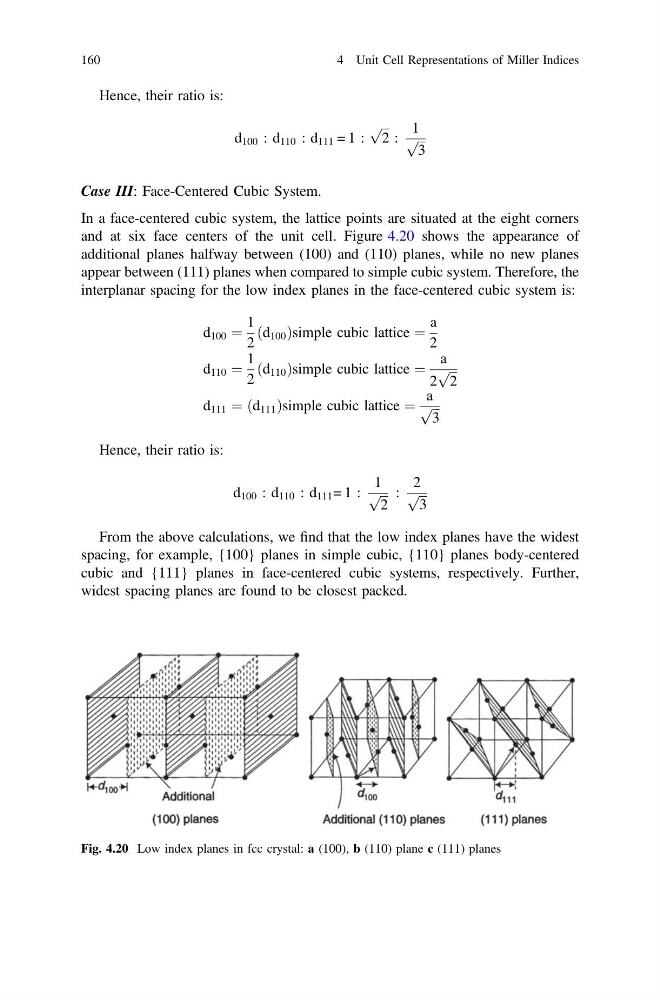
and at six face centers of the unit cell. Figure 4.20 shows the appearance of
additional planes halfway between (100) and (110) planes, while no new planes
appear between (111) planes when compared to simple cubic system. Therefore, the
interplanar spacing for the low index planes in the face-centered cubic system is:
d 100 ¼
1
2
d 100
ð
Þsimple cubic lattice ¼
a
2
d 110 ¼
1
2
d 110
ð
Þsimple cubic lattice ¼
a
2
ffiffi ffi
2
p
d 111 ¼ d 111
ð
Þsimple cubic lattice ¼
a
ffiffi ffi
3
p
Hence, their ratio is:
d 100 : d 110 : d 111 = 1 :
1
ffiffi ffi
2
p :
2
ffiffi ffi
3
p
From the above calculations, we find that the low index planes have the widest
spacing, for example, {100} planes in simple cubic, {110} planes body-centered
cubic and {111} planes in face-centered cubic systems, respectively. Further,
widest spacing planes are found to be closest packed.
Fig. 4.20 Low index planes in fcc crystal: a (100), b (110) plane c (111) planes
160
4 Unit Cell Representations of Miller Indices
d 100 : d 110 : d 111 = 1 :
ffiffi ffi
2
p
:
1
ffiffi ffi
3
p
Case III: Face-Centered Cubic System.
In a face-centered cubic system, the lattice points are situated at the eight corners
and at six face centers of the unit cell. Figure 4.20 shows the appearance of
additional planes halfway between (100) and (110) planes, while no new planes
appear between (111) planes when compared to simple cubic system. Therefore, the
interplanar spacing for the low index planes in the face-centered cubic system is:
d 100 ¼
1
2
d 100
ð
Þsimple cubic lattice ¼
a
2
d 110 ¼
1
2
d 110
ð
Þsimple cubic lattice ¼
a
2
ffiffi ffi
2
p
d 111 ¼ d 111
ð
Þsimple cubic lattice ¼
a
ffiffi ffi
3
p
Hence, their ratio is:
d 100 : d 110 : d 111 = 1 :
1
ffiffi ffi
2
p :
2
ffiffi ffi
3
p
From the above calculations, we find that the low index planes have the widest
spacing, for example, {100} planes in simple cubic, {110} planes body-centered
cubic and {111} planes in face-centered cubic systems, respectively. Further,
widest spacing planes are found to be closest packed.
Fig. 4.20 Low index planes in fcc crystal: a (100), b (110) plane c (111) planes
160
4 Unit Cell Representations of Miller Indices