

Solution: Given: Tetragonal crystal whose lattice parameters are: a = b = 2.42Å,
and c = 1.74Å. d 101 ¼ ?
From Table 4.3, we have
d hkl ¼
h
2 + k
2
a 2 +
l
2
c 2
! À1=2
and d 101 ¼
1
2
þ 0
2
2:42
ð
Þ
2
þ
1
2
1:74
ð
Þ
2
"
# À1=2
¼ 1:41 ˚
A
Example 3 Determine the interplanar spacing in sc, bcc and fcc unit cells. Analyze
the results obtained from them.
Solution: Let us take the three cases one by one.
Case I: Simple Cubic System.
In a simple cubic system, the lattice parameter a = b = c but the lattice points are
situated only at the corners of the unit cell. Thus the interplanar spacing can be
determined by simply using the equation
d ¼
a
h
2
þ k
2 + l
2
À
Á 1=2
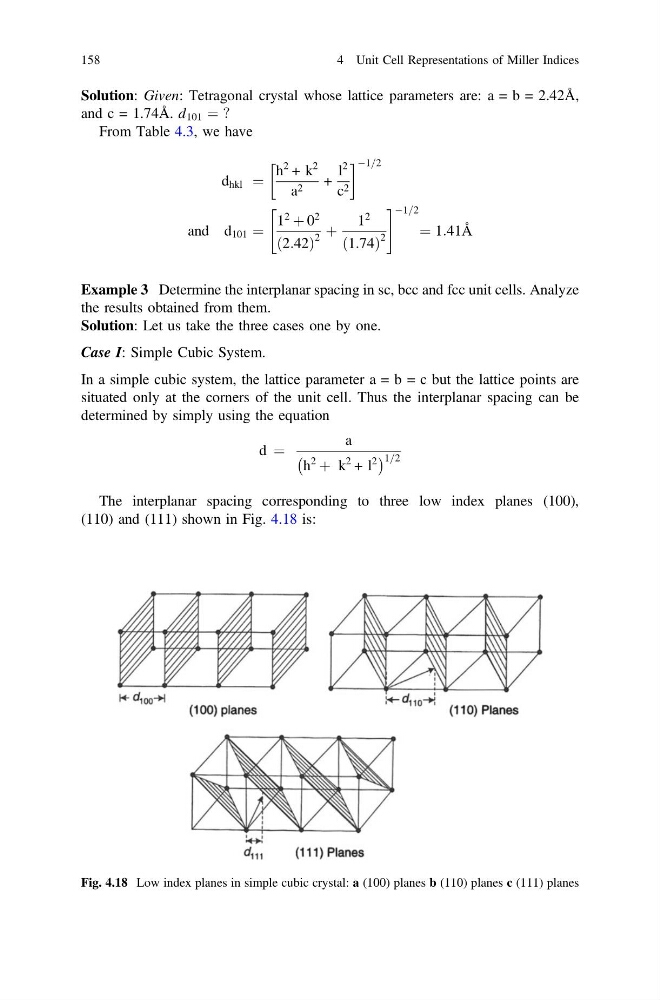
The interplanar spacing corresponding to three low index planes (100),
(110) and (111) shown in Fig. 4.18 is:
Fig. 4.18 Low index planes in simple cubic crystal: a (100) planes b (110) planes c (111) planes
158
4 Unit Cell Representations of Miller Indices
and c = 1.74Å. d 101 ¼ ?
From Table 4.3, we have
d hkl ¼
h
2 + k
2
a 2 +
l
2
c 2
! À1=2
and d 101 ¼
1
2
þ 0
2
2:42
ð
Þ
2
þ
1
2
1:74
ð
Þ
2
"
# À1=2
¼ 1:41 ˚
A
Example 3 Determine the interplanar spacing in sc, bcc and fcc unit cells. Analyze
the results obtained from them.
Solution: Let us take the three cases one by one.
Case I: Simple Cubic System.
In a simple cubic system, the lattice parameter a = b = c but the lattice points are
situated only at the corners of the unit cell. Thus the interplanar spacing can be
determined by simply using the equation
d ¼
a
h
2
þ k
2 + l
2
À
Á 1=2
The interplanar spacing corresponding to three low index planes (100),
(110) and (111) shown in Fig. 4.18 is:
Fig. 4.18 Low index planes in simple cubic crystal: a (100) planes b (110) planes c (111) planes
158
4 Unit Cell Representations of Miller Indices