

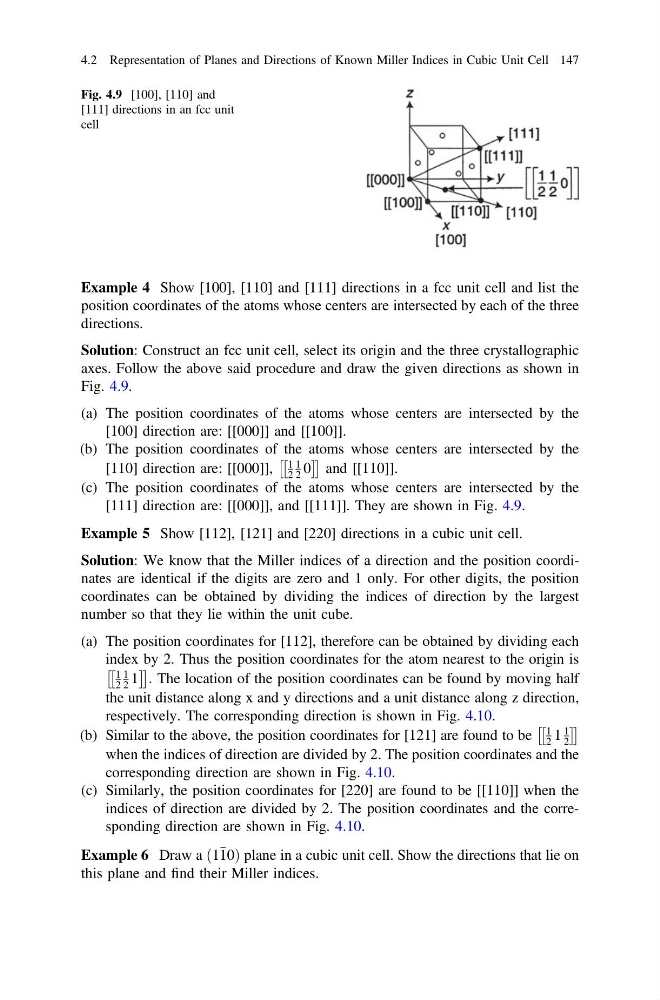
Example 4 Show [100], [110] and [111] directions in a fcc unit cell and list the
position coordinates of the atoms whose centers are intersected by each of the three
directions.
Solution: Construct an fcc unit cell, select its origin and the three crystallographic
axes. Follow the above said procedure and draw the given directions as shown in
Fig. 4.9.
(a) The position coordinates of the atoms whose centers are intersected by the
[100] direction are: [[000]] and [[100]].
(b) The position coordinates of the atoms whose centers are intersected by the
[110] direction are: [[000]],
1
2
1
2 0
Â
Ã
Â
Ã
and [[110]].
(c) The position coordinates of the atoms whose centers are intersected by the
[111] direction are: [[000]], and [[111]]. They are shown in Fig. 4.9.
Example 5 Show [112], [121] and [220] directions in a cubic unit cell.
Solution: We know that the Miller indices of a direction and the position coordinates are identical if the digits are zero and 1 only. For other digits, the position
coordinates can be obtained by dividing the indices of direction by the largest
number so that they lie within the unit cube.
(a) The position coordinates for [112], therefore can be obtained by dividing each
index by 2. Thus the position coordinates for the atom nearest to the origin is
1
2
1
2 1
Â
Ã
Â
Ã
: The location of the position coordinates can be found by moving half
the unit distance along x and y directions and a unit distance along z direction,
respectively. The corresponding direction is shown in Fig. 4.10.
(b) Similar to the above, the position coordinates for [121] are found to be
1
2 1
1
2
Â
Ã
Â
Ã
when the indices of direction are divided by 2. The position coordinates and the
corresponding direction are shown in Fig. 4.10.
(c) Similarly, the position coordinates for [220] are found to be [[110]] when the
indices of direction are divided by 2. The position coordinates and the corresponding direction are shown in Fig. 4.10.
Example 6 Draw a 1 10
ð
Þ plane in a cubic unit cell. Show the directions that lie on
this plane and find their Miller indices.
Fig. 4.9 [100], [110] and
[111] directions in an fcc unit
cell
4.2 Representation of Planes and Directions of Known Miller Indices in Cubic Unit Cell 147
position coordinates of the atoms whose centers are intersected by each of the three
directions.
Solution: Construct an fcc unit cell, select its origin and the three crystallographic
axes. Follow the above said procedure and draw the given directions as shown in
Fig. 4.9.
(a) The position coordinates of the atoms whose centers are intersected by the
[100] direction are: [[000]] and [[100]].
(b) The position coordinates of the atoms whose centers are intersected by the
[110] direction are: [[000]],
1
2
1
2 0
Â
Ã
Â
Ã
and [[110]].
(c) The position coordinates of the atoms whose centers are intersected by the
[111] direction are: [[000]], and [[111]]. They are shown in Fig. 4.9.
Example 5 Show [112], [121] and [220] directions in a cubic unit cell.
Solution: We know that the Miller indices of a direction and the position coordinates are identical if the digits are zero and 1 only. For other digits, the position
coordinates can be obtained by dividing the indices of direction by the largest
number so that they lie within the unit cube.
(a) The position coordinates for [112], therefore can be obtained by dividing each
index by 2. Thus the position coordinates for the atom nearest to the origin is
1
2
1
2 1
Â
Ã
Â
Ã
: The location of the position coordinates can be found by moving half
the unit distance along x and y directions and a unit distance along z direction,
respectively. The corresponding direction is shown in Fig. 4.10.
(b) Similar to the above, the position coordinates for [121] are found to be
1
2 1
1
2
Â
Ã
Â
Ã
when the indices of direction are divided by 2. The position coordinates and the
corresponding direction are shown in Fig. 4.10.
(c) Similarly, the position coordinates for [220] are found to be [[110]] when the
indices of direction are divided by 2. The position coordinates and the corresponding direction are shown in Fig. 4.10.
Example 6 Draw a 1 10
ð
Þ plane in a cubic unit cell. Show the directions that lie on
this plane and find their Miller indices.
Fig. 4.9 [100], [110] and
[111] directions in an fcc unit
cell
4.2 Representation of Planes and Directions of Known Miller Indices in Cubic Unit Cell 147