

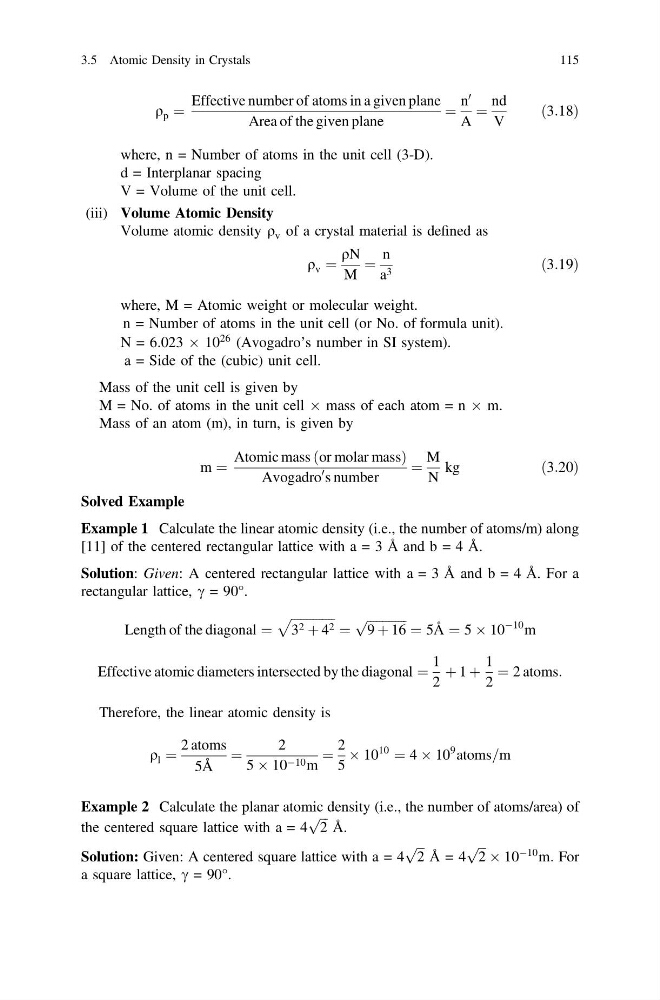
q p ¼
Effective number of atoms in a given plane
Area of the given plane
¼
n
0
A
¼
nd
V
ð3:18Þ
where, n = Number of atoms in the unit cell (3-D).
d = Interplanar spacing
V = Volume of the unit cell.
(iii) Volume Atomic Density
Volume atomic density q v of a crystal material is defined as
q v ¼
qN
M
¼
n
a 3
ð3:19Þ
where, M = Atomic weight or molecular weight.
n = Number of atoms in the unit cell (or No. of formula unit).
N = 6.023 Â 10
26 (Avogadro’s number in SI system).
a = Side of the (cubic) unit cell.
Mass of the unit cell is given by
M = No. of atoms in the unit cell  mass of each atom = n  m.
Mass of an atom (m), in turn, is given by
m ¼
Atomic mass ðor molar massÞ
Avogadro
0 s number
¼
M
N
kg
ð3:20Þ
Solved Example
Example 1 Calculate the linear atomic density (i.e., the number of atoms/m) along
[11] of the centered rectangular lattice with a = 3 Å and b = 4 Å.
Solution: Given: A centered rectangular lattice with a = 3 Å and b = 4 Å. For a
rectangular lattice, c = 90°.
Length of the diagonal ¼
ffiffiffiffiffiffiffiffiffiffiffiffiffiffi
3 2 þ 4 2
p
¼
ffiffiffiffiffiffiffiffiffiffiffiffiffi
9 þ 16
p
¼ 5 ˚
A ¼ 5 Â 10
À10 m
Effective atomic diameters intersected by the diagonal ¼
1
2
þ 1 þ
1
2
¼ 2 atoms:
Therefore, the linear atomic density is
q l ¼
2 atoms
5 ˚
A
¼
2
5 Â 10 À10 m
¼
2
5
 10
10
¼ 4 Â 10
9 atoms=m
Example 2 Calculate the planar atomic density (i.e., the number of atoms/area) of
the centered square lattice with a = 4
ffiffi ffi
2
p Å.
Solution: Given: A centered square lattice with a = 4
ffiffi ffi
2
p Å = 4
ffiffi ffi
2
p  10
À10 m: For
a square lattice, c = 90°.
3.5 Atomic Density in Crystals
115
Effective number of atoms in a given plane
Area of the given plane
¼
n
0
A
¼
nd
V
ð3:18Þ
where, n = Number of atoms in the unit cell (3-D).
d = Interplanar spacing
V = Volume of the unit cell.
(iii) Volume Atomic Density
Volume atomic density q v of a crystal material is defined as
q v ¼
qN
M
¼
n
a 3
ð3:19Þ
where, M = Atomic weight or molecular weight.
n = Number of atoms in the unit cell (or No. of formula unit).
N = 6.023 Â 10
26 (Avogadro’s number in SI system).
a = Side of the (cubic) unit cell.
Mass of the unit cell is given by
M = No. of atoms in the unit cell  mass of each atom = n  m.
Mass of an atom (m), in turn, is given by
m ¼
Atomic mass ðor molar massÞ
Avogadro
0 s number
¼
M
N
kg
ð3:20Þ
Solved Example
Example 1 Calculate the linear atomic density (i.e., the number of atoms/m) along
[11] of the centered rectangular lattice with a = 3 Å and b = 4 Å.
Solution: Given: A centered rectangular lattice with a = 3 Å and b = 4 Å. For a
rectangular lattice, c = 90°.
Length of the diagonal ¼
ffiffiffiffiffiffiffiffiffiffiffiffiffiffi
3 2 þ 4 2
p
¼
ffiffiffiffiffiffiffiffiffiffiffiffiffi
9 þ 16
p
¼ 5 ˚
A ¼ 5 Â 10
À10 m
Effective atomic diameters intersected by the diagonal ¼
1
2
þ 1 þ
1
2
¼ 2 atoms:
Therefore, the linear atomic density is
q l ¼
2 atoms
5 ˚
A
¼
2
5 Â 10 À10 m
¼
2
5
 10
10
¼ 4 Â 10
9 atoms=m
Example 2 Calculate the planar atomic density (i.e., the number of atoms/area) of
the centered square lattice with a = 4
ffiffi ffi
2
p Å.
Solution: Given: A centered square lattice with a = 4
ffiffi ffi
2
p Å = 4
ffiffi ffi
2
p  10
À10 m: For
a square lattice, c = 90°.
3.5 Atomic Density in Crystals
115