

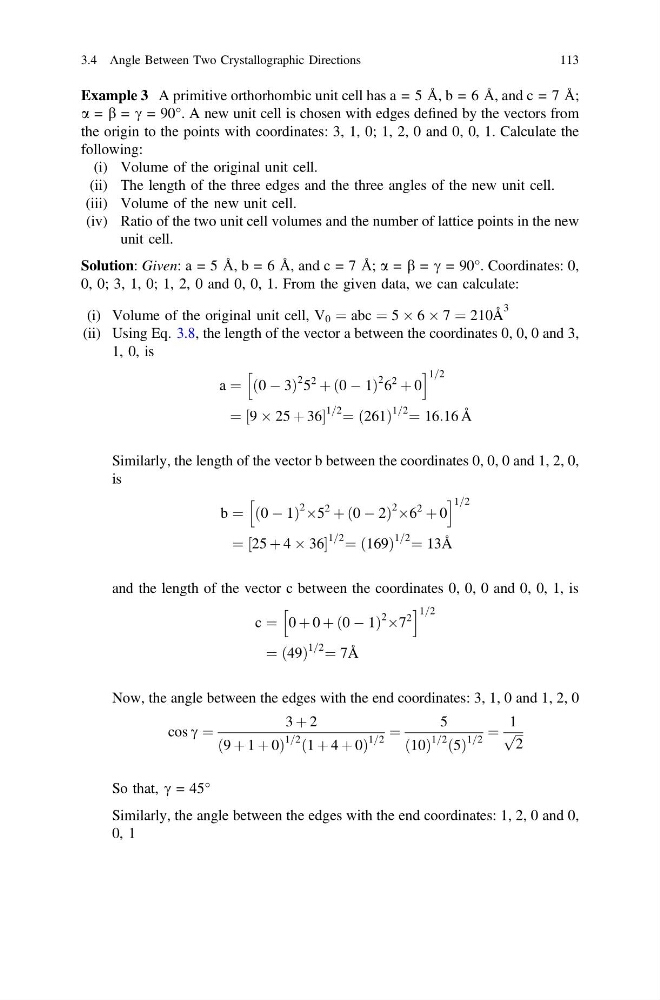
Example 3 A primitive orthorhombic unit cell has a = 5 Å, b = 6 Å, and c = 7 Å;
a = b = c = 90°. A new unit cell is chosen with edges defined by the vectors from
the origin to the points with coordinates: 3, 1, 0; 1, 2, 0 and 0, 0, 1. Calculate the
following:
(i) Volume of the original unit cell.
(ii) The length of the three edges and the three angles of the new unit cell.
(iii) Volume of the new unit cell.
(iv) Ratio of the two unit cell volumes and the number of lattice points in the new
unit cell.
Solution: Given: a = 5 Å, b = 6 Å, and c = 7 Å; a = b = c = 90°. Coordinates: 0,
0, 0; 3, 1, 0; 1, 2, 0 and 0, 0, 1. From the given data, we can calculate:
(i) Volume of the original unit cell, V 0 ¼ abc ¼ 5 Â 6 Â 7 ¼ 210 ˚
A
3
(ii) Using Eq. 3.8, the length of the vector a between the coordinates 0, 0, 0 and 3,
1, 0, is
a ¼ 0 À 3
ð
Þ
2 5
2
þ 0 À 1
ð
Þ
2 6
2
þ 0
h
i 1=2
¼ 9 Â 25 þ 36
½
1=2 ¼ 261
ð
Þ
1=2 ¼ 16:16 ˚
A
Similarly, the length of the vector b between the coordinates 0, 0, 0 and 1, 2, 0,
is
b ¼ 0 À 1
ð
Þ
2 Â5
2
þ 0 À 2
ð
Þ
2 Â6
2
þ 0
h
i 1=2
¼ 25 þ 4 Â 36
½
1=2 ¼ 169
ð
Þ
1=2 ¼ 13 ˚
A
and the length of the vector c between the coordinates 0, 0, 0 and 0, 0, 1, is
c ¼ 0 þ 0 þ 0 À 1
ð
Þ
2 Â7
2
h
i 1=2
¼ 49
ð Þ
1=2 ¼ 7 ˚
A
Now, the angle between the edges with the end coordinates: 3, 1, 0 and 1, 2, 0
cos c ¼
3 þ 2
9 þ 1 þ 0
ð
Þ
1=2 1 þ 4 þ 0
ð
Þ
1=2
¼
5
10
ð Þ
1=2 5
ð Þ
1=2
¼
1
ffiffi ffi
2
p
So that, c = 45°
Similarly, the angle between the edges with the end coordinates: 1, 2, 0 and 0,
0, 1
3.4 Angle Between Two Crystallographic Directions
113
a = b = c = 90°. A new unit cell is chosen with edges defined by the vectors from
the origin to the points with coordinates: 3, 1, 0; 1, 2, 0 and 0, 0, 1. Calculate the
following:
(i) Volume of the original unit cell.
(ii) The length of the three edges and the three angles of the new unit cell.
(iii) Volume of the new unit cell.
(iv) Ratio of the two unit cell volumes and the number of lattice points in the new
unit cell.
Solution: Given: a = 5 Å, b = 6 Å, and c = 7 Å; a = b = c = 90°. Coordinates: 0,
0, 0; 3, 1, 0; 1, 2, 0 and 0, 0, 1. From the given data, we can calculate:
(i) Volume of the original unit cell, V 0 ¼ abc ¼ 5 Â 6 Â 7 ¼ 210 ˚
A
3
(ii) Using Eq. 3.8, the length of the vector a between the coordinates 0, 0, 0 and 3,
1, 0, is
a ¼ 0 À 3
ð
Þ
2 5
2
þ 0 À 1
ð
Þ
2 6
2
þ 0
h
i 1=2
¼ 9 Â 25 þ 36
½
1=2 ¼ 261
ð
Þ
1=2 ¼ 16:16 ˚
A
Similarly, the length of the vector b between the coordinates 0, 0, 0 and 1, 2, 0,
is
b ¼ 0 À 1
ð
Þ
2 Â5
2
þ 0 À 2
ð
Þ
2 Â6
2
þ 0
h
i 1=2
¼ 25 þ 4 Â 36
½
1=2 ¼ 169
ð
Þ
1=2 ¼ 13 ˚
A
and the length of the vector c between the coordinates 0, 0, 0 and 0, 0, 1, is
c ¼ 0 þ 0 þ 0 À 1
ð
Þ
2 Â7
2
h
i 1=2
¼ 49
ð Þ
1=2 ¼ 7 ˚
A
Now, the angle between the edges with the end coordinates: 3, 1, 0 and 1, 2, 0
cos c ¼
3 þ 2
9 þ 1 þ 0
ð
Þ
1=2 1 þ 4 þ 0
ð
Þ
1=2
¼
5
10
ð Þ
1=2 5
ð Þ
1=2
¼
1
ffiffi ffi
2
p
So that, c = 45°
Similarly, the angle between the edges with the end coordinates: 1, 2, 0 and 0,
0, 1
3.4 Angle Between Two Crystallographic Directions
113