

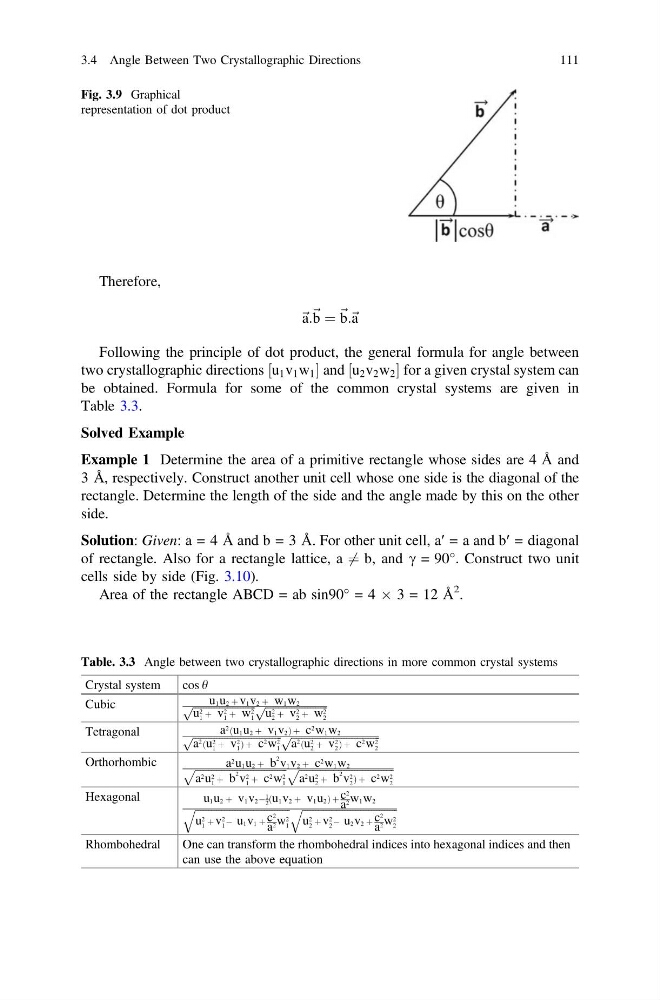
Therefore,
~ a: ~ b ¼ ~ b:~ a
Following the principle of dot product, the general formula for angle between
two crystallographic directions u 1 v 1 w 1
½
and u 2 v 2 w 2
½
for a given crystal system can
be obtained. Formula for some of the common crystal systems are given in
Table 3.3.
Solved Example
Example 1 Determine the area of a primitive rectangle whose sides are 4 Å and
3 Å, respectively. Construct another unit cell whose one side is the diagonal of the
rectangle. Determine the length of the side and the angle made by this on the other
side.
Solution: Given: a = 4 Å and b = 3 Å. For other unit cell, a′ = a and b′ = diagonal
of rectangle. Also for a rectangle lattice, a 6 ¼ b, and c = 90°. Construct two unit
cells side by side (Fig. 3.10).
Area of the rectangle ABCD = ab sin90° = 4 Â 3 = 12 Å
2 .
Fig. 3.9 Graphical
representation of dot product
Table. 3.3 Angle between two crystallographic directions in more common crystal systems
Crystal system
cos h
Cubic
u1u2 þ v1v2 þ w1w2
ffiffiffiffiffiffiffiffiffiffiffiffiffiffiffiffiffiffiffiffiffiffiffi ffi
u
2
1 þ v
2
1 þ w
2
1
p
ffiffiffiffiffiffiffiffiffiffiffiffiffiffiffiffiffiffiffiffiffiffiffi ffi
u
2
2 þ v
2
2 þ w
2
2
p
Tetragonal
a
2 ðu1u2 þ v1v2Þþ c
2 w1w2
ffiffiffiffiffiffiffiffiffiffiffiffiffiffiffiffiffiffiffiffiffiffiffiffiffiffiffiffiffiffiffiffiffi ffi
a
2 ðu
2
1 þ v
2
1 Þ þ c
2 w
2
1
p
ffiffiffiffiffiffiffiffiffiffiffiffiffiffiffiffiffiffiffiffiffiffiffiffiffiffiffiffiffiffiffiffiffi ffi
a
2 ðu
2
2 þ v
2
2 Þ þ c
2 w
2
2
p
Orthorhombic
a
2 u1u2 þ b
2 v1v2 þ c
2 w1w2
ffiffiffiffiffiffiffiffiffiffiffiffiffiffiffiffiffiffiffiffiffiffiffiffiffiffiffiffiffiffiffiffiffiffi ffi
a
2 u
2
1 þ b
2 v
2
1 þ c
2 w
2
1
p
ffiffiffiffiffiffiffiffiffiffiffiffiffiffiffiffiffiffiffiffiffiffiffiffiffiffiffiffiffiffiffiffiffiffiffiffi
a
2 u
2
2 þ b
2 v
2
2 Þ þ c
2 w
2
2
p
Hexagonal
u1u2 þ v1v2À
1
2 ðu1v2 þ v1u2Þþ c
2
a
2 w1w2
ffiffiffiffiffiffiffiffiffiffiffiffiffiffiffiffiffiffiffiffiffiffiffiffiffiffiffiffiffiffiffiffiffiffiffiffi
u
2
1 þ v
2
1 À u1v1 þ c
2
a
2 w
2
1
q
ffiffiffiffiffiffiffiffiffiffiffiffiffiffiffiffiffiffiffiffiffiffiffiffiffiffiffiffiffiffiffiffiffiffiffiffi
u
2
2 þ v
2
2 À u2v2 þ c
2
a
2 w
2
2
q
Rhombohedral
One can transform the rhombohedral indices into hexagonal indices and then
can use the above equation
3.4 Angle Between Two Crystallographic Directions
111
~ a: ~ b ¼ ~ b:~ a
Following the principle of dot product, the general formula for angle between
two crystallographic directions u 1 v 1 w 1
½
and u 2 v 2 w 2
½
for a given crystal system can
be obtained. Formula for some of the common crystal systems are given in
Table 3.3.
Solved Example
Example 1 Determine the area of a primitive rectangle whose sides are 4 Å and
3 Å, respectively. Construct another unit cell whose one side is the diagonal of the
rectangle. Determine the length of the side and the angle made by this on the other
side.
Solution: Given: a = 4 Å and b = 3 Å. For other unit cell, a′ = a and b′ = diagonal
of rectangle. Also for a rectangle lattice, a 6 ¼ b, and c = 90°. Construct two unit
cells side by side (Fig. 3.10).
Area of the rectangle ABCD = ab sin90° = 4 Â 3 = 12 Å
2 .
Fig. 3.9 Graphical
representation of dot product
Table. 3.3 Angle between two crystallographic directions in more common crystal systems
Crystal system
cos h
Cubic
u1u2 þ v1v2 þ w1w2
ffiffiffiffiffiffiffiffiffiffiffiffiffiffiffiffiffiffiffiffiffiffiffi ffi
u
2
1 þ v
2
1 þ w
2
1
p
ffiffiffiffiffiffiffiffiffiffiffiffiffiffiffiffiffiffiffiffiffiffiffi ffi
u
2
2 þ v
2
2 þ w
2
2
p
Tetragonal
a
2 ðu1u2 þ v1v2Þþ c
2 w1w2
ffiffiffiffiffiffiffiffiffiffiffiffiffiffiffiffiffiffiffiffiffiffiffiffiffiffiffiffiffiffiffiffiffi ffi
a
2 ðu
2
1 þ v
2
1 Þ þ c
2 w
2
1
p
ffiffiffiffiffiffiffiffiffiffiffiffiffiffiffiffiffiffiffiffiffiffiffiffiffiffiffiffiffiffiffiffiffi ffi
a
2 ðu
2
2 þ v
2
2 Þ þ c
2 w
2
2
p
Orthorhombic
a
2 u1u2 þ b
2 v1v2 þ c
2 w1w2
ffiffiffiffiffiffiffiffiffiffiffiffiffiffiffiffiffiffiffiffiffiffiffiffiffiffiffiffiffiffiffiffiffiffi ffi
a
2 u
2
1 þ b
2 v
2
1 þ c
2 w
2
1
p
ffiffiffiffiffiffiffiffiffiffiffiffiffiffiffiffiffiffiffiffiffiffiffiffiffiffiffiffiffiffiffiffiffiffiffiffi
a
2 u
2
2 þ b
2 v
2
2 Þ þ c
2 w
2
2
p
Hexagonal
u1u2 þ v1v2À
1
2 ðu1v2 þ v1u2Þþ c
2
a
2 w1w2
ffiffiffiffiffiffiffiffiffiffiffiffiffiffiffiffiffiffiffiffiffiffiffiffiffiffiffiffiffiffiffiffiffiffiffiffi
u
2
1 þ v
2
1 À u1v1 þ c
2
a
2 w
2
1
q
ffiffiffiffiffiffiffiffiffiffiffiffiffiffiffiffiffiffiffiffiffiffiffiffiffiffiffiffiffiffiffiffiffiffiffiffi
u
2
2 þ v
2
2 À u2v2 þ c
2
a
2 w
2
2
q
Rhombohedral
One can transform the rhombohedral indices into hexagonal indices and then
can use the above equation
3.4 Angle Between Two Crystallographic Directions
111