

Now, draw a unit cell (A) as per the given lattice parameters. The position
coordinates of the atom within the reference cell are:
xa ¼ 0:5a ¼ 0:5 Â 10 ¼ 5 ˚
Aðlength along the basis vector aÞ
yb ¼ 0:5 b ¼ 0:5 Â 10 ˚
A ¼ 5 ˚
Aðlength along the basis vector bÞ
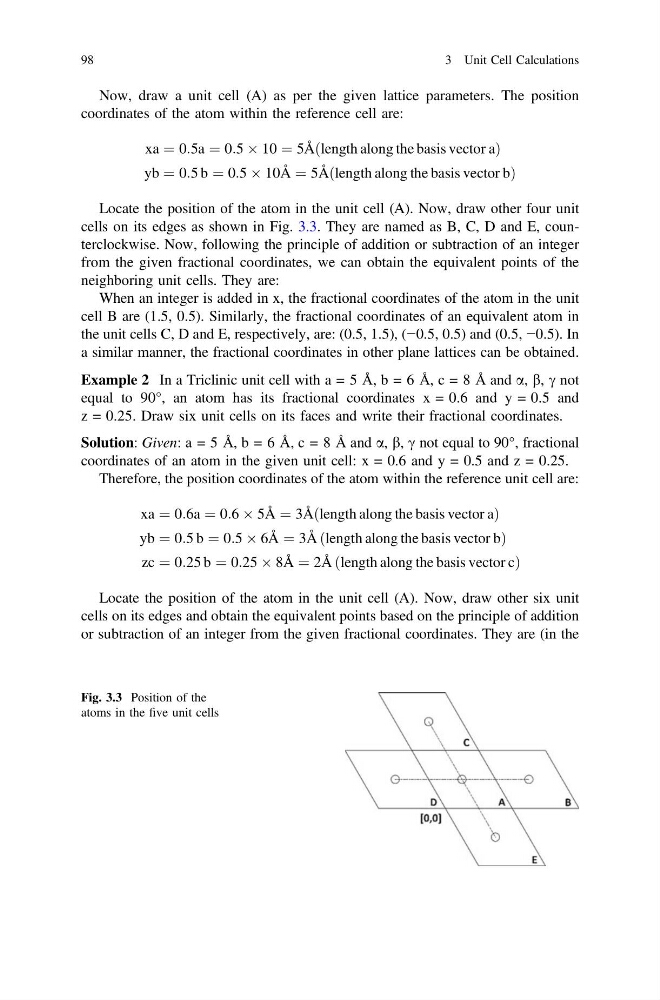
Locate the position of the atom in the unit cell (A). Now, draw other four unit
cells on its edges as shown in Fig. 3.3. They are named as B, C, D and E, counterclockwise. Now, following the principle of addition or subtraction of an integer
from the given fractional coordinates, we can obtain the equivalent points of the
neighboring unit cells. They are:
When an integer is added in x, the fractional coordinates of the atom in the unit
cell B are (1.5, 0.5). Similarly, the fractional coordinates of an equivalent atom in
the unit cells C, D and E, respectively, are: (0.5, 1.5), (−0.5, 0.5) and (0.5, −0.5). In
a similar manner, the fractional coordinates in other plane lattices can be obtained.
Example 2 In a Triclinic unit cell with a = 5 Å, b = 6 Å, c = 8 Å and a, b, c not
equal to 90°, an atom has its fractional coordinates x = 0.6 and y = 0.5 and
z = 0.25. Draw six unit cells on its faces and write their fractional coordinates.
Solution: Given: a = 5 Å, b = 6 Å, c = 8 Å and a, b, c not equal to 90°, fractional
coordinates of an atom in the given unit cell: x = 0.6 and y = 0.5 and z = 0.25.
Therefore, the position coordinates of the atom within the reference unit cell are:
xa ¼ 0:6a ¼ 0:6 Â 5 ˚
A ¼ 3 ˚
Aðlength along the basis vector aÞ
yb ¼ 0:5 b ¼ 0:5 Â 6 ˚
A ¼ 3 ˚
A ðlength along the basis vector bÞ
zc ¼ 0:25 b ¼ 0:25 Â 8 ˚
A ¼ 2 ˚
A ðlength along the basis vector cÞ
Locate the position of the atom in the unit cell (A). Now, draw other six unit
cells on its edges and obtain the equivalent points based on the principle of addition
or subtraction of an integer from the given fractional coordinates. They are (in the
Fig. 3.3 Position of the
atoms in the five unit cells
98
3 Unit Cell Calculations
coordinates of the atom within the reference cell are:
xa ¼ 0:5a ¼ 0:5 Â 10 ¼ 5 ˚
Aðlength along the basis vector aÞ
yb ¼ 0:5 b ¼ 0:5 Â 10 ˚
A ¼ 5 ˚
Aðlength along the basis vector bÞ
Locate the position of the atom in the unit cell (A). Now, draw other four unit
cells on its edges as shown in Fig. 3.3. They are named as B, C, D and E, counterclockwise. Now, following the principle of addition or subtraction of an integer
from the given fractional coordinates, we can obtain the equivalent points of the
neighboring unit cells. They are:
When an integer is added in x, the fractional coordinates of the atom in the unit
cell B are (1.5, 0.5). Similarly, the fractional coordinates of an equivalent atom in
the unit cells C, D and E, respectively, are: (0.5, 1.5), (−0.5, 0.5) and (0.5, −0.5). In
a similar manner, the fractional coordinates in other plane lattices can be obtained.
Example 2 In a Triclinic unit cell with a = 5 Å, b = 6 Å, c = 8 Å and a, b, c not
equal to 90°, an atom has its fractional coordinates x = 0.6 and y = 0.5 and
z = 0.25. Draw six unit cells on its faces and write their fractional coordinates.
Solution: Given: a = 5 Å, b = 6 Å, c = 8 Å and a, b, c not equal to 90°, fractional
coordinates of an atom in the given unit cell: x = 0.6 and y = 0.5 and z = 0.25.
Therefore, the position coordinates of the atom within the reference unit cell are:
xa ¼ 0:6a ¼ 0:6 Â 5 ˚
A ¼ 3 ˚
Aðlength along the basis vector aÞ
yb ¼ 0:5 b ¼ 0:5 Â 6 ˚
A ¼ 3 ˚
A ðlength along the basis vector bÞ
zc ¼ 0:25 b ¼ 0:25 Â 8 ˚
A ¼ 2 ˚
A ðlength along the basis vector cÞ
Locate the position of the atom in the unit cell (A). Now, draw other six unit
cells on its edges and obtain the equivalent points based on the principle of addition
or subtraction of an integer from the given fractional coordinates. They are (in the
Fig. 3.3 Position of the
atoms in the five unit cells
98
3 Unit Cell Calculations