

d h ¼
2p
a
1
2
2
þ
1
2
2
þ
1
2
2
"
# 1=2
¼
ffiffi ffi
3
p p
a
¼ 1:732
p
a
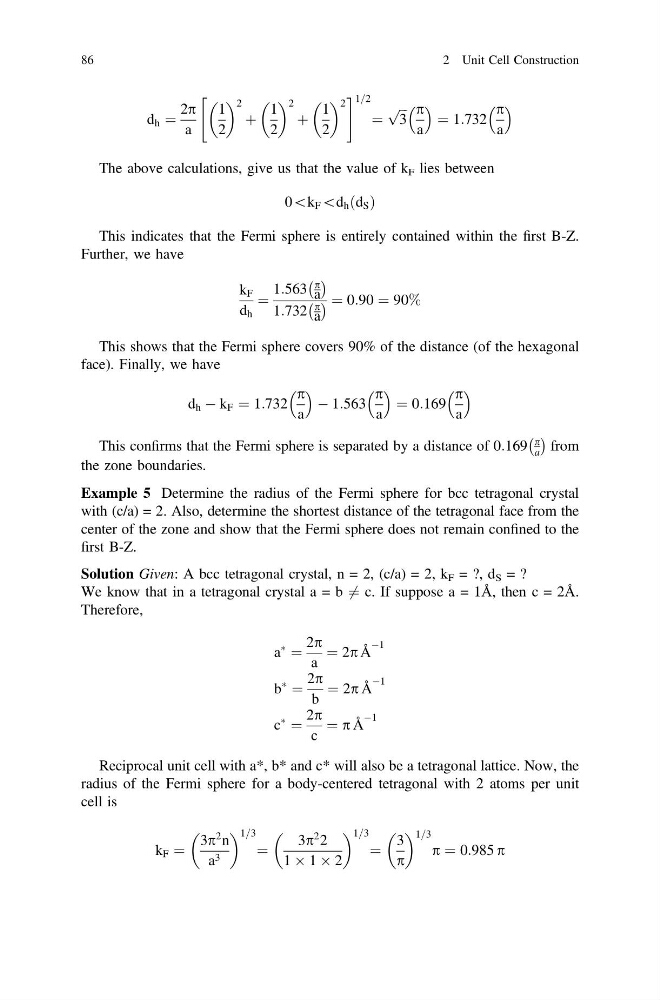
The above calculations, give us that the value of k F lies between
0\k F \d h d S
ð Þ
This indicates that the Fermi sphere is entirely contained within the first B-Z.
Further, we have
k F
d h
¼
1:563
p
a
À Á
1:732
p
a
À Á ¼ 0:90 ¼ 90%
This shows that the Fermi sphere covers 90% of the distance (of the hexagonal
face). Finally, we have
d h À k F ¼ 1:732
p
a
À 1:563
p
a
¼ 0:169
p
a
This confirms that the Fermi sphere is separated by a distance of 0:169
p
a
À Á
from
the zone boundaries.
Example 5 Determine the radius of the Fermi sphere for bcc tetragonal crystal
with (c/a) = 2. Also, determine the shortest distance of the tetragonal face from the
center of the zone and show that the Fermi sphere does not remain confined to the
first B-Z.
Solution Given: A bcc tetragonal crystal, n = 2, (c/a) = 2, k F = ?, d S = ?
We know that in a tetragonal crystal a = b 6 ¼ c. If suppose a = 1Å, then c = 2Å.
Therefore,
a
Ã
¼
2p
a
¼ 2p ˚
A
À1
b
Ã
¼
2p
b
¼ 2p ˚
A
À1
c
Ã
¼
2p
c
¼ p ˚
A
À1
Reciprocal unit cell with a*, b* and c* will also be a tetragonal lattice. Now, the
radius of the Fermi sphere for a body-centered tetragonal with 2 atoms per unit
cell is
k F ¼
3p
2 n
a 3
1=3
¼
3p
2 2
1 Â 1 Â 2
1=3
¼
3
p
1=3
p ¼ 0:985 p
86
2 Unit Cell Construction
2p
a
1
2
2
þ
1
2
2
þ
1
2
2
"
# 1=2
¼
ffiffi ffi
3
p p
a
¼ 1:732
p
a
The above calculations, give us that the value of k F lies between
0\k F \d h d S
ð Þ
This indicates that the Fermi sphere is entirely contained within the first B-Z.
Further, we have
k F
d h
¼
1:563
p
a
À Á
1:732
p
a
À Á ¼ 0:90 ¼ 90%
This shows that the Fermi sphere covers 90% of the distance (of the hexagonal
face). Finally, we have
d h À k F ¼ 1:732
p
a
À 1:563
p
a
¼ 0:169
p
a
This confirms that the Fermi sphere is separated by a distance of 0:169
p
a
À Á
from
the zone boundaries.
Example 5 Determine the radius of the Fermi sphere for bcc tetragonal crystal
with (c/a) = 2. Also, determine the shortest distance of the tetragonal face from the
center of the zone and show that the Fermi sphere does not remain confined to the
first B-Z.
Solution Given: A bcc tetragonal crystal, n = 2, (c/a) = 2, k F = ?, d S = ?
We know that in a tetragonal crystal a = b 6 ¼ c. If suppose a = 1Å, then c = 2Å.
Therefore,
a
Ã
¼
2p
a
¼ 2p ˚
A
À1
b
Ã
¼
2p
b
¼ 2p ˚
A
À1
c
Ã
¼
2p
c
¼ p ˚
A
À1
Reciprocal unit cell with a*, b* and c* will also be a tetragonal lattice. Now, the
radius of the Fermi sphere for a body-centered tetragonal with 2 atoms per unit
cell is
k F ¼
3p
2 n
a 3
1=3
¼
3p
2 2
1 Â 1 Â 2
1=3
¼
3
p
1=3
p ¼ 0:985 p
86
2 Unit Cell Construction