

62
L. Rondoni
p
(q)
i () =
(q)
i +
2
(q)
i −
2
⎧
⎨
⎩
ρ((; )
j =i
d j
⎫
⎬
⎭
d i
(1.221)
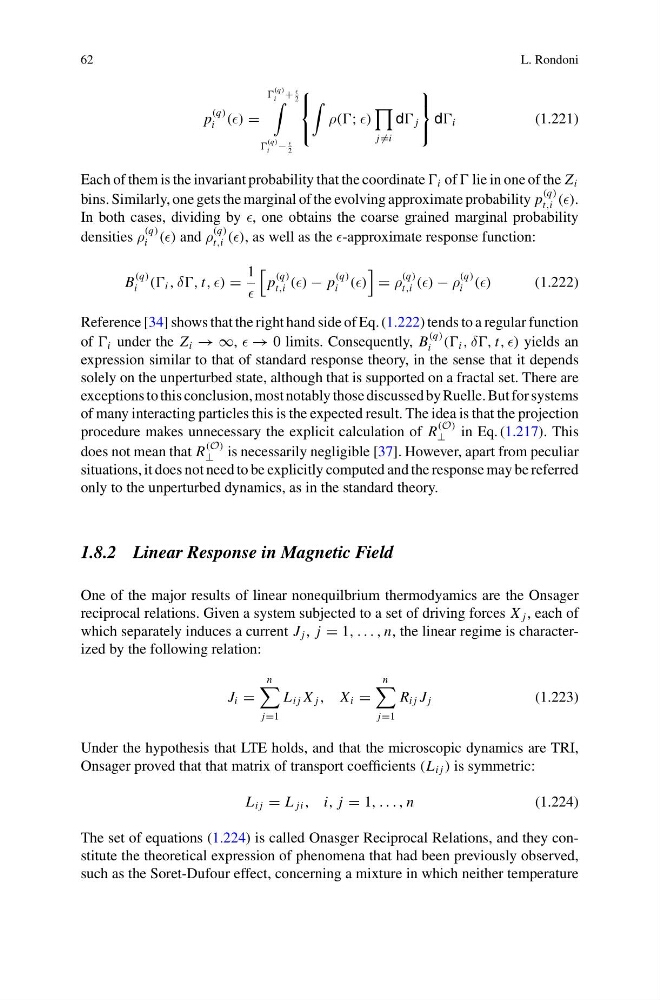
Each of them is the invariant probability that the coordinate i of lie in one of the Z i
bins. Similarly, one gets the marginal of the evolving approximate probability p
(q)
t,i ().
In both cases, dividing by , one obtains the coarse grained marginal probability
densities ρ
(q)
i () and ρ
(q)
t,i (), as well as the -approximate response function:
B
(q)
i (( i , δ, t, ) =
1
p
(q)
t,i () − p
(q)
i ()
= ρ
(q)
t,i () − ρ
(q)
i ()
(1.222)
Reference [34] shows that the right hand side of Eq. (1.222) tends to a regular function
of i under the Z i → ∞, → 0 limits. Consequently, B
(q)
i (( i , δ, t, ) yields an
expression similar to that of standard response theory, in the sense that it depends
solely on the unperturbed state, although that is supported on a fractal set. There are
exceptions to this conclusion, most notably those discussed by Ruelle. But for systems
of many interacting particles this is the expected result. The idea is that the projection
procedure makes unnecessary the explicit calculation of R
(O)
⊥ in Eq. (1.217). This
does not mean that R
(O)
⊥ is necessarily negligible [37]. However, apart from peculiar
situations, it does not need to be explicitly computed and the response may be referred
only to the unperturbed dynamics, as in the standard theory.
1.8.2 Linear Response in Magnetic Field
One of the major results of linear nonequilbrium thermodyamics are the Onsager
reciprocal relations. Given a system subjected to a set of driving forces X j , each of
which separately induces a current J j , j = 1, . . . , n, the linear regime is characterized by the following relation:
J i =
n
j=1
L i j X j , X i =
n
j=1
R i j J j
(1.223)
Under the hypothesis that LTE holds, and that the microscopic dynamics are TRI,
Onsager proved that that matrix of transport coefficients (L i j ) is symmetric:
L i j = L ji , i, j = 1, . . . , n
(1.224)
The set of equations (1.224) is called Onasger Reciprocal Relations, and they constitute the theoretical expression of phenomena that had been previously observed,
such as the Soret-Dufour effect, concerning a mixture in which neither temperature
L. Rondoni
p
(q)
i () =
(q)
i +
2
(q)
i −
2
⎧
⎨
⎩
ρ((; )
j =i
d j
⎫
⎬
⎭
d i
(1.221)
Each of them is the invariant probability that the coordinate i of lie in one of the Z i
bins. Similarly, one gets the marginal of the evolving approximate probability p
(q)
t,i ().
In both cases, dividing by , one obtains the coarse grained marginal probability
densities ρ
(q)
i () and ρ
(q)
t,i (), as well as the -approximate response function:
B
(q)
i (( i , δ, t, ) =
1
p
(q)
t,i () − p
(q)
i ()
= ρ
(q)
t,i () − ρ
(q)
i ()
(1.222)
Reference [34] shows that the right hand side of Eq. (1.222) tends to a regular function
of i under the Z i → ∞, → 0 limits. Consequently, B
(q)
i (( i , δ, t, ) yields an
expression similar to that of standard response theory, in the sense that it depends
solely on the unperturbed state, although that is supported on a fractal set. There are
exceptions to this conclusion, most notably those discussed by Ruelle. But for systems
of many interacting particles this is the expected result. The idea is that the projection
procedure makes unnecessary the explicit calculation of R
(O)
⊥ in Eq. (1.217). This
does not mean that R
(O)
⊥ is necessarily negligible [37]. However, apart from peculiar
situations, it does not need to be explicitly computed and the response may be referred
only to the unperturbed dynamics, as in the standard theory.
1.8.2 Linear Response in Magnetic Field
One of the major results of linear nonequilbrium thermodyamics are the Onsager
reciprocal relations. Given a system subjected to a set of driving forces X j , each of
which separately induces a current J j , j = 1, . . . , n, the linear regime is characterized by the following relation:
J i =
n
j=1
L i j X j , X i =
n
j=1
R i j J j
(1.223)
Under the hypothesis that LTE holds, and that the microscopic dynamics are TRI,
Onsager proved that that matrix of transport coefficients (L i j ) is symmetric:
L i j = L ji , i, j = 1, . . . , n
(1.224)
The set of equations (1.224) is called Onasger Reciprocal Relations, and they constitute the theoretical expression of phenomena that had been previously observed,
such as the Soret-Dufour effect, concerning a mixture in which neither temperature