

50
L. Rondoni
For this to make sense, cells must be sufficiently large to contain a large number of
particles whose motion is sufficiently random, that those which enter or leave a cell
are a negligible number compared to those inside. At the same time the cells must
be sufficiently small compared to the observation scale, that they appear like a point.
Clearly, this requires a wide separation of scales.
Suppose we now folllow an elementary set qp, as the particles contained in
it move in their container. Assume that ρ accurately describes the mass density in μspace and within the set under consideration. No particles enter or leave q, even if
its shape may be deformed in time. Particles may however enter or leave p because
colliding with each other they may suddenly fall into or exit from p. Therefore,
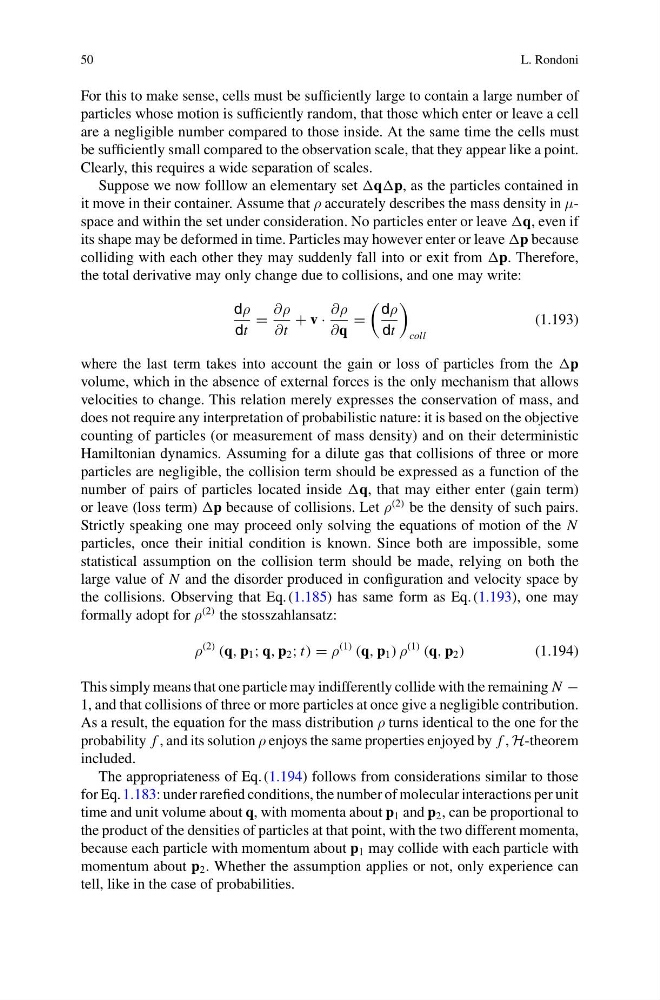
the total derivative may only change due to collisions, and one may write:
dρ
dt
=
∂ρ
∂t
+ v ·
∂ρ
∂q
=
dρ
dt
coll
(1.193)
where the last term takes into account the gain or loss of particles from the p
volume, which in the absence of external forces is the only mechanism that allows
velocities to change. This relation merely expresses the conservation of mass, and
does not require any interpretation of probabilistic nature: it is based on the objective
counting of particles (or measurement of mass density) and on their deterministic
Hamiltonian dynamics. Assuming for a dilute gas that collisions of three or more
particles are negligible, the collision term should be expressed as a function of the
number of pairs of particles located inside q, that may either enter (gain term)
or leave (loss term) p because of collisions. Let ρ
(2) be the density of such pairs.
Strictly speaking one may proceed only solving the equations of motion of the N
particles, once their initial condition is known. Since both are impossible, some
statistical assumption on the collision term should be made, relying on both the
large value of N and the disorder produced in configuration and velocity space by
the collisions. Observing that Eq. (1.185) has same form as Eq. (1.193), one may
formally adopt for ρ
(2) the stosszahlansatz:
ρ
(2)
(q, p 1 ; q, p 2 ; t) = ρ
(1)
(q, p 1 ) ρ
(1)
(q, p 2 )
(1.194)
This simply means that one particle may indifferently collide with the remaining N −
1, and that collisions of three or more particles at once give a negligible contribution.
As a result, the equation for the mass distribution ρ turns identical to the one for the
probability f , and its solution ρ enjoys the same properties enjoyed by f , H-theorem
included.
The appropriateness of Eq. (1.194) follows from considerations similar to those
for Eq. 1.183: under rarefied conditions, the number of molecular interactions per unit
time and unit volume about q, with momenta about p 1 and p 2 , can be proportional to
the product of the densities of particles at that point, with the two different momenta,
because each particle with momentum about p 1 may collide with each particle with
momentum about p 2 . Whether the assumption applies or not, only experience can
tell, like in the case of probabilities.
L. Rondoni
For this to make sense, cells must be sufficiently large to contain a large number of
particles whose motion is sufficiently random, that those which enter or leave a cell
are a negligible number compared to those inside. At the same time the cells must
be sufficiently small compared to the observation scale, that they appear like a point.
Clearly, this requires a wide separation of scales.
Suppose we now folllow an elementary set qp, as the particles contained in
it move in their container. Assume that ρ accurately describes the mass density in μspace and within the set under consideration. No particles enter or leave q, even if
its shape may be deformed in time. Particles may however enter or leave p because
colliding with each other they may suddenly fall into or exit from p. Therefore,
the total derivative may only change due to collisions, and one may write:
dρ
dt
=
∂ρ
∂t
+ v ·
∂ρ
∂q
=
dρ
dt
coll
(1.193)
where the last term takes into account the gain or loss of particles from the p
volume, which in the absence of external forces is the only mechanism that allows
velocities to change. This relation merely expresses the conservation of mass, and
does not require any interpretation of probabilistic nature: it is based on the objective
counting of particles (or measurement of mass density) and on their deterministic
Hamiltonian dynamics. Assuming for a dilute gas that collisions of three or more
particles are negligible, the collision term should be expressed as a function of the
number of pairs of particles located inside q, that may either enter (gain term)
or leave (loss term) p because of collisions. Let ρ
(2) be the density of such pairs.
Strictly speaking one may proceed only solving the equations of motion of the N
particles, once their initial condition is known. Since both are impossible, some
statistical assumption on the collision term should be made, relying on both the
large value of N and the disorder produced in configuration and velocity space by
the collisions. Observing that Eq. (1.185) has same form as Eq. (1.193), one may
formally adopt for ρ
(2) the stosszahlansatz:
ρ
(2)
(q, p 1 ; q, p 2 ; t) = ρ
(1)
(q, p 1 ) ρ
(1)
(q, p 2 )
(1.194)
This simply means that one particle may indifferently collide with the remaining N −
1, and that collisions of three or more particles at once give a negligible contribution.
As a result, the equation for the mass distribution ρ turns identical to the one for the
probability f , and its solution ρ enjoys the same properties enjoyed by f , H-theorem
included.
The appropriateness of Eq. (1.194) follows from considerations similar to those
for Eq. 1.183: under rarefied conditions, the number of molecular interactions per unit
time and unit volume about q, with momenta about p 1 and p 2 , can be proportional to
the product of the densities of particles at that point, with the two different momenta,
because each particle with momentum about p 1 may collide with each particle with
momentum about p 2 . Whether the assumption applies or not, only experience can
tell, like in the case of probabilities.