

36
L. Rondoni
˙
v(t) = −
t
−∞
γ(t − t
)v(t
)dt
+ (t), E[(t)] = 0
(1.138)
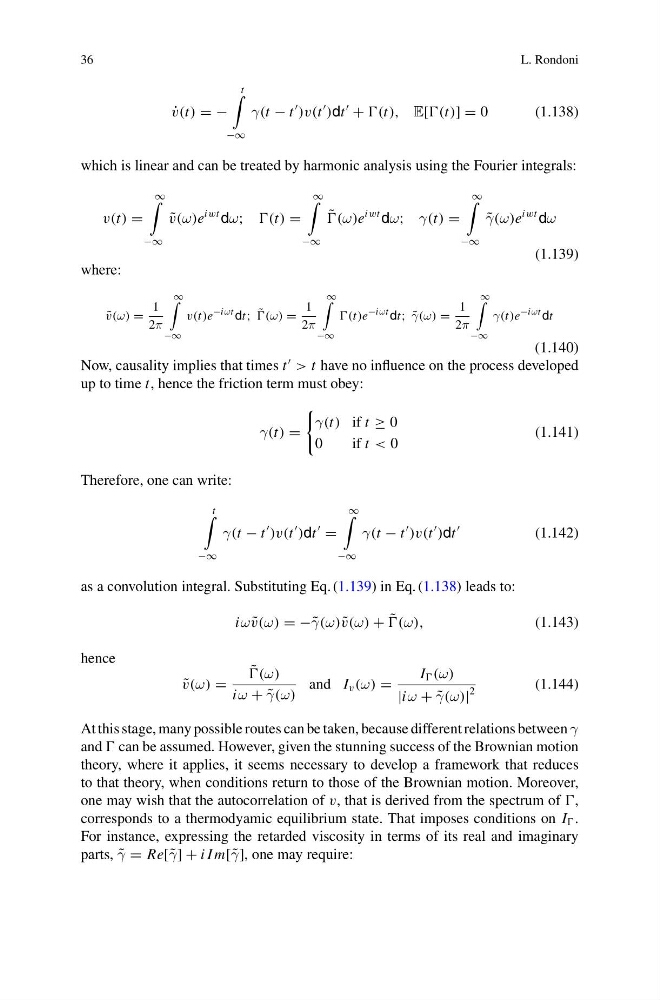
which is linear and can be treated by harmonic analysis using the Fourier integrals:
v(t) =
∞
−∞
˜
v(ω)e
iwt dω; (t) =
∞
−∞
˜
(ω)e
iwt dω; γ(t) =
∞
−∞
˜
γ(ω)e
iwt dω
(1.139)
where:
˜
v(ω) =
1
2π
∞
−∞
v(t)e
−iωt dt; ˜
(ω) =
1
2π
∞
−∞
(t)e
−iωt dt; ˜
γ(ω) =
1
2π
∞
−∞
γ(t)e
−iωt dt
(1.140)
Now, causality implies that times t
> t have no influence on the process developed
up to time t, hence the friction term must obey:
γ(t) =
γ(t) if t ≥ 0
0
ift < 0
(1.141)
Therefore, one can write:
t
−∞
γ(t − t
)v(t
)dt
=
∞
−∞
γ(t − t
)v(t
)dt
(1.142)
as a convolution integral. Substituting Eq. (1.139) in Eq. (1.138) leads to:
iω ˜
v(ω) = −˜ γ(ω) ˜
v(ω) + ˜
(ω),
(1.143)
hence
˜
v(ω) =
˜
(ω)
iω + ˜
γ(ω)
and I v (ω) =
I (ω)
|iω + ˜
γ(ω)|
2
(1.144)
At this stage, many possible routes can be taken, because different relations between γ
and can be assumed. However, given the stunning success of the Brownian motion
theory, where it applies, it seems necessary to develop a framework that reduces
to that theory, when conditions return to those of the Brownian motion. Moreover,
one may wish that the autocorrelation of v, that is derived from the spectrum of ,
corresponds to a thermodyamic equilibrium state. That imposes conditions on I .
For instance, expressing the retarded viscosity in terms of its real and imaginary
parts, ˜
γ = Re[ ˜
γ] + i I m[ ˜
γ], one may require:
L. Rondoni
˙
v(t) = −
t
−∞
γ(t − t
)v(t
)dt
+ (t), E[(t)] = 0
(1.138)
which is linear and can be treated by harmonic analysis using the Fourier integrals:
v(t) =
∞
−∞
˜
v(ω)e
iwt dω; (t) =
∞
−∞
˜
(ω)e
iwt dω; γ(t) =
∞
−∞
˜
γ(ω)e
iwt dω
(1.139)
where:
˜
v(ω) =
1
2π
∞
−∞
v(t)e
−iωt dt; ˜
(ω) =
1
2π
∞
−∞
(t)e
−iωt dt; ˜
γ(ω) =
1
2π
∞
−∞
γ(t)e
−iωt dt
(1.140)
Now, causality implies that times t
> t have no influence on the process developed
up to time t, hence the friction term must obey:
γ(t) =
γ(t) if t ≥ 0
0
ift < 0
(1.141)
Therefore, one can write:
t
−∞
γ(t − t
)v(t
)dt
=
∞
−∞
γ(t − t
)v(t
)dt
(1.142)
as a convolution integral. Substituting Eq. (1.139) in Eq. (1.138) leads to:
iω ˜
v(ω) = −˜ γ(ω) ˜
v(ω) + ˜
(ω),
(1.143)
hence
˜
v(ω) =
˜
(ω)
iω + ˜
γ(ω)
and I v (ω) =
I (ω)
|iω + ˜
γ(ω)|
2
(1.144)
At this stage, many possible routes can be taken, because different relations between γ
and can be assumed. However, given the stunning success of the Brownian motion
theory, where it applies, it seems necessary to develop a framework that reduces
to that theory, when conditions return to those of the Brownian motion. Moreover,
one may wish that the autocorrelation of v, that is derived from the spectrum of ,
corresponds to a thermodyamic equilibrium state. That imposes conditions on I .
For instance, expressing the retarded viscosity in terms of its real and imaginary
parts, ˜
γ = Re[ ˜
γ] + i I m[ ˜
γ], one may require: