

350
K. Xiao and C.-X. Wu
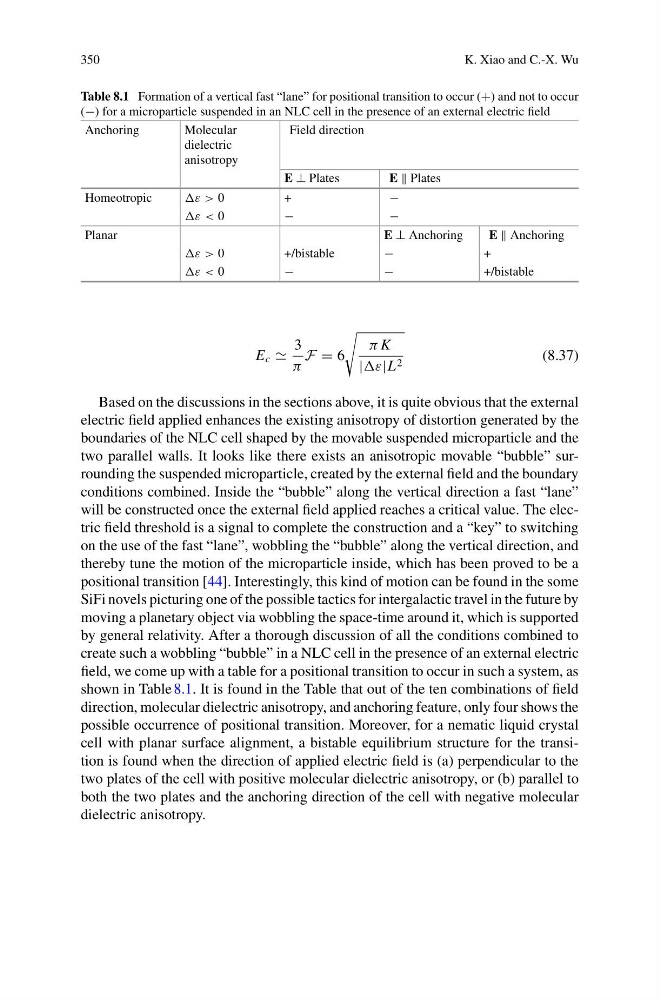
Table 8.1 Formation of a vertical fast “lane” for positional transition to occur (+) and not to occur
(−) for a microparticle suspended in an NLC cell in the presence of an external electric field
Anchoring
Molecular
dielectric
anisotropy
Field direction
E ⊥ Plates
E Plates
Homeotropic
> 0
+
−
ε < 0
−
−
Planar
E ⊥ Anchoring
E Anchoring
ε > 0
+/bistable
−
+
ε < 0
−
−
+/bistable
E c
3
π
F = 6
π K
|ε|L 2
(8.37)
Based on the discussions in the sections above, it is quite obvious that the external
electric field applied enhances the existing anisotropy of distortion generated by the
boundaries of the NLC cell shaped by the movable suspended microparticle and the
two parallel walls. It looks like there exists an anisotropic movable “bubble” surrounding the suspended microparticle, created by the external field and the boundary
conditions combined. Inside the “bubble” along the vertical direction a fast “lane”
will be constructed once the external field applied reaches a critical value. The electric field threshold is a signal to complete the construction and a “key” to switching
on the use of the fast “lane”, wobbling the “bubble” along the vertical direction, and
thereby tune the motion of the microparticle inside, which has been proved to be a
positional transition [44]. Interestingly, this kind of motion can be found in the some
SiFi novels picturing one of the possible tactics for intergalactic travel in the future by
moving a planetary object via wobbling the space-time around it, which is supported
by general relativity. After a thorough discussion of all the conditions combined to
create such a wobbling “bubble” in a NLC cell in the presence of an external electric
field, we come up with a table for a positional transition to occur in such a system, as
shown in Table 8.1. It is found in the Table that out of the ten combinations of field
direction, molecular dielectric anisotropy, and anchoring feature, only four shows the
possible occurrence of positional transition. Moreover, for a nematic liquid crystal
cell with planar surface alignment, a bistable equilibrium structure for the transition is found when the direction of applied electric field is (a) perpendicular to the
two plates of the cell with positive molecular dielectric anisotropy, or (b) parallel to
both the two plates and the anchoring direction of the cell with negative molecular
dielectric anisotropy.
K. Xiao and C.-X. Wu
Table 8.1 Formation of a vertical fast “lane” for positional transition to occur (+) and not to occur
(−) for a microparticle suspended in an NLC cell in the presence of an external electric field
Anchoring
Molecular
dielectric
anisotropy
Field direction
E ⊥ Plates
E Plates
Homeotropic
> 0
+
−
ε < 0
−
−
Planar
E ⊥ Anchoring
E Anchoring
ε > 0
+/bistable
−
+
ε < 0
−
−
+/bistable
E c
3
π
F = 6
π K
|ε|L 2
(8.37)
Based on the discussions in the sections above, it is quite obvious that the external
electric field applied enhances the existing anisotropy of distortion generated by the
boundaries of the NLC cell shaped by the movable suspended microparticle and the
two parallel walls. It looks like there exists an anisotropic movable “bubble” surrounding the suspended microparticle, created by the external field and the boundary
conditions combined. Inside the “bubble” along the vertical direction a fast “lane”
will be constructed once the external field applied reaches a critical value. The electric field threshold is a signal to complete the construction and a “key” to switching
on the use of the fast “lane”, wobbling the “bubble” along the vertical direction, and
thereby tune the motion of the microparticle inside, which has been proved to be a
positional transition [44]. Interestingly, this kind of motion can be found in the some
SiFi novels picturing one of the possible tactics for intergalactic travel in the future by
moving a planetary object via wobbling the space-time around it, which is supported
by general relativity. After a thorough discussion of all the conditions combined to
create such a wobbling “bubble” in a NLC cell in the presence of an external electric
field, we come up with a table for a positional transition to occur in such a system, as
shown in Table 8.1. It is found in the Table that out of the ten combinations of field
direction, molecular dielectric anisotropy, and anchoring feature, only four shows the
possible occurrence of positional transition. Moreover, for a nematic liquid crystal
cell with planar surface alignment, a bistable equilibrium structure for the transition is found when the direction of applied electric field is (a) perpendicular to the
two plates of the cell with positive molecular dielectric anisotropy, or (b) parallel to
both the two plates and the anchoring direction of the cell with negative molecular
dielectric anisotropy.