

7 A Primer on Gels (with an Emphasis on Molecular Gels)
301
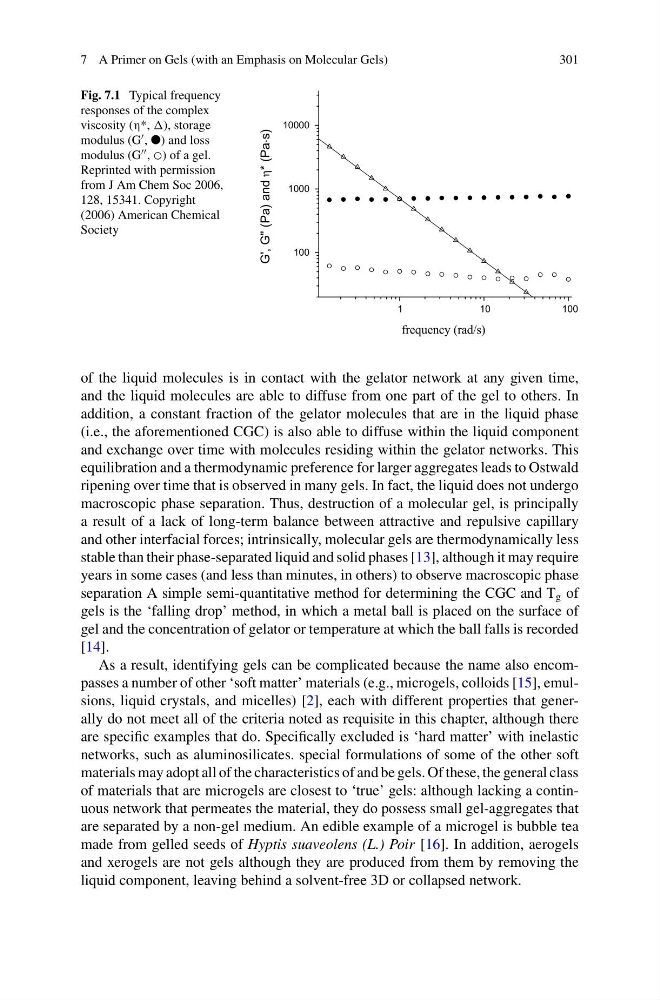
Fig. 7.1 Typical frequency
responses of the complex
viscosity (η*, ), storage
modulus (G , ●) and loss
modulus (G , ◯) of a gel.
Reprinted with permission
from J Am Chem Soc 2006,
128, 15341. Copyright
(2006) American Chemical
Society
100
10
1
100
1000
10000
.
G', G" (Pa) and η*
(Pa s)
frequency (rad/s)
of the liquid molecules is in contact with the gelator network at any given time,
and the liquid molecules are able to diffuse from one part of the gel to others. In
addition, a constant fraction of the gelator molecules that are in the liquid phase
(i.e., the aforementioned CGC) is also able to diffuse within the liquid component
and exchange over time with molecules residing within the gelator networks. This
equilibration and a thermodynamic preference for larger aggregates leads to Ostwald
ripening over time that is observed in many gels. In fact, the liquid does not undergo
macroscopic phase separation. Thus, destruction of a molecular gel, is principally
a result of a lack of long-term balance between attractive and repulsive capillary
and other interfacial forces; intrinsically, molecular gels are thermodynamically less
stable than their phase-separated liquid and solid phases [13], although it may require
years in some cases (and less than minutes, in others) to observe macroscopic phase
separation A simple semi-quantitative method for determining the CGC and T g of
gels is the ‘falling drop’ method, in which a metal ball is placed on the surface of
gel and the concentration of gelator or temperature at which the ball falls is recorded
[14].
As a result, identifying gels can be complicated because the name also encompasses a number of other ‘soft matter’ materials (e.g., microgels, colloids [15], emulsions, liquid crystals, and micelles) [2], each with different properties that generally do not meet all of the criteria noted as requisite in this chapter, although there
are specific examples that do. Specifically excluded is ‘hard matter’ with inelastic
networks, such as aluminosilicates. special formulations of some of the other soft
materials may adopt all of the characteristics of and be gels. Of these, the general class
of materials that are microgels are closest to ‘true’ gels: although lacking a continuous network that permeates the material, they do possess small gel-aggregates that
are separated by a non-gel medium. An edible example of a microgel is bubble tea
made from gelled seeds of Hyptis suaveolens (L.) Poir [16]. In addition, aerogels
and xerogels are not gels although they are produced from them by removing the
liquid component, leaving behind a solvent-free 3D or collapsed network.
301
Fig. 7.1 Typical frequency
responses of the complex
viscosity (η*, ), storage
modulus (G , ●) and loss
modulus (G , ◯) of a gel.
Reprinted with permission
from J Am Chem Soc 2006,
128, 15341. Copyright
(2006) American Chemical
Society
100
10
1
100
1000
10000
.
G', G" (Pa) and η*
(Pa s)
frequency (rad/s)
of the liquid molecules is in contact with the gelator network at any given time,
and the liquid molecules are able to diffuse from one part of the gel to others. In
addition, a constant fraction of the gelator molecules that are in the liquid phase
(i.e., the aforementioned CGC) is also able to diffuse within the liquid component
and exchange over time with molecules residing within the gelator networks. This
equilibration and a thermodynamic preference for larger aggregates leads to Ostwald
ripening over time that is observed in many gels. In fact, the liquid does not undergo
macroscopic phase separation. Thus, destruction of a molecular gel, is principally
a result of a lack of long-term balance between attractive and repulsive capillary
and other interfacial forces; intrinsically, molecular gels are thermodynamically less
stable than their phase-separated liquid and solid phases [13], although it may require
years in some cases (and less than minutes, in others) to observe macroscopic phase
separation A simple semi-quantitative method for determining the CGC and T g of
gels is the ‘falling drop’ method, in which a metal ball is placed on the surface of
gel and the concentration of gelator or temperature at which the ball falls is recorded
[14].
As a result, identifying gels can be complicated because the name also encompasses a number of other ‘soft matter’ materials (e.g., microgels, colloids [15], emulsions, liquid crystals, and micelles) [2], each with different properties that generally do not meet all of the criteria noted as requisite in this chapter, although there
are specific examples that do. Specifically excluded is ‘hard matter’ with inelastic
networks, such as aluminosilicates. special formulations of some of the other soft
materials may adopt all of the characteristics of and be gels. Of these, the general class
of materials that are microgels are closest to ‘true’ gels: although lacking a continuous network that permeates the material, they do possess small gel-aggregates that
are separated by a non-gel medium. An edible example of a microgel is bubble tea
made from gelled seeds of Hyptis suaveolens (L.) Poir [16]. In addition, aerogels
and xerogels are not gels although they are produced from them by removing the
liquid component, leaving behind a solvent-free 3D or collapsed network.