

6 Cocoon Silk: From Mesoscopic Materials Design …
295
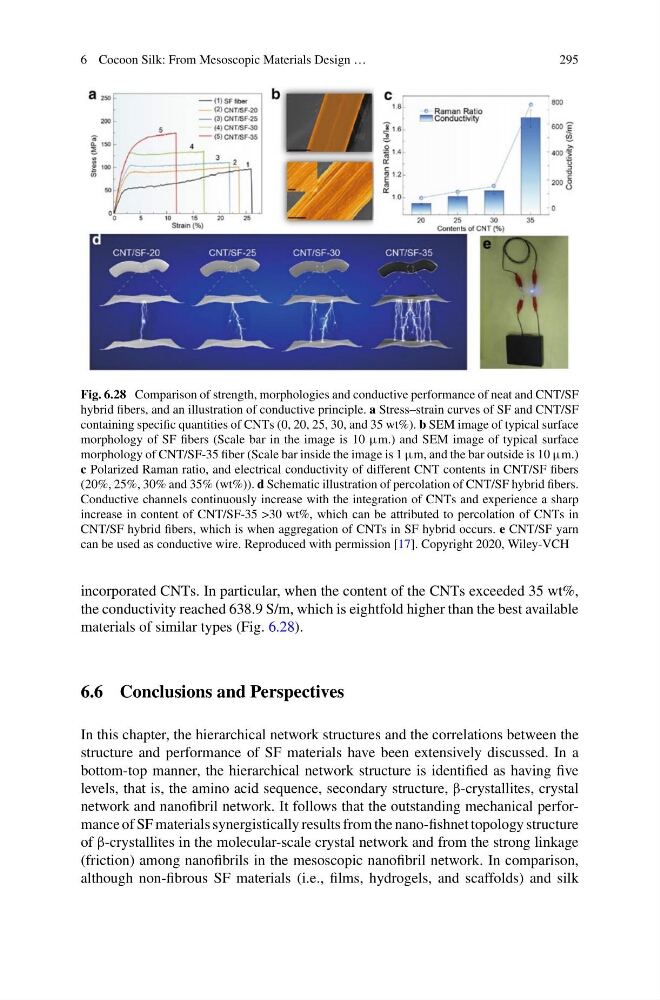
Fig. 6.28 Comparison of strength, morphologies and conductive performance of neat and CNT/SF
hybrid fibers, and an illustration of conductive principle. a Stress–strain curves of SF and CNT/SF
containing specific quantities of CNTs (0, 20, 25, 30, and 35 wt%). b SEM image of typical surface
morphology of SF fibers (Scale bar in the image is 10 μm.) and SEM image of typical surface
morphology of CNT/SF-35 fiber (Scale bar inside the image is 1 μm, and the bar outside is 10 μm.)
c Polarized Raman ratio, and electrical conductivity of different CNT contents in CNT/SF fibers
(20%, 25%, 30% and 35% (wt%)). d Schematic illustration of percolation of CNT/SF hybrid fibers.
Conductive channels continuously increase with the integration of CNTs and experience a sharp
increase in content of CNT/SF-35 >30 wt%, which can be attributed to percolation of CNTs in
CNT/SF hybrid fibers, which is when aggregation of CNTs in SF hybrid occurs. e CNT/SF yarn
can be used as conductive wire. Reproduced with permission [17]. Copyright 2020, Wiley-VCH
incorporated CNTs. In particular, when the content of the CNTs exceeded 35 wt%,
the conductivity reached 638.9 S/m, which is eightfold higher than the best available
materials of similar types (Fig. 6.28).
6.6 Conclusions and Perspectives
In this chapter, the hierarchical network structures and the correlations between the
structure and performance of SF materials have been extensively discussed. In a
bottom-top manner, the hierarchical network structure is identified as having five
levels, that is, the amino acid sequence, secondary structure, β-crystallites, crystal
network and nanofibril network. It follows that the outstanding mechanical performance of SF materials synergistically results from the nano-fishnet topology structure
of β-crystallites in the molecular-scale crystal network and from the strong linkage
(friction) among nanofibrils in the mesoscopic nanofibril network. In comparison,
although non-fibrous SF materials (i.e., films, hydrogels, and scaffolds) and silk
295
Fig. 6.28 Comparison of strength, morphologies and conductive performance of neat and CNT/SF
hybrid fibers, and an illustration of conductive principle. a Stress–strain curves of SF and CNT/SF
containing specific quantities of CNTs (0, 20, 25, 30, and 35 wt%). b SEM image of typical surface
morphology of SF fibers (Scale bar in the image is 10 μm.) and SEM image of typical surface
morphology of CNT/SF-35 fiber (Scale bar inside the image is 1 μm, and the bar outside is 10 μm.)
c Polarized Raman ratio, and electrical conductivity of different CNT contents in CNT/SF fibers
(20%, 25%, 30% and 35% (wt%)). d Schematic illustration of percolation of CNT/SF hybrid fibers.
Conductive channels continuously increase with the integration of CNTs and experience a sharp
increase in content of CNT/SF-35 >30 wt%, which can be attributed to percolation of CNTs in
CNT/SF hybrid fibers, which is when aggregation of CNTs in SF hybrid occurs. e CNT/SF yarn
can be used as conductive wire. Reproduced with permission [17]. Copyright 2020, Wiley-VCH
incorporated CNTs. In particular, when the content of the CNTs exceeded 35 wt%,
the conductivity reached 638.9 S/m, which is eightfold higher than the best available
materials of similar types (Fig. 6.28).
6.6 Conclusions and Perspectives
In this chapter, the hierarchical network structures and the correlations between the
structure and performance of SF materials have been extensively discussed. In a
bottom-top manner, the hierarchical network structure is identified as having five
levels, that is, the amino acid sequence, secondary structure, β-crystallites, crystal
network and nanofibril network. It follows that the outstanding mechanical performance of SF materials synergistically results from the nano-fishnet topology structure
of β-crystallites in the molecular-scale crystal network and from the strong linkage
(friction) among nanofibrils in the mesoscopic nanofibril network. In comparison,
although non-fibrous SF materials (i.e., films, hydrogels, and scaffolds) and silk