

284
W. Qiu and X.-Y. Liu
Here, ρ c is the particle density in the nuclei, γ is the surface free energy area
density, and Δμ is the chemical potential difference between the mother and crystalline phases [62]. As observed in Eq. 6.1, it is evident that Δμ is the prime factor;
hence, we need to highlight and comprehensively discuss it. The following Eq. 6.7
can be obtained from the definition of Δμ.
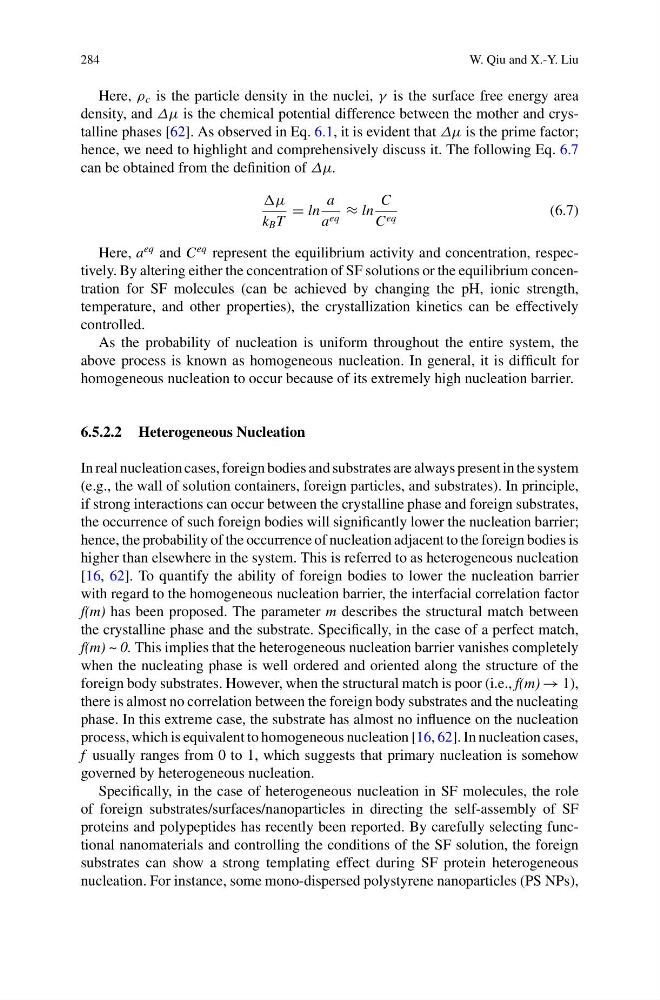
μ
k B T
= ln
a
a eq ≈ ln
C
C eq
(6.7)
Here, a
eq and C
eq represent the equilibrium activity and concentration, respectively. By altering either the concentration of SF solutions or the equilibrium concentration for SF molecules (can be achieved by changing the pH, ionic strength,
temperature, and other properties), the crystallization kinetics can be effectively
controlled.
As the probability of nucleation is uniform throughout the entire system, the
above process is known as homogeneous nucleation. In general, it is difficult for
homogeneous nucleation to occur because of its extremely high nucleation barrier.
6.5.2.2 Heterogeneous Nucleation
In real nucleation cases, foreign bodies and substrates are always present in the system
(e.g., the wall of solution containers, foreign particles, and substrates). In principle,
if strong interactions can occur between the crystalline phase and foreign substrates,
the occurrence of such foreign bodies will significantly lower the nucleation barrier;
hence, the probability of the occurrence of nucleation adjacent to the foreign bodies is
higher than elsewhere in the system. This is referred to as heterogeneous nucleation
[16, 62]. To quantify the ability of foreign bodies to lower the nucleation barrier
with regard to the homogeneous nucleation barrier, the interfacial correlation factor
f(m) has been proposed. The parameter m describes the structural match between
the crystalline phase and the substrate. Specifically, in the case of a perfect match,
f(m) ~ 0. This implies that the heterogeneous nucleation barrier vanishes completely
when the nucleating phase is well ordered and oriented along the structure of the
foreign body substrates. However, when the structural match is poor (i.e., f(m) → 1),
there is almost no correlation between the foreign body substrates and the nucleating
phase. In this extreme case, the substrate has almost no influence on the nucleation
process, which is equivalent to homogeneous nucleation [16, 62]. In nucleation cases,
f usually ranges from 0 to 1, which suggests that primary nucleation is somehow
governed by heterogeneous nucleation.
Specifically, in the case of heterogeneous nucleation in SF molecules, the role
of foreign substrates/surfaces/nanoparticles in directing the self-assembly of SF
proteins and polypeptides has recently been reported. By carefully selecting functional nanomaterials and controlling the conditions of the SF solution, the foreign
substrates can show a strong templating effect during SF protein heterogeneous
nucleation. For instance, some mono-dispersed polystyrene nanoparticles (PS NPs),
W. Qiu and X.-Y. Liu
Here, ρ c is the particle density in the nuclei, γ is the surface free energy area
density, and Δμ is the chemical potential difference between the mother and crystalline phases [62]. As observed in Eq. 6.1, it is evident that Δμ is the prime factor;
hence, we need to highlight and comprehensively discuss it. The following Eq. 6.7
can be obtained from the definition of Δμ.
μ
k B T
= ln
a
a eq ≈ ln
C
C eq
(6.7)
Here, a
eq and C
eq represent the equilibrium activity and concentration, respectively. By altering either the concentration of SF solutions or the equilibrium concentration for SF molecules (can be achieved by changing the pH, ionic strength,
temperature, and other properties), the crystallization kinetics can be effectively
controlled.
As the probability of nucleation is uniform throughout the entire system, the
above process is known as homogeneous nucleation. In general, it is difficult for
homogeneous nucleation to occur because of its extremely high nucleation barrier.
6.5.2.2 Heterogeneous Nucleation
In real nucleation cases, foreign bodies and substrates are always present in the system
(e.g., the wall of solution containers, foreign particles, and substrates). In principle,
if strong interactions can occur between the crystalline phase and foreign substrates,
the occurrence of such foreign bodies will significantly lower the nucleation barrier;
hence, the probability of the occurrence of nucleation adjacent to the foreign bodies is
higher than elsewhere in the system. This is referred to as heterogeneous nucleation
[16, 62]. To quantify the ability of foreign bodies to lower the nucleation barrier
with regard to the homogeneous nucleation barrier, the interfacial correlation factor
f(m) has been proposed. The parameter m describes the structural match between
the crystalline phase and the substrate. Specifically, in the case of a perfect match,
f(m) ~ 0. This implies that the heterogeneous nucleation barrier vanishes completely
when the nucleating phase is well ordered and oriented along the structure of the
foreign body substrates. However, when the structural match is poor (i.e., f(m) → 1),
there is almost no correlation between the foreign body substrates and the nucleating
phase. In this extreme case, the substrate has almost no influence on the nucleation
process, which is equivalent to homogeneous nucleation [16, 62]. In nucleation cases,
f usually ranges from 0 to 1, which suggests that primary nucleation is somehow
governed by heterogeneous nucleation.
Specifically, in the case of heterogeneous nucleation in SF molecules, the role
of foreign substrates/surfaces/nanoparticles in directing the self-assembly of SF
proteins and polypeptides has recently been reported. By carefully selecting functional nanomaterials and controlling the conditions of the SF solution, the foreign
substrates can show a strong templating effect during SF protein heterogeneous
nucleation. For instance, some mono-dispersed polystyrene nanoparticles (PS NPs),