

6 Cocoon Silk: From Mesoscopic Materials Design …
271
bend, they will absorb the infrared energy and consequently display a characteristic spectrum. Because the vibration frequencies for different bonds are distinct, the
corresponding spectrum can therefore be regarded as a fingerprint of the molecules
that can be used for identification. Peak deconvolution analysis is usually required for
SF material characterization using FTIR to quantify the content of each secondary
structure. Specifically, deconvolution is carried out on the amide I vibration band,
which is composed of strongly overlapping components that correspond to various
secondary structures, including the β-sheet, α-helix, β-turn, and random coil. The
amide I vibration band is chosen because it is the only band among all amide vibration bands that depends on the secondary structure of the protein backbone; thus, it
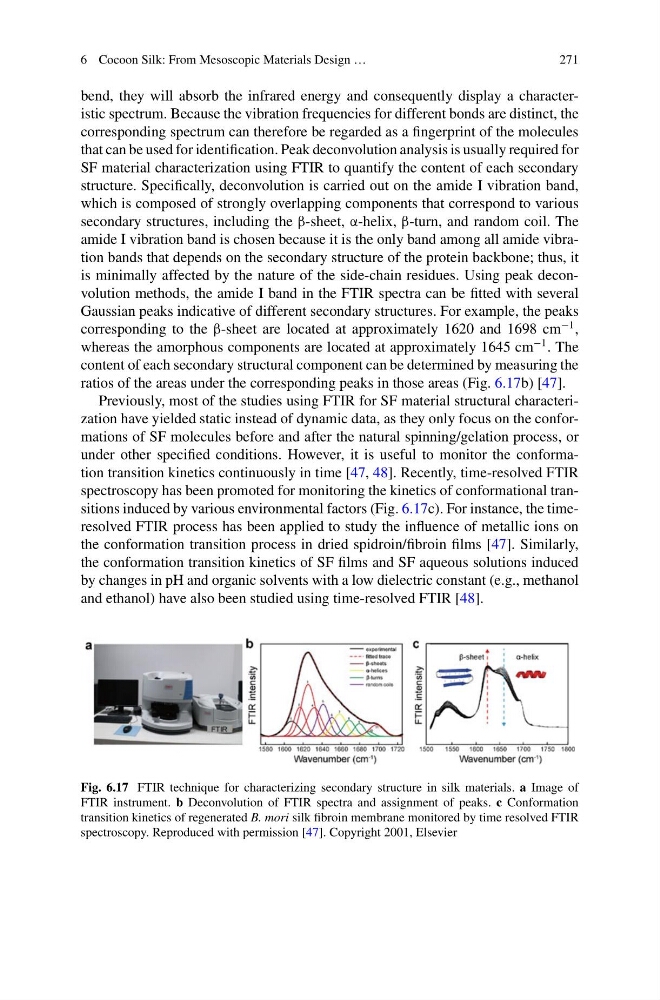
is minimally affected by the nature of the side-chain residues. Using peak deconvolution methods, the amide I band in the FTIR spectra can be fitted with several
Gaussian peaks indicative of different secondary structures. For example, the peaks
corresponding to the β-sheet are located at approximately 1620 and 1698 cm
−1 ,
whereas the amorphous components are located at approximately 1645 cm
−1 . The
content of each secondary structural component can be determined by measuring the
ratios of the areas under the corresponding peaks in those areas (Fig. 6.17b) [47].
Previously, most of the studies using FTIR for SF material structural characterization have yielded static instead of dynamic data, as they only focus on the conformations of SF molecules before and after the natural spinning/gelation process, or
under other specified conditions. However, it is useful to monitor the conformation transition kinetics continuously in time [47, 48]. Recently, time-resolved FTIR
spectroscopy has been promoted for monitoring the kinetics of conformational transitions induced by various environmental factors (Fig. 6.17c). For instance, the timeresolved FTIR process has been applied to study the influence of metallic ions on
the conformation transition process in dried spidroin/fibroin films [47]. Similarly,
the conformation transition kinetics of SF films and SF aqueous solutions induced
by changes in pH and organic solvents with a low dielectric constant (e.g., methanol
and ethanol) have also been studied using time-resolved FTIR [48].
Fig. 6.17 FTIR technique for characterizing secondary structure in silk materials. a Image of
FTIR instrument. b Deconvolution of FTIR spectra and assignment of peaks. c Conformation
transition kinetics of regenerated B. mori silk fibroin membrane monitored by time resolved FTIR
spectroscopy. Reproduced with permission [47]. Copyright 2001, Elsevier
271
bend, they will absorb the infrared energy and consequently display a characteristic spectrum. Because the vibration frequencies for different bonds are distinct, the
corresponding spectrum can therefore be regarded as a fingerprint of the molecules
that can be used for identification. Peak deconvolution analysis is usually required for
SF material characterization using FTIR to quantify the content of each secondary
structure. Specifically, deconvolution is carried out on the amide I vibration band,
which is composed of strongly overlapping components that correspond to various
secondary structures, including the β-sheet, α-helix, β-turn, and random coil. The
amide I vibration band is chosen because it is the only band among all amide vibration bands that depends on the secondary structure of the protein backbone; thus, it
is minimally affected by the nature of the side-chain residues. Using peak deconvolution methods, the amide I band in the FTIR spectra can be fitted with several
Gaussian peaks indicative of different secondary structures. For example, the peaks
corresponding to the β-sheet are located at approximately 1620 and 1698 cm
−1 ,
whereas the amorphous components are located at approximately 1645 cm
−1 . The
content of each secondary structural component can be determined by measuring the
ratios of the areas under the corresponding peaks in those areas (Fig. 6.17b) [47].
Previously, most of the studies using FTIR for SF material structural characterization have yielded static instead of dynamic data, as they only focus on the conformations of SF molecules before and after the natural spinning/gelation process, or
under other specified conditions. However, it is useful to monitor the conformation transition kinetics continuously in time [47, 48]. Recently, time-resolved FTIR
spectroscopy has been promoted for monitoring the kinetics of conformational transitions induced by various environmental factors (Fig. 6.17c). For instance, the timeresolved FTIR process has been applied to study the influence of metallic ions on
the conformation transition process in dried spidroin/fibroin films [47]. Similarly,
the conformation transition kinetics of SF films and SF aqueous solutions induced
by changes in pH and organic solvents with a low dielectric constant (e.g., methanol
and ethanol) have also been studied using time-resolved FTIR [48].
Fig. 6.17 FTIR technique for characterizing secondary structure in silk materials. a Image of
FTIR instrument. b Deconvolution of FTIR spectra and assignment of peaks. c Conformation
transition kinetics of regenerated B. mori silk fibroin membrane monitored by time resolved FTIR
spectroscopy. Reproduced with permission [47]. Copyright 2001, Elsevier