

264
W. Qiu and X.-Y. Liu
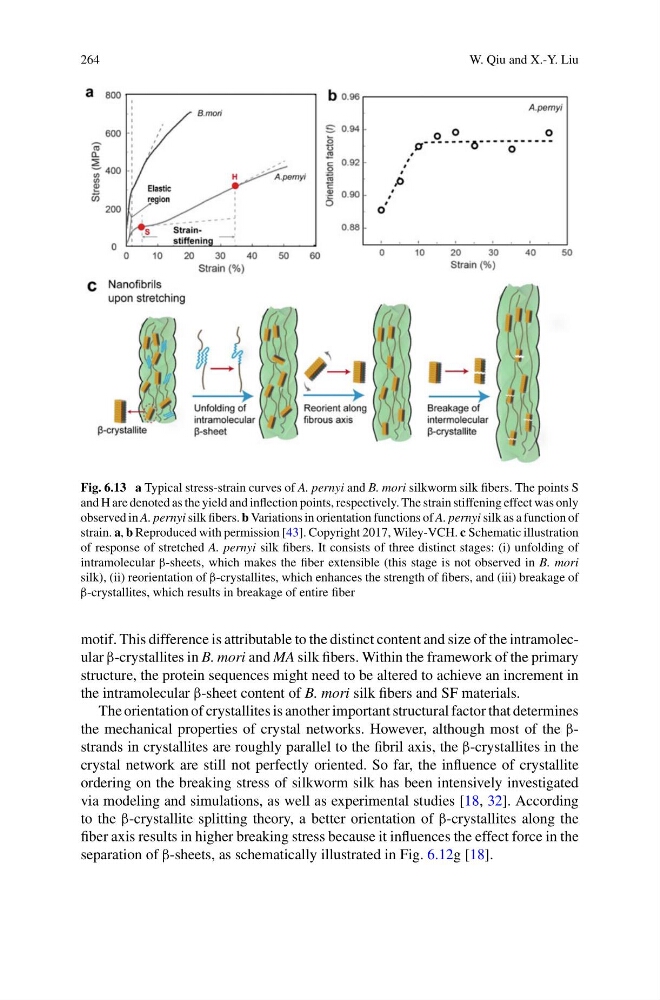
Fig. 6.13 a Typical stress-strain curves of A. pernyi and B. mori silkworm silk fibers. The points S
and H are denoted as the yield and inflection points, respectively. The strain stiffening effect was only
observed in A. pernyi silk fibers. b Variations in orientation functions of A. pernyi silk as a function of
strain. a, b Reproduced with permission [43]. Copyright 2017, Wiley-VCH. c Schematic illustration
of response of stretched A. pernyi silk fibers. It consists of three distinct stages: (i) unfolding of
intramolecular β-sheets, which makes the fiber extensible (this stage is not observed in B. mori
silk), (ii) reorientation of β-crystallites, which enhances the strength of fibers, and (iii) breakage of
β-crystallites, which results in breakage of entire fiber
motif. This difference is attributable to the distinct content and size of the intramolecular β-crystallites in B. mori and MA silk fibers. Within the framework of the primary
structure, the protein sequences might need to be altered to achieve an increment in
the intramolecular β-sheet content of B. mori silk fibers and SF materials.
The orientation of crystallites is another important structural factor that determines
the mechanical properties of crystal networks. However, although most of the βstrands in crystallites are roughly parallel to the fibril axis, the β-crystallites in the
crystal network are still not perfectly oriented. So far, the influence of crystallite
ordering on the breaking stress of silkworm silk has been intensively investigated
via modeling and simulations, as well as experimental studies [18, 32]. According
to the β-crystallite splitting theory, a better orientation of β-crystallites along the
fiber axis results in higher breaking stress because it influences the effect force in the
separation of β-sheets, as schematically illustrated in Fig. 6.12g [18].
W. Qiu and X.-Y. Liu
Fig. 6.13 a Typical stress-strain curves of A. pernyi and B. mori silkworm silk fibers. The points S
and H are denoted as the yield and inflection points, respectively. The strain stiffening effect was only
observed in A. pernyi silk fibers. b Variations in orientation functions of A. pernyi silk as a function of
strain. a, b Reproduced with permission [43]. Copyright 2017, Wiley-VCH. c Schematic illustration
of response of stretched A. pernyi silk fibers. It consists of three distinct stages: (i) unfolding of
intramolecular β-sheets, which makes the fiber extensible (this stage is not observed in B. mori
silk), (ii) reorientation of β-crystallites, which enhances the strength of fibers, and (iii) breakage of
β-crystallites, which results in breakage of entire fiber
motif. This difference is attributable to the distinct content and size of the intramolecular β-crystallites in B. mori and MA silk fibers. Within the framework of the primary
structure, the protein sequences might need to be altered to achieve an increment in
the intramolecular β-sheet content of B. mori silk fibers and SF materials.
The orientation of crystallites is another important structural factor that determines
the mechanical properties of crystal networks. However, although most of the βstrands in crystallites are roughly parallel to the fibril axis, the β-crystallites in the
crystal network are still not perfectly oriented. So far, the influence of crystallite
ordering on the breaking stress of silkworm silk has been intensively investigated
via modeling and simulations, as well as experimental studies [18, 32]. According
to the β-crystallite splitting theory, a better orientation of β-crystallites along the
fiber axis results in higher breaking stress because it influences the effect force in the
separation of β-sheets, as schematically illustrated in Fig. 6.12g [18].