

254
W. Qiu and X.-Y. Liu
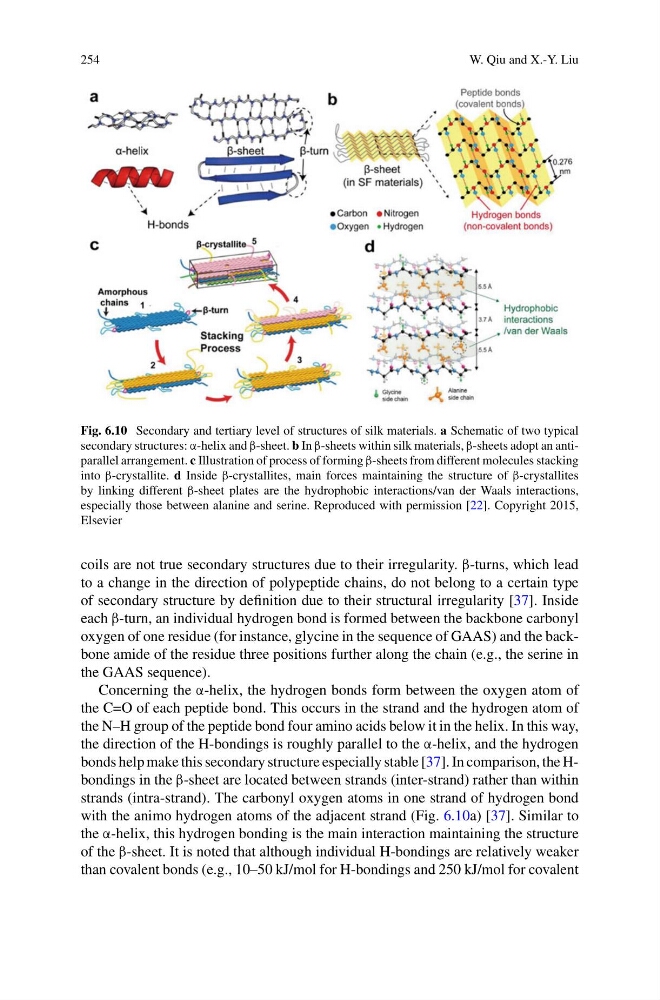
Fig. 6.10 Secondary and tertiary level of structures of silk materials. a Schematic of two typical
secondary structures: α-helix and β-sheet. b In β-sheets within silk materials, β-sheets adopt an antiparallel arrangement. c Illustration of process of forming β-sheets from different molecules stacking
into β-crystallite. d Inside β-crystallites, main forces maintaining the structure of β-crystallites
by linking different β-sheet plates are the hydrophobic interactions/van der Waals interactions,
especially those between alanine and serine. Reproduced with permission [22]. Copyright 2015,
Elsevier
coils are not true secondary structures due to their irregularity. β-turns, which lead
to a change in the direction of polypeptide chains, do not belong to a certain type
of secondary structure by definition due to their structural irregularity [37]. Inside
each β-turn, an individual hydrogen bond is formed between the backbone carbonyl
oxygen of one residue (for instance, glycine in the sequence of GAAS) and the backbone amide of the residue three positions further along the chain (e.g., the serine in
the GAAS sequence).
Concerning the α-helix, the hydrogen bonds form between the oxygen atom of
the C=O of each peptide bond. This occurs in the strand and the hydrogen atom of
the N–H group of the peptide bond four amino acids below it in the helix. In this way,
the direction of the H-bondings is roughly parallel to the α-helix, and the hydrogen
bonds help make this secondary structure especially stable [37]. In comparison, the Hbondings in the β-sheet are located between strands (inter-strand) rather than within
strands (intra-strand). The carbonyl oxygen atoms in one strand of hydrogen bond
with the animo hydrogen atoms of the adjacent strand (Fig. 6.10a) [37]. Similar to
the α-helix, this hydrogen bonding is the main interaction maintaining the structure
of the β-sheet. It is noted that although individual H-bondings are relatively weaker
than covalent bonds (e.g., 10–50 kJ/mol for H-bondings and 250 kJ/mol for covalent
W. Qiu and X.-Y. Liu
Fig. 6.10 Secondary and tertiary level of structures of silk materials. a Schematic of two typical
secondary structures: α-helix and β-sheet. b In β-sheets within silk materials, β-sheets adopt an antiparallel arrangement. c Illustration of process of forming β-sheets from different molecules stacking
into β-crystallite. d Inside β-crystallites, main forces maintaining the structure of β-crystallites
by linking different β-sheet plates are the hydrophobic interactions/van der Waals interactions,
especially those between alanine and serine. Reproduced with permission [22]. Copyright 2015,
Elsevier
coils are not true secondary structures due to their irregularity. β-turns, which lead
to a change in the direction of polypeptide chains, do not belong to a certain type
of secondary structure by definition due to their structural irregularity [37]. Inside
each β-turn, an individual hydrogen bond is formed between the backbone carbonyl
oxygen of one residue (for instance, glycine in the sequence of GAAS) and the backbone amide of the residue three positions further along the chain (e.g., the serine in
the GAAS sequence).
Concerning the α-helix, the hydrogen bonds form between the oxygen atom of
the C=O of each peptide bond. This occurs in the strand and the hydrogen atom of
the N–H group of the peptide bond four amino acids below it in the helix. In this way,
the direction of the H-bondings is roughly parallel to the α-helix, and the hydrogen
bonds help make this secondary structure especially stable [37]. In comparison, the Hbondings in the β-sheet are located between strands (inter-strand) rather than within
strands (intra-strand). The carbonyl oxygen atoms in one strand of hydrogen bond
with the animo hydrogen atoms of the adjacent strand (Fig. 6.10a) [37]. Similar to
the α-helix, this hydrogen bonding is the main interaction maintaining the structure
of the β-sheet. It is noted that although individual H-bondings are relatively weaker
than covalent bonds (e.g., 10–50 kJ/mol for H-bondings and 250 kJ/mol for covalent