

242
W. Qiu and X.-Y. Liu
6.1 Introduction
6.1.1 Silkworm Silk and Silk Fibroin (SF) Materials
Silk is a fine continuous protein fiber produced by spiders or insect larvae. Spiders
spin threads of silk to make cocoons for their eggs and in their webs to catch prey,
and such silks have been admired for their extraordinary mechanical properties since
ancient times. However, while the application of spiders for silk production is limited
because spiders cannot be raised, silk produced by insect larvae such as silkworms is
a world-renowned fiber. Among the types of silk fibers, those spun by Bombyx mori
(B. mori) silkworms are usually regarded as “the queen of fibers,” have been widely
used in the textile industry for more than five thousand years, and are also symbols
of the foreign trade of ancient China [1, 2]. With the development of materials
science and a deeper investigation of silk, silkworm silk is no longer limited to the
traditional textile industry, but is currently regarded as one of the most promising
materials of the twenty-first century. Owing to its properties, such as excellent optical
and electronic characteristics [3–5], robust mechanical properties [6–9], in vitro
and in vivo biocompatibility [10], and slow proteolytic biodegradation [1], silk has
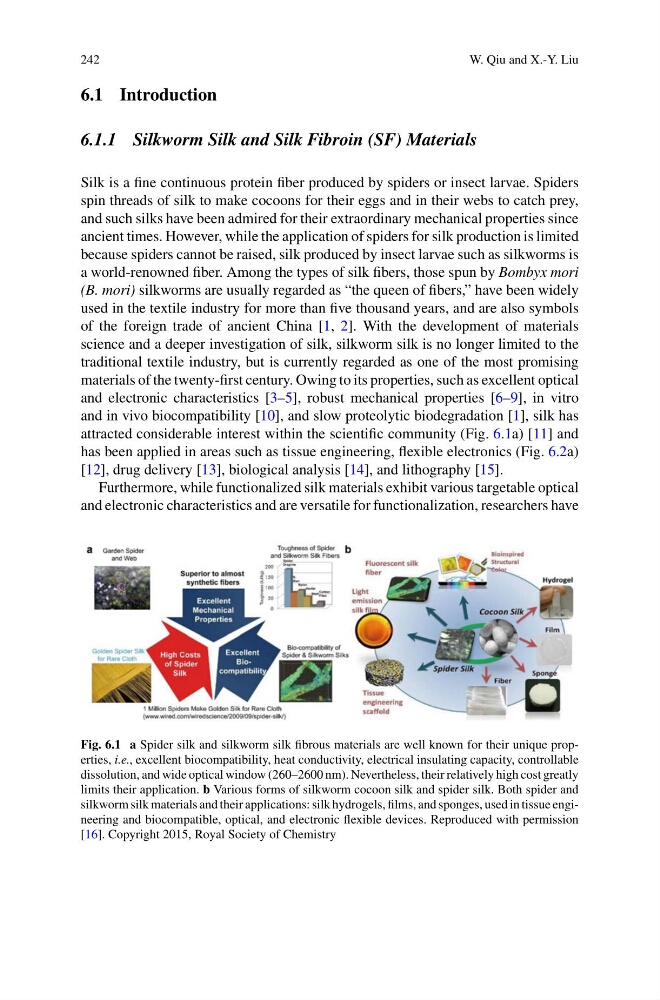
attracted considerable interest within the scientific community (Fig. 6.1a) [11] and
has been applied in areas such as tissue engineering, flexible electronics (Fig. 6.2a)
[12], drug delivery [13], biological analysis [14], and lithography [15].
Furthermore, while functionalized silk materials exhibit various targetable optical
and electronic characteristics and are versatile for functionalization, researchers have
Fig. 6.1 a Spider silk and silkworm silk fibrous materials are well known for their unique properties, i.e., excellent biocompatibility, heat conductivity, electrical insulating capacity, controllable
dissolution, and wide optical window (260–2600 nm). Nevertheless, their relatively high cost greatly
limits their application. b Various forms of silkworm cocoon silk and spider silk. Both spider and
silkworm silk materials and their applications: silk hydrogels, films, and sponges, used in tissue engineering and biocompatible, optical, and electronic flexible devices. Reproduced with permission
[16]. Copyright 2015, Royal Society of Chemistry
W. Qiu and X.-Y. Liu
6.1 Introduction
6.1.1 Silkworm Silk and Silk Fibroin (SF) Materials
Silk is a fine continuous protein fiber produced by spiders or insect larvae. Spiders
spin threads of silk to make cocoons for their eggs and in their webs to catch prey,
and such silks have been admired for their extraordinary mechanical properties since
ancient times. However, while the application of spiders for silk production is limited
because spiders cannot be raised, silk produced by insect larvae such as silkworms is
a world-renowned fiber. Among the types of silk fibers, those spun by Bombyx mori
(B. mori) silkworms are usually regarded as “the queen of fibers,” have been widely
used in the textile industry for more than five thousand years, and are also symbols
of the foreign trade of ancient China [1, 2]. With the development of materials
science and a deeper investigation of silk, silkworm silk is no longer limited to the
traditional textile industry, but is currently regarded as one of the most promising
materials of the twenty-first century. Owing to its properties, such as excellent optical
and electronic characteristics [3–5], robust mechanical properties [6–9], in vitro
and in vivo biocompatibility [10], and slow proteolytic biodegradation [1], silk has
attracted considerable interest within the scientific community (Fig. 6.1a) [11] and
has been applied in areas such as tissue engineering, flexible electronics (Fig. 6.2a)
[12], drug delivery [13], biological analysis [14], and lithography [15].
Furthermore, while functionalized silk materials exhibit various targetable optical
and electronic characteristics and are versatile for functionalization, researchers have
Fig. 6.1 a Spider silk and silkworm silk fibrous materials are well known for their unique properties, i.e., excellent biocompatibility, heat conductivity, electrical insulating capacity, controllable
dissolution, and wide optical window (260–2600 nm). Nevertheless, their relatively high cost greatly
limits their application. b Various forms of silkworm cocoon silk and spider silk. Both spider and
silkworm silk materials and their applications: silk hydrogels, films, and sponges, used in tissue engineering and biocompatible, optical, and electronic flexible devices. Reproduced with permission
[16]. Copyright 2015, Royal Society of Chemistry