

5 Basics of Molecular Modeling and Molecular Simulation
231
It can be proven that the Andersen thermostat indeed simulates the momentum
space of the canonical ensemble correctly. However, the angular momentum of the
system is not conserved during the replacement of particle velocities, causing the
whole system to rotate randomly in accordance with time, which leads to some
difficulties for conducting data analysis.
Nosé-Hoover Thermostat
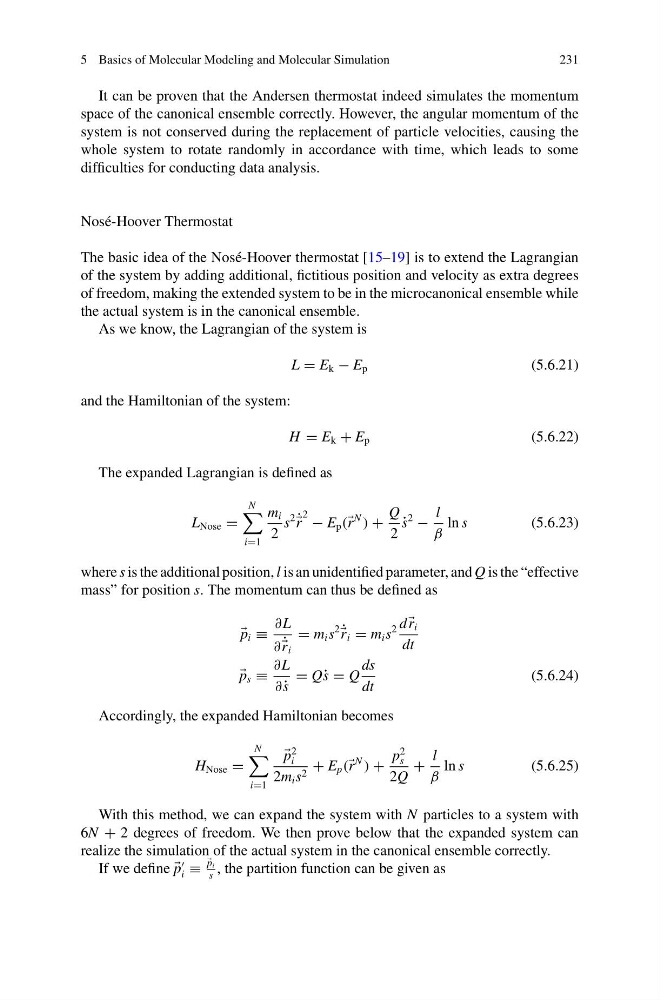
The basic idea of the Nosé-Hoover thermostat [15–19] is to extend the Lagrangian
of the system by adding additional, fictitious position and velocity as extra degrees
of freedom, making the extended system to be in the microcanonical ensemble while
the actual system is in the canonical ensemble.
As we know, the Lagrangian of the system is
L = E k − E p
(5.6.21)
and the Hamiltonian of the system:
H = E k + E p
(5.6.22)
The expanded Lagrangian is defined as
L Nose =
N
i=1
m i
2
s
2 ˙
r
2 − E p ( r
N
) +
Q
2
˙
s
2
−
l
β
ln s
(5.6.23)
where s is the additional position, l is an unidentified parameter, and Q is the “effective
mass” for position s. The momentum can thus be defined as
p i ≡
∂L
∂ ˙
r i
= m i s
2 ˙
r i = m i s
2 d r i
dt
p s ≡
∂L
∂ ˙
s
= Q˙ s = Q
ds
dt
(5.6.24)
Accordingly, the expanded Hamiltonian becomes
H Nose =
N
i=1
p
2
i
2m i s 2 + E p ( r
N
) +
p
2
s
2Q
+
l
β
ln s
(5.6.25)
With this method, we can expand the system with N particles to a system with
6N + 2 degrees of freedom. We then prove below that the expanded system can
realize the simulation of the actual system in the canonical ensemble correctly.
If we define
p
i ≡
p i
s
, the partition function can be given as
231
It can be proven that the Andersen thermostat indeed simulates the momentum
space of the canonical ensemble correctly. However, the angular momentum of the
system is not conserved during the replacement of particle velocities, causing the
whole system to rotate randomly in accordance with time, which leads to some
difficulties for conducting data analysis.
Nosé-Hoover Thermostat
The basic idea of the Nosé-Hoover thermostat [15–19] is to extend the Lagrangian
of the system by adding additional, fictitious position and velocity as extra degrees
of freedom, making the extended system to be in the microcanonical ensemble while
the actual system is in the canonical ensemble.
As we know, the Lagrangian of the system is
L = E k − E p
(5.6.21)
and the Hamiltonian of the system:
H = E k + E p
(5.6.22)
The expanded Lagrangian is defined as
L Nose =
N
i=1
m i
2
s
2 ˙
r
2 − E p ( r
N
) +
Q
2
˙
s
2
−
l
β
ln s
(5.6.23)
where s is the additional position, l is an unidentified parameter, and Q is the “effective
mass” for position s. The momentum can thus be defined as
p i ≡
∂L
∂ ˙
r i
= m i s
2 ˙
r i = m i s
2 d r i
dt
p s ≡
∂L
∂ ˙
s
= Q˙ s = Q
ds
dt
(5.6.24)
Accordingly, the expanded Hamiltonian becomes
H Nose =
N
i=1
p
2
i
2m i s 2 + E p ( r
N
) +
p
2
s
2Q
+
l
β
ln s
(5.6.25)
With this method, we can expand the system with N particles to a system with
6N + 2 degrees of freedom. We then prove below that the expanded system can
realize the simulation of the actual system in the canonical ensemble correctly.
If we define
p
i ≡
p i
s
, the partition function can be given as