

5 Basics of Molecular Modeling and Molecular Simulation
215
Pressure:
P = E/L
3
(5.3.32)
Mass Density:
ρ = M /L
3
(5.3.33)
Molecular Number Density:
n = 1/L
3
(5.3.34)
Dielectric Constant:
ε =
N A · Q
2
L · E
(5.3.35)
5.4.2 Lennard-Jones Potential
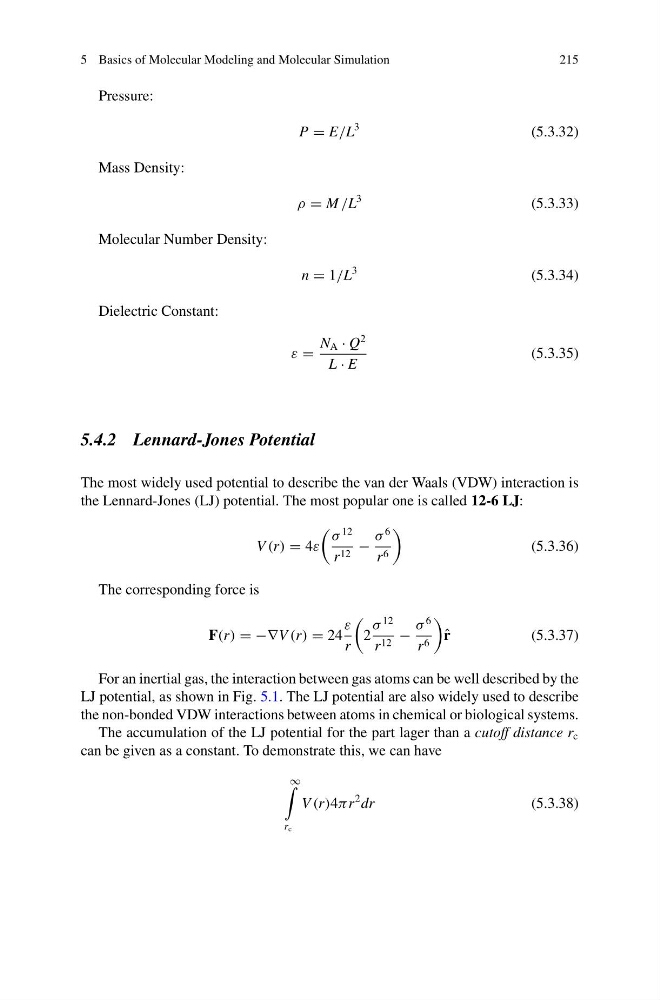
The most widely used potential to describe the van der Waals (VDW) interaction is
the Lennard-Jones (LJ) potential. The most popular one is called 12-6 LJ:
V (r) = 4ε
σ
12
r 12 −
σ
6
r 6
(5.3.36)
The corresponding force is
F(r) = −∇V (r) = 24
ε
r
2
σ
12
r 12 −
σ
6
r 6
ˆ
r
(5.3.37)
For an inertial gas, the interaction between gas atoms can be well described by the
LJ potential, as shown in Fig. 5.1. The LJ potential are also widely used to describe
the non-bonded VDW interactions between atoms in chemical or biological systems.
The accumulation of the LJ potential for the part lager than a cutoff distance r c
can be given as a constant. To demonstrate this, we can have
∞
r c
V (r)4π r
2 dr
(5.3.38)
215
Pressure:
P = E/L
3
(5.3.32)
Mass Density:
ρ = M /L
3
(5.3.33)
Molecular Number Density:
n = 1/L
3
(5.3.34)
Dielectric Constant:
ε =
N A · Q
2
L · E
(5.3.35)
5.4.2 Lennard-Jones Potential
The most widely used potential to describe the van der Waals (VDW) interaction is
the Lennard-Jones (LJ) potential. The most popular one is called 12-6 LJ:
V (r) = 4ε
σ
12
r 12 −
σ
6
r 6
(5.3.36)
The corresponding force is
F(r) = −∇V (r) = 24
ε
r
2
σ
12
r 12 −
σ
6
r 6
ˆ
r
(5.3.37)
For an inertial gas, the interaction between gas atoms can be well described by the
LJ potential, as shown in Fig. 5.1. The LJ potential are also widely used to describe
the non-bonded VDW interactions between atoms in chemical or biological systems.
The accumulation of the LJ potential for the part lager than a cutoff distance r c
can be given as a constant. To demonstrate this, we can have
∞
r c
V (r)4π r
2 dr
(5.3.38)