

204
C. Tang (唐晨宇) and Y. Wang (王延颋)
5.2.1.3 Electron Correlation Methods
On top of the HF method, the electron correlation methods incorporate the correction
for electron correlations into the HF equations to obtain more accurate computational
results. To achieve such corrections, several different methods can be applied, which
will be briefly introduced as follows.
Configuration Interaction (CI) Method
The basis for the CI method is very simple that an exact many-body wave function
may be written as a linear combination of the Slater determinants Φ i :
Ψ = a 0 Φ HF +
i=1
a i Φ i
(5.2.16)
where Φ HF is the Hartree-Fock determinant, Φ i is the determinant with some electrons
virtually “excited” from the ground state in Φ HF , and a 0 and a i are parameters. The
fundamental issue for the CI method is to obtain a satisfying accuracy while keeping
the expansion length as short as possible. It can be proven that the single excitation
leads to zero, so the least accurate expansion is CISD, where S refers to singlet and
D refers to doublet. There are more accurately CISDT and CISDTQ, where T refers
to triplet and Q refers to quadruplet. Leaving more terms in the expression results in
a better accuracy of the CI method.
Many-Body Perturbation (MP) Method
The many-body perturbation method, based on the quantum perturbation theory, is
almost synonymous to the Møller-Plesset method, its most popular implementation,
which treats electron correlation as a perturbation to the Hartree-Fork wave function.
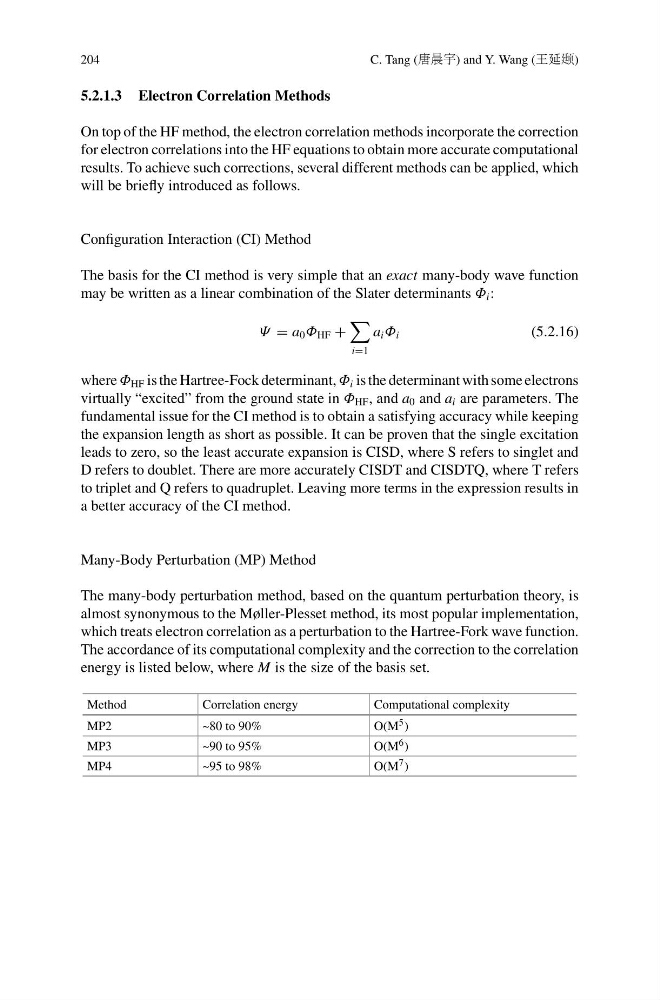
The accordance of its computational complexity and the correction to the correlation
energy is listed below, where M is the size of the basis set.
Method
Correlation energy
Computational complexity
MP2
~80 to 90%
O(M 5 )
MP3
~90 to 95%
O(M 6 )
MP4
~95 to 98%
O(M 7 )
C. Tang (唐晨宇) and Y. Wang (王延颋)
5.2.1.3 Electron Correlation Methods
On top of the HF method, the electron correlation methods incorporate the correction
for electron correlations into the HF equations to obtain more accurate computational
results. To achieve such corrections, several different methods can be applied, which
will be briefly introduced as follows.
Configuration Interaction (CI) Method
The basis for the CI method is very simple that an exact many-body wave function
may be written as a linear combination of the Slater determinants Φ i :
Ψ = a 0 Φ HF +
i=1
a i Φ i
(5.2.16)
where Φ HF is the Hartree-Fock determinant, Φ i is the determinant with some electrons
virtually “excited” from the ground state in Φ HF , and a 0 and a i are parameters. The
fundamental issue for the CI method is to obtain a satisfying accuracy while keeping
the expansion length as short as possible. It can be proven that the single excitation
leads to zero, so the least accurate expansion is CISD, where S refers to singlet and
D refers to doublet. There are more accurately CISDT and CISDTQ, where T refers
to triplet and Q refers to quadruplet. Leaving more terms in the expression results in
a better accuracy of the CI method.
Many-Body Perturbation (MP) Method
The many-body perturbation method, based on the quantum perturbation theory, is
almost synonymous to the Møller-Plesset method, its most popular implementation,
which treats electron correlation as a perturbation to the Hartree-Fork wave function.
The accordance of its computational complexity and the correction to the correlation
energy is listed below, where M is the size of the basis set.
Method
Correlation energy
Computational complexity
MP2
~80 to 90%
O(M 5 )
MP3
~90 to 95%
O(M 6 )
MP4
~95 to 98%
O(M 7 )